

If you’ve ever requested quotes for custom lip gloss tubes from multiple suppliers, you already know the disorientation that follows: one factory sends you a unit price of $0.18, another quotes $0.74 for what appears to be the same specification. The gap isn’t a mistake — it’s a signal. Understanding what drives that gap is the difference between a profitable sourcing decision and an expensive lesson.
This guide is built for cosmetic brand buyers, private label operators, and ODM/OEM procurement managers who need a clear cost baseline before entering supplier negotiations. We systematically collected and analyzed quotes from 8 factories — a mix of direct manufacturers and trading companies across Guangdong and Zhejiang — across four MOQ tiers. What emerged is a pricing framework that gives you real leverage at the negotiation table.
1. Why Lip Gloss Tube Prices Vary So Dramatically
1.1 The Hidden Variables Behind Every Quote
Three variables account for the majority of price dispersion in lip gloss tube wholesale pricing: MOQ tier, material grade, and customization process complexity. Most buyers focus on unit price alone and miss the compounding effect of these factors working together.
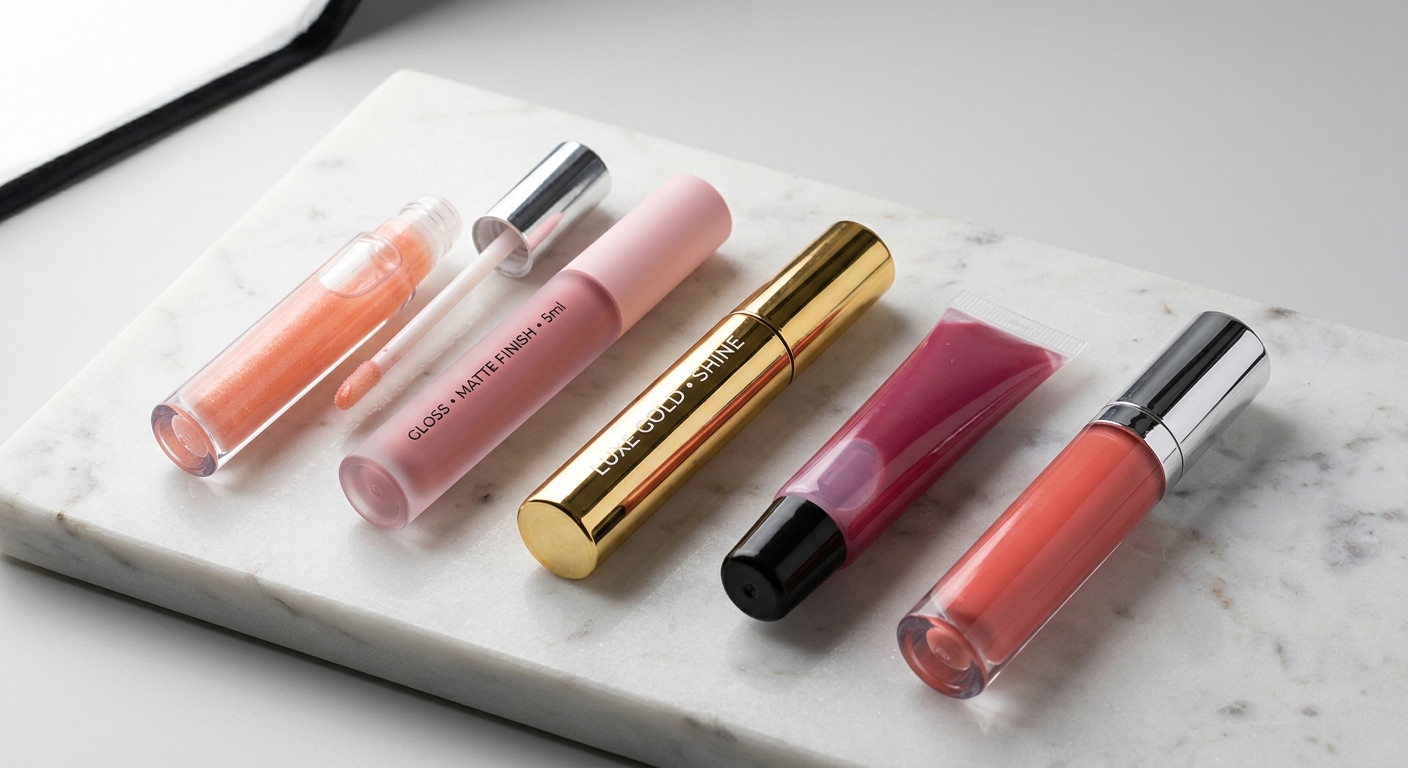
Material grade is the first fork in the road. Standard ABS plastic, transparent PET, soft PE squeeze tubes, and custom acrylic each carry fundamentally different raw material costs, tooling requirements, and quality tolerances. An ABS tube at 1,000 units may quote at $0.22, while a custom acrylic variant with the same dimensions runs $0.65 — before any surface treatment.
Customization processes stack costs non-linearly. Silk-screen LOGO printing adds roughly $0.03–$0.06 per unit. Electroplating the tube body adds $0.08–$0.15. A custom wand applicator shape — rather than a standard doe-foot — can trigger a new mold fee of $800–$2,500 regardless of order volume.
MOQ is the most misunderstood lever. The price difference between a 500-unit run and a 5,000-unit run for the same spec can exceed 35%. Factories price small orders to cover setup amortization; at scale, that cost disappears into the per-unit margin.
1.2 Factory Tier vs. Trading Company: Who’s Actually Quoting You?
A direct-source factory and a trading company can send you near-identical PDF quotations. The difference lives in the margin layer the trading company inserts — typically 15%–30% above factory price — and in the communication distance between you and the actual production floor.
Identifying a trading company is straightforward with three checks: ask for their factory audit certificate or ISO documentation with a physical production address; request a video walkthrough of the production line; and cross-reference their business registration (工厂 vs. 贸易公司 in Chinese business licenses). Trading companies aren’t inherently bad partners — they often provide better English communication and consolidated logistics — but you should price that service into your expectations, not discover it post-payment.
2. Real Quote Breakdown: What 8 Factories Actually Told Us
2.1 Price Range by MOQ Tier
The table below consolidates quote data across material types and order volumes. All prices are FOB Guangzhou/Ningbo and exclude tooling fees unless noted.
| Material Type | 500 Units (USD/pc) | 1,000 Units (USD/pc) | 5,000 Units (USD/pc) | 10,000 Units (USD/pc) | Sample Fee | Lead Time (bulk) |
|---|---|---|---|---|---|---|
| Standard ABS | $0.28–$0.38 | $0.22–$0.30 | $0.15–$0.20 | $0.12–$0.17 | $35–$80 | 20–30 days |
| Transparent PET | $0.32–$0.45 | $0.25–$0.35 | $0.18–$0.24 | $0.14–$0.19 | $40–$90 | 20–35 days |
| Soft PE Squeeze | $0.20–$0.30 | $0.16–$0.24 | $0.11–$0.16 | $0.09–$0.13 | $30–$60 | 15–25 days |
| Custom Acrylic | $0.60–$0.85 | $0.50–$0.70 | $0.38–$0.52 | $0.30–$0.42 | $80–$150 | 30–45 days |
Notes: Prices above reflect unprinted, standard-color tubes. Add-on costs for printing, plating, or custom applicators are itemized in Section 2.2. Tooling fees ($600–$2,500) apply to custom shapes and are one-time charges.
The sharpest price inflection point occurs between 1,000 and 5,000 units — typically a 25%–32% per-unit reduction. Beyond 10,000 units, incremental savings flatten to 5%–10%, making the 5,000-unit threshold the most strategically significant for growing brands.
2.2 What Drives the Cost Up: Customization Add-On Pricing
Each customization layer adds predictable cost. Here’s what our factory quotes revealed as standard add-on ranges:
- Silk-screen LOGO printing (1 color): +$0.03–$0.05/unit
- Hot stamping / foil stamping: +$0.05–$0.08/unit
- Full electroplating (chrome or gold finish): +$0.10–$0.18/unit
- Frosted / matte surface treatment: +$0.04–$0.07/unit
- Custom cap color (Pantone-matched): +$0.06–$0.12/unit (includes color-matching fee)
- Custom wand applicator shape: +$800–$2,500 one-time mold fee
- Gradient or dual-tone tube body: +$0.08–$0.14/unit
The combination of electroplating plus custom applicator mold plus LOGO printing on a 1,000-unit order can shift your effective unit cost from $0.25 to $0.58 — a 132% increase that catches underprepared buyers off guard.
3. How to Evaluate a Quote Beyond the Unit Price
3.1 Total Landed Cost: Tooling, Sampling, Shipping & Duties
Unit price is a starting point, not a total cost. For a 5,000-unit order of custom ABS lip gloss tubes with LOGO printing, a realistic total landed cost breakdown looks like this:
- Product cost (FOB): ~$950 ($0.19/unit)
- Tooling fee (if custom shape): $1,200 (one-time)
- Sample fee: $60
- Sea freight (Guangzhou → Los Angeles): ~$180–$280 (LCL for this volume)
- US import duty (HTS 3923.30): ~3.4% of CIF value
- Customs brokerage & port fees: ~$150–$200
Total landed cost for this scenario: approximately $2,700–$2,900, bringing the true per-unit cost to $0.54–$0.58 — nearly triple the quoted FOB unit price. Buyers who negotiate only on FOB unit price without modeling total landed cost routinely overspend or misallocate budget.
Air freight, relevant for urgent reorders or samples, runs 6–8× the cost of sea freight for equivalent volume and should be reserved for time-critical situations only.
3.2 Quality Benchmarks You Must Verify Before Paying
Price means nothing if the tubes fail compliance or leak during transit. Before finalizing any supplier, verify the following:
- FDA compliance: Confirm materials are food-contact safe if tubes will hold lip products sold in the US market. Request material safety data sheets (MSDS).
- REACH/EU compliance: Required for EU distribution. Ask for REACH SVHC declaration.
- Wall thickness tolerance: Specify ±0.1mm tolerance in your purchase order. Thin-walled tubes fail under temperature variation during shipping.
- Leak test protocol: Request documentation of their pressure/vacuum leak testing standard. Reputable factories test 100% or use AQL 1.5 sampling.
- Colorfast testing: For printed or plated tubes, request rub-resistance test reports (minimum 50 dry rubs per EN 71-3 equivalent).
4. How to Get the Best Price Without Sacrificing Quality
4.1 Negotiation Levers Most Buyers Never Use
Most buyers negotiate on unit price and MOQ alone. Three underutilized levers consistently yield better outcomes:
Payment terms: Offering 30% deposit / 70% before shipment (rather than standard 30/70 after inspection) rarely moves the needle. What does move it: offering Letter of Credit or early full payment for a 3%–5% discount. Factories with cash flow constraints respond strongly to upfront payment security.
Mixed-SKU consolidation: If you’re ordering multiple lip gloss tube variants (different colors, sizes, or cap styles), consolidating them under a single PO toward a shared MOQ threshold unlocks volume pricing across the entire order. Many buyers don’t realize factories will blend SKUs to hit tier thresholds.
Framework agreements: Committing to a 12-month rolling purchase volume — even without a binding contract — signals reliability. Factories prioritize production scheduling for predictable customers and will often lock in current pricing for 6–12 months in exchange for volume commitment.
4.2 Red Flags in a Lip Gloss Tube Quote
A quote that looks too good should trigger scrutiny, not celebration. Watch for these warning patterns:
- No tooling fee on a “custom” shape: Custom molds cost money. A factory waiving tooling fees entirely is either using existing generic tooling (meaning your “custom” tube isn’t exclusive) or burying the cost elsewhere.
- Free samples with no conditions: Legitimate factories charge sample fees to filter serious buyers. Free samples with no lead time and no documentation requests often signal a trading company sending stock samples from a third-party factory.
- Lead time under 10 days for 5,000+ units: Production, QC, and packaging for a mid-volume custom run physically cannot compress below 15 days. Promises of 7–8 day turnaround indicate either pre-made stock being relabeled or a timeline that will slip dramatically post-deposit.
FAQ
Q1: What is the minimum order quantity for custom lip gloss tubes from a manufacturer? Most direct factories set MOQs at 1,000–3,000 units for standard customization (LOGO printing, custom color). For fully custom shapes requiring new tooling, MOQs typically start at 3,000–5,000 units to amortize mold investment. Some trading companies offer 500-unit MOQs by sourcing from multiple factories, at a premium.
Q2: Why did two factories quote me prices that differ by 40% for the same spec? The most common causes: one is a trading company with a 20%–30% margin layer; the factories use different material grades (virgin vs. recycled resin); or the lower quote excludes tooling, printing, or compliance testing that the higher quote includes. Always request fully itemized quotes with identical specifications before comparing.
Q3: Are lip gloss tubes from Chinese manufacturers compliant with FDA or EU cosmetic regulations? Compliance depends on the specific factory and materials, not country of origin. Reputable Chinese manufacturers producing for US or EU markets maintain FDA-compliant material certifications and REACH declarations. Always request documentation — don’t assume compliance based on price tier or factory size.
Conclusion
Pricing transparency is the foundation of efficient cosmetic packaging procurement. The data from 8 factory quotes makes one thing clear: the unit price on a quotation sheet is a starting point, not a final answer. The real cost of custom lip gloss tubes is shaped by material selection, customization complexity, order volume, total landed cost modeling, and the factory tier you’re actually dealing with.
Buyers who understand the price inflection points — particularly the 5,000-unit threshold and the compounding effect of customization add-ons — enter negotiations with structural advantages. Those who chase the lowest FOB unit price without verifying compliance, tooling transparency, and realistic lead times consistently pay more in the end: through failed shipments, quality disputes, or reorders that erode margin.
Use this framework to build your cost baseline, ask the right questions, and select a lip gloss tube supplier whose pricing reflects genuine value rather than a race to the bottom.