
Introduction
Scaling production without sacrificing quality is one of the toughest challenges in cosmetic packaging. When you’re ordering custom lipstick tubes by the hundreds of thousands—or even millions—the fear of inconsistency, defects, and brand-damaging variations keeps many brand owners up at night. Custom lipstick tubes can absolutely maintain flawless quality at high volumes, but achieving this consistency depends on how your manufacturing partner manages the lifecycle—specifically through material science, precision tooling, rigorous quality control systems, and production processes engineered for consistency at scale.
What Makes High-Volume Production of Custom Lipstick Tubes Different from Low-Volume Runs?
The gap between a 5,000-unit run and a 500,000-unit run isn’t just about quantity; it’s a fundamentally different manufacturing challenge. Low-volume production allows for more hands-on oversight, manual adjustments, and per-unit inspection. High-volume production demands something else entirely: systems that bake quality directly into the process itself.
Factories equipped for large-scale custom lipstick tube manufacturing operate with semi-automated and fully automated injection molding lines, capable of producing between 500,000 and over 5 million units monthly. That kind of output requires machinery that runs consistently, shift after shift, without drifting out of specification. It requires molds engineered for millions of cycles, materials sourced with batch-to-batch consistency, and quality control protocols that catch defects before they become patterns.
Implementing these automated systems inherently improves component consistency because automated processes eliminate the operational variability that human hands introduce. A well-tuned injection molding machine running 100,000 cycles will produce virtually identical parts. The core challenge is not the scale itself—it is whether the lipstick tube manufacturer has built the technological infrastructure to handle scale properly.
How Does Material Selection Impact the Quality of Custom Lipstick Tubes at High Volumes?
You can’t scale quality if you can’t scale materials. The resins and metals that go into custom lipstick tubes need to be available in consistent quality, batch after batch, in the quantities required for high-volume production. When sourcing materials for custom lipstick tubes, consistency is paramount—any variation in resin grade or metal alloy will multiply across millions of units.
Plastic Options: PP, ABS, and the Economics of Scale
Polypropylene (PP) and acrylonitrile butadiene styrene (ABS) are the workhorses of high-volume lipstick tube production. These materials offer an ideal balance of strength, flexibility, and finishability. They’re lightweight, highly customizable, and tough enough for everyday use. Most importantly, they’re available in consistent grades from major resin suppliers worldwide, which means batch-to-batch variation is minimal. These materials are widely used for custom lipstick tubes because they deliver reliable performance at scale.
PP is particularly valued for its chemical resistance and durability, making it suitable for tubes that will hold pigmented or oil-based formulas. ABS offers excellent impact resistance and takes surface finishes beautifully—whether you’re after matte, glossy, or metallic effects.
For brands that need FDA-approved, non-toxic materials, suppliers using PP, PETG, or acrylic can provide documentation confirming compliance with FDA, EU REACH, and RoHS regulations.
Aluminum: The Premium Choice That Scales
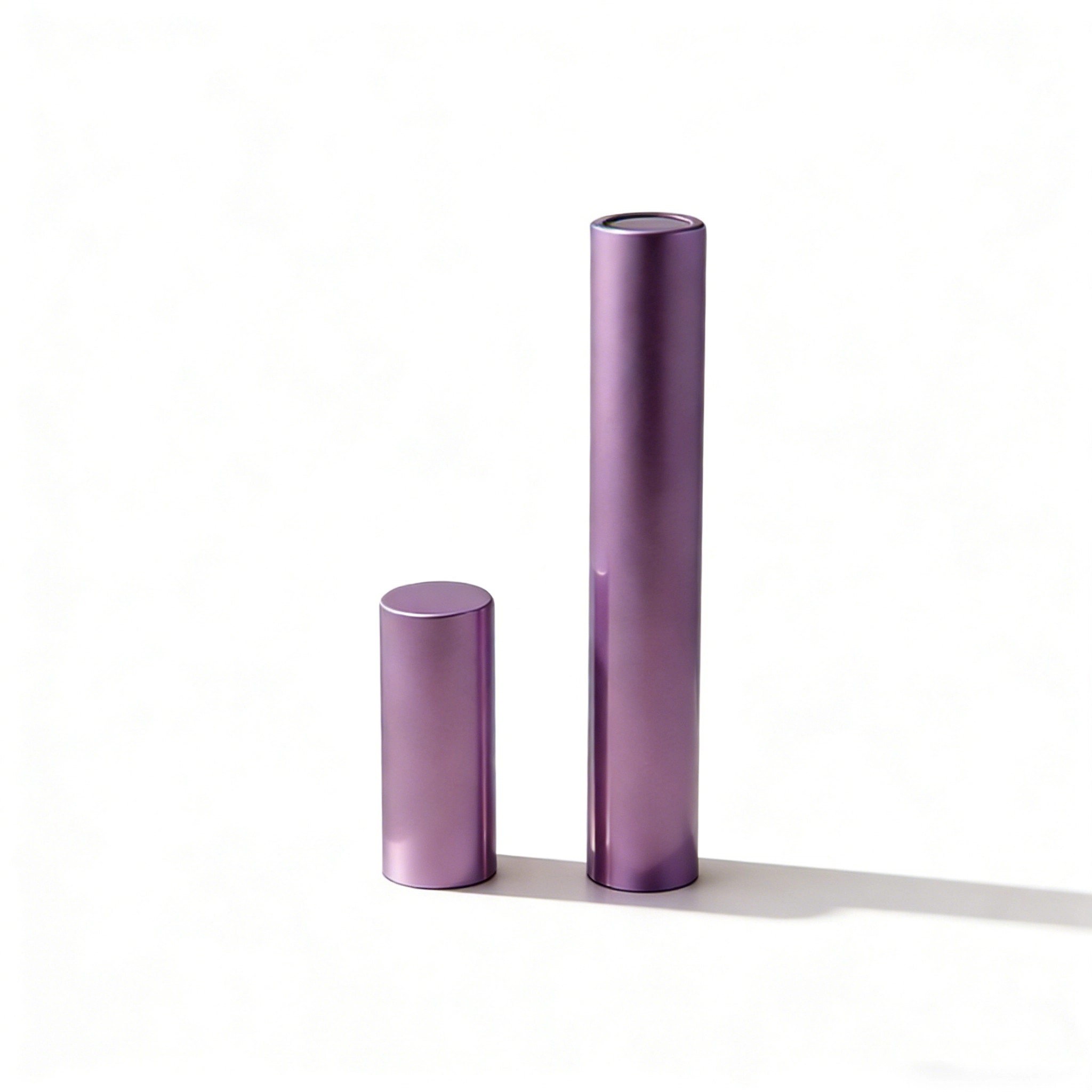
Aluminum lipstick tubes bring a different set of advantages to high-volume production. They offer a “cold touch” and significant weight that consumers associate with luxury. Anodized aluminum is lightweight yet tough against dents and scratches. According to Mintel’s Global Packaging Trends Report (2024), metallic finishes continue to dominate high-end beauty packaging due to their perceived value and durability. Aluminum custom lipstick tubes are particularly popular for luxury brands that want a distinctive tactile experience.
At scale, aluminum presents unique considerations. A supplier like Tianjin Takeuchi Package, which produces approximately 20 million cosmetic container sets annually, demonstrates that aluminum production can be scaled effectively when the right systems are in place. The company’s production capabilities include stamping, surface oxidation, spraying treatments, vacuum deposition, silk screen printing, and hot stamping—all of which must be controlled tightly to maintain quality across millions of units.
The Material Choice Matrix
| Material | Best For | Scalability | Cost per Unit (Approx.) | Key Quality Considerations |
|---|---|---|---|---|
| PP (Polypropylene) | High-volume, cost-effective lines | Excellent; widely available | Low | Chemical resistance, durable |
| ABS | Premium finishes, impact resistance | Excellent; consistent supply | Low-Medium | Takes surface finishes well |
| PETG | Clarity, “glass-look” effects | Good; requires careful processing | Medium | Transparency, strength |
| Aluminum | Luxury positioning, recyclability | Good; requires specialized equipment | Medium-High | Anodizing quality, scratch resistance |
Why Mold Design Is the Foundation for Custom Lipstick Tubes Quality at Scale
If you want custom lipstick tubes that maintain quality across millions of units, start with the mold. Mold design isn’t just about creating the right shape—it’s about engineering for longevity, consistency, and efficiency. Precision mold design directly determines whether your custom lipstick tubes will remain flawless after a million cycles, because every microscopic imperfection in the tool gets replicated on every part.
Multi-Cavity Molds: The Engine of High-Volume Production
High-volume production relies on multi-cavity molds that produce multiple parts in each cycle. Manufacturers offer 16-cavity, 32-cavity, 64-cavity, and even 128-cavity molds optimized for fast cycle times and consistent quality. A 96-cavity mold, for example, is ideal for mass production, significantly improving efficiency by allowing multiple lipstick cups to be produced at once.
Here’s the catch: more cavities mean more potential points of failure. Every cavity in a multi-cavity mold must be machined to identical specifications. Temperature control must be uniform across the entire mold. Ejection systems must work in perfect synchronization. The best manufacturers use high-precision mold design to ensure the production of standardized, high-quality components.
Tooling Development and Lead Times
Custom mold development typically takes 7–14 days, depending on complexity. That timeline might seem long, but it’s an investment in quality that pays dividends across millions of units. A well-designed mold produces consistent parts from cycle one to cycle one million. A poorly designed mold? You’ll see drift, wear, and defects that compound as production volume increases.
What Does Quality Control Look Like for Custom Lipstick Tubes at High Production Volumes?
Quality control at high volumes isn’t about inspecting every single unit—that’s neither practical nor necessary. Instead, it’s about building a system that catches defects at every stage, from raw materials to finished goods. Every batch of custom lipstick tubes undergoes rigorous testing that goes far beyond visual checks.
The Four-Stage QC Protocol
Leading manufacturers implement a multi-stage Quality Management Solution throughout the entire production cycle. A typical four-stage protocol looks like this:
-
IQC (Incoming Quality Control): Raw material purity and compliance checks before anything enters production.
-
IPQC (In-Process Quality Control): Real-time monitoring of injection molding precision during production.
-
FQC (Final Quality Control): 100% functional testing—checking everything from cap torque to mechanism smoothness.
-
OQC (Outgoing Quality Control): Final shipping inspection for surface finish, cleanliness, and packaging integrity.
Industry Standards: ISO, AQL, and What They Mean for Your Brand
Quality control in cosmetic packaging isn’t guesswork—it’s governed by international standards that provide objective benchmarks.
ISO 22716 is a globally recognized Good Manufacturing Practice (GMP) standard in the cosmetics industry, recommended for compliance by regulatory authorities including the EU, the FDA, and Japan. An ISO9001-certified factory has processes in place to monitor and improve quality at every stage—from supplier selection to final inspection.
ISO 2859 regulates sampling and inspection procedures, defining Acceptable Quality Limits (AQL). Under this standard, defects are classified into critical, major, and minor categories:
-
Critical defects: AQL of 0.1–0.65 (affect product safety or render it unusable)
-
Major defects: AQL is typically around 2.5%
-
Minor defects: AQL of 4.0–6.5 depending on product type
What does this mean for your custom lipstick tubes? In a batch of 100 units, 2 or 3 major defects might be acceptable under AQL 2.5—but any more than that would trigger a batch rejection. Top-tier manufacturers aim for far tighter tolerances. One industry case study shows a manufacturer maintaining a defect rate of less than 0.05% across millions of units of high-clarity cosmetic packaging.
Beyond Inspection: Testing That Matters
Visual inspection catches surface issues. But quality at scale requires deeper testing:
-
Torque testing: Measuring the force required to open and close caps—too tight or too loose, and you have a problem
-
Salt spray testing: Verifying plating durability under humidity and chemical exposure, especially for metallic finishes
-
Functional testing: Seal integrity, cap alignment, and finish adhesion under temperature and humidity variations
-
Automated vision inspection: Systems that identify every defect and ensure meticulous quality assessment throughout manufacturing
How Does Production Volume Affect Customization Options?
One concern brands often have is that high-volume production limits customization. The reality is more nuanced.
Customization That Scales
Modern custom lipstick tube manufacturing supports full customization even at high volumes:
-
Tube diameter (13mm–20mm)
-
Color matching to Pantone standards
-
Logo application through engraving, hot stamping, or pad printing
-
Shape and closure style
-
Surface finishes: matte, glossy, metallic, UV coating, vacuum metallization
Even at high volumes, custom lipstick tubes can be produced with intricate logos and finishes, as long as the supplier integrates these capabilities into their automated workflow. Factories with in-house mold design teams and automated assembly lines can deliver consistent output and respond quickly to design changes. In-house surface decoration capabilities—vacuum metallization, UV coating, pad printing, silk screening—ensure that decorative elements maintain quality across the entire run.
The MOQ Question
Minimum order quantities for custom lipstick tubes vary widely. Most custom orders have MOQs starting around 10,000–12,000 pieces, though this depends on design complexity and production requirements. Some suppliers offer flexibility starting from 1,000 pieces for simpler designs.
For brands scaling up, the economics improve dramatically at higher volumes. Ordering custom lipstick tubes in high volume unlocks savings across materials, closures, labeling, and sleeves.
What Separates a High-Volume Manufacturer That Delivers Quality from One That Doesn’t?
Not all manufacturers are created equal. Here’s what to look for when evaluating a partner for high-volume custom lipstick tube production.
Production Capacity and Technical Infrastructure
Look for evidence of operational strength:
-
In-house injection molding with presses rated at 50 tons or higher
-
Integrated surface decoration capabilities
-
Multi-cavity mold technology
-
Monthly output capacity exceeding 1 million units for volume stability
Quality Assurance Indicators
Beyond ISO certification, look at real-time performance data:
-
On-time delivery rate ≥95%
-
Response time ≤3 hours
-
Reorder rate >25% (signals customer satisfaction and product consistency)
Supplier Evaluation: Beyond Price and MOQ
Selecting a lipstick tube supplier requires a multi-dimensional assessment that balances technical capability, responsiveness, and long-term reliability. Relying solely on cost or MOQ can expose buyers to quality inconsistencies, delayed shipments, or communication bottlenecks.
| Evaluation Factor | What to Look For | Why It Matters |
|---|---|---|
| Material Compliance | FDA, REACH, RoHS documentation | Ensures regulatory compliance and safety |
| Production Capacity | >1 million units/month capacity | Proves ability to handle scale |
| Quality Control | Documented IQC/IPQC/FQC/OQC protocols | Catches defects at every stage |
| Response Time | <4 hours for issue resolution | Enables fast problem-solving |
| Reorder Rate | >25% | Indicates satisfied, repeat customers |
Real-World Quality at Scale: What’s Actually Achievable?
The numbers tell the story. A manufacturer with ASI Performance Standard certification produces approximately 20 million cosmetic container sets annually. Factories in Guangdong operate high-capacity production lines capable of fulfilling large-volume contracts with unit prices starting as low as $0.20 per piece. These facilities are ideal for brands seeking scalable output without compromising on basic quality standards.
One manufacturer reports maintaining a defect rate of less than 0.05% across millions of units—a level of quality that would have seemed impossible just a decade ago. That’s what happens when precision engineering, automated systems, and rigorous quality control converge.
Conclusion
Can custom lipstick tubes maintain quality at high production volumes? Absolutely—but only when the manufacturer has built the right systems. Materials, mold design, multi-stage quality control, and automated assembly must all work together to deliver consistency across millions of units. Ultimately, high-volume quality depends entirely on your choice of partner. Brands that succeed at scale look for manufacturers who treat quality as a real system, not just a checklist. They make sure the factory invests in durable tooling, tracks raw materials, runs strict QC protocols, and proves their capability through real performance data before signing the contract.
Evaluate Your Supplier Before You Order
Your lipstick packaging is the very first thing customers touch, so quality cannot be left to chance. The best way to secure your supply chain is to partner with a manufacturer that has the machinery and expertise to deliver identical results at any volume.
We recommend requesting samples first to test the material strength, mechanism smoothness, and surface finish for yourself. Finding the right partner before placing a massive volume order makes all the difference. Get in touch with us today to discuss your custom lipstick tube requirements and discover how high-volume consistency can help grow your brand.