

Abstract
For cosmetic brands and private-label buyers sourcing mascara packaging, selecting the right combination of tube material and brush wand type is not a stylistic preference — it is a specification-critical decision that directly affects formula performance, shelf stability, and regulatory standing. A mismatched wiper ring can shear a fiber-loaded formula. An incompatible tube substrate can compromise the barrier integrity of an anhydrous pigment suspension. A brush wand with the wrong bristle geometry will fail to deliver the volumizing or lengthening effect your marketing team has promised.
This guide is written for procurement managers, R formulators, and brand developers who need a technically grounded framework for evaluating mascara packaging components. We cover brush wand technology — silicone versus fiber — tube substrate selection between aluminum and PCR plastic, wiper ring sizing logic, and the compliance checkpoints that B2B buyers cannot afford to overlook. Whether you are launching a new mascara SKU or reformulating an existing line, the decisions mapped here will reduce development risk and accelerate your time to market.
Brush Wand Technology — Silicone vs. Fiber
Silicone Mascara Brush — Performance Characteristics
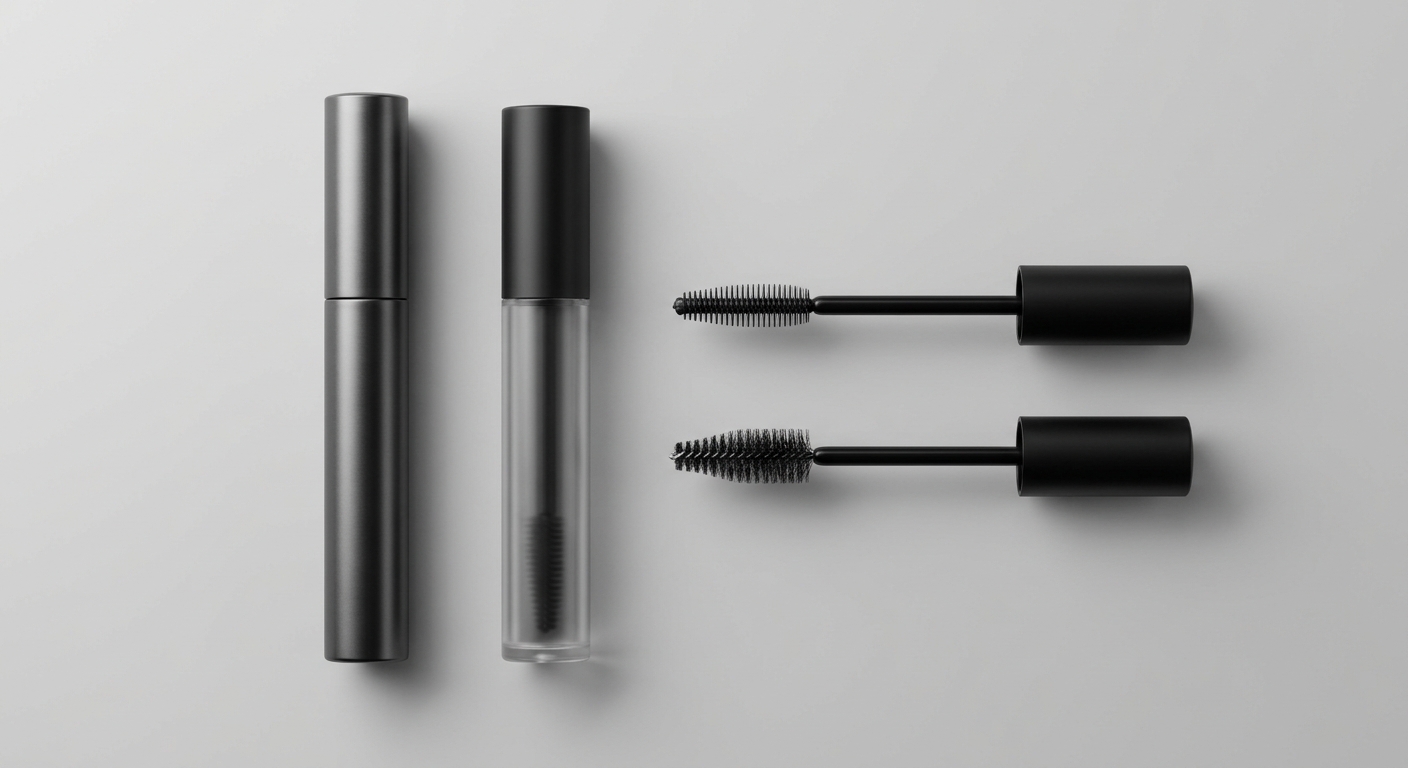
Silicone mascara brushes are injection-molded components, meaning every bristle position, taper angle, and tip geometry is defined at the tooling stage. This manufacturing precision translates directly into application consistency: each brush deposits a near-identical formula load per stroke, which is critical for mascaras positioned on defined separation, lash-by-lash coating, or tubing-formula performance.
Key performance attributes of silicone brushes include:
- Formula load control: Molded bristle density limits over-pickup from the tube, reducing clumping on low-viscosity formulas (typically 3,000–8,000 cPs).
- Hygiene advantage: Non-porous silicone does not absorb formula between uses, reducing microbial harboring risk — a meaningful factor for preservative-free or natural formulations.
- Cleaning compatibility: Silicone wands can withstand solvent-based cleaning during QC sampling without bristle deformation.
- Ideal viscosity range: Best matched to fluid-to-medium viscosity formulas (3,000–12,000 cPs) where precise metering is more important than bulk volume delivery.
Silicone brushes are the preferred specification for tubing mascaras, water-activated formulas, and any SKU requiring ophthalmologist-tested claims, where consistent, low-irritation application is part of the product story.
Fiber Mascara Wand — Performance Characteristics
Fiber wands — constructed from nylon, polyester, or natural-origin bristle materials twisted or crimped onto a metal or plastic core — offer a fundamentally different performance profile. Bristle density, length variation, and core shape (hourglass, ball-tip, comb) are the primary levers for achieving volumizing or lengthening effects.
- Volumizing configurations: Shorter, densely packed bristles maximize formula pickup from the tube wall, depositing higher product volume per stroke — optimal for wax-heavy formulas above 10,000 cPs.
- Lengthening configurations: Tapered or spaced bristles with longer filaments comb through lashes with less drag, ideal for film-forming polymer formulas that need even distribution along the lash shaft.
- Compatibility with complex formulas: Fiber-loaded mascaras (those containing micro-fibers for lash extension) require wands with adequate inter-bristle clearance to prevent fiber balling at the brush head.
| Bristle Material | Brush Shape | Recommended Viscosity (cPs) | Key Effect | MOQ Indicator | Cleaning Method |
|---|---|---|---|---|---|
| Silicone (molded) | Straight / Curved | 3,000–12,000 | Separation, tubing | 5.000–10.000 eenheden | Solvent wipe, autoclave-safe |
| Nylon fiber | Hourglass / Ball | 8,000–18,000 | Volume, buildable coverage | 3,000–8,000 units | Warm water rinse |
| Polyester fiber | Tapered / Comb | 6,000–14,000 | Lengthening, definition | 3,000–8,000 units | Warm water rinse |
| Natural-origin fiber | Straight dense | 10,000–20,000 | Intense volume | 5,000+ units | Dry wipe only |
Mascara Tube Materials — Aluminum vs. PCR Plastic
Aluminum Mascara Tubes — Structural & Brand Value
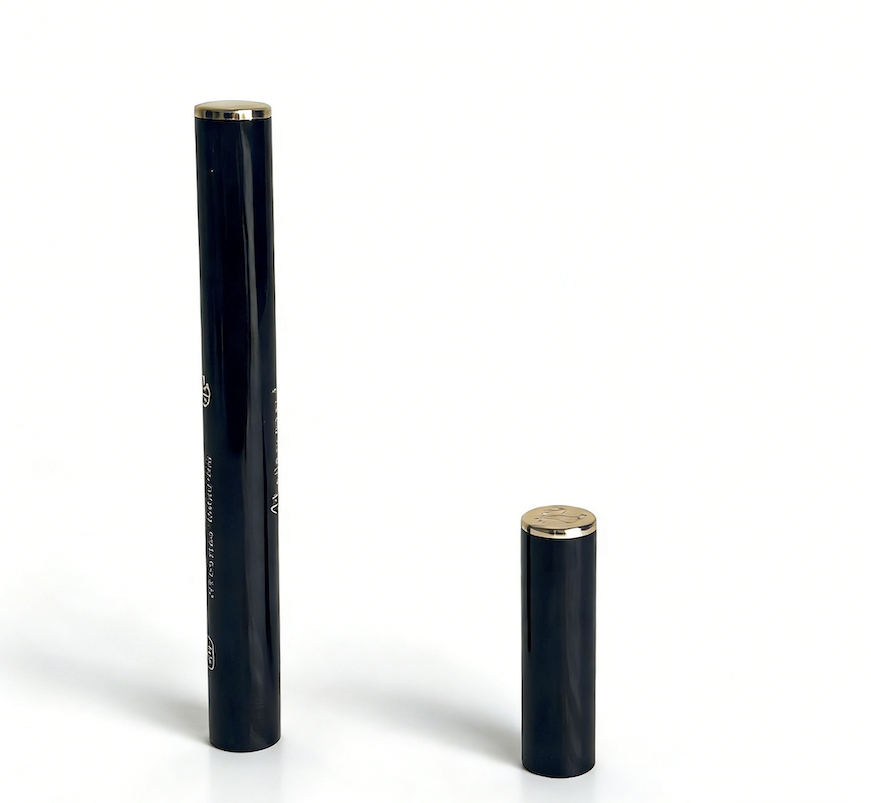
Aluminum mascara tubes deliver a barrier performance profile that no plastic substrate fully replicates. The material is inherently impermeable to oxygen, moisture vapor, and UV light — properties that extend the functional shelf life of anhydrous formulas, pigment-dense suspensions, and preservative-sensitive natural mascaras without requiring additional liner coatings.
From a brand positioning standpoint, aluminum commands a premium tactile perception. The weight, the matte or gloss anodized finish options, and the cold-to-touch surface all communicate quality at the point of sale — a significant factor for prestige and professional lines competing at higher retail price points.
Structural advantages for procurement teams:
- Recycleerbaarheid: Aluminum is infinitely recyclable without material degradation, supporting circular economy claims and meeting EU Green Claims Directive expectations.
- Formula compatibility: Particularly suited to anhydrous formulas, oil-based lengthening serums, and waterproof formulas where moisture ingress would destabilize the emulsion.
- Decorating options: Anodizing, hot stamping, and sleeve labeling are all viable, offering design flexibility without adhesion compromise.
The primary trade-off is cost and tooling lead time. Aluminum tubes carry a higher per-unit cost than plastic alternatives and require longer supplier qualification cycles for custom dimensions.
PCR Plastic Mascara Tubes — Sustainability & Cost Profile
Post-consumer recycled (PCR) plastic tubes — typically constructed from 30%–100% recycled PP or HDPE — have become the dominant sustainability response for mass-market and indie mascara brands navigating ESG reporting requirements without absorbing the cost premium of aluminum.
Key commercial considerations:
- Recycled content verification: Credible PCR claims require Global Recycled Standard (GRS) certification from the resin supplier, not just the packaging converter. Buyers should request chain-of-custody documentation at the RFQ stage.
- Performance parity: PCR PP at 30–50% recycled content maintains comparable oxygen barrier and drop-impact performance to virgin PP for water-based and emulsion formulas. Above 70% PCR content, material consistency can vary — requiring tighter incoming QC on wall thickness and weld integrity.
- Cost delta: PCR plastic tubes typically price at a 5–15% premium over virgin plastic equivalents, substantially below aluminum’s cost differential, making them the practical sustainability choice for mid-market volume programs.
- Lightweighting: PCR plastic tubes reduce total shipment weight versus aluminum, lowering Scope 3 logistics emissions — a metric increasingly tracked in brand sustainability reporting.
Wiper Ring Sizing & Formula Compatibility
Wiper Diameter Selection Logic
The wiper ring — the elastomeric collar seated inside the tube neck — performs two simultaneous functions: it meters the formula load on the brush wand at extraction, and it maintains an airtight seal to prevent premature drying or oxidation of the formula reservoir. Getting the inner diameter (ID) tolerance wrong introduces defects that cannot be corrected post-fill.
Under-wiping (wiper ID too large relative to brush diameter): Excess formula is pulled out on each stroke, leading to clumping, smearing, and accelerated formula depletion. This is a common defect with high-viscosity wax formulas paired with oversized wipers.
Over-wiping (wiper ID too small): Insufficient formula reaches the lash, causing dry, patchy application. Fiber-loaded formulas are particularly vulnerable — micro-fibers are stripped from the formula matrix at the wiper, reducing the product’s defining performance claim.
General wiper ID selection guidelines by formula viscosity:
- 3,000–8,000 cPs (fluid formulas): Wiper ID 5.5–6.0 mm
- 8,000–15,000 cPs (medium-body formulas): Wiper ID 6.0–6.8 mm
- 15,000–25,000 cPs (high-viscosity / wax-heavy): Wiper ID 6.8–8.0 mm
Custom Wiper Configurations for Specialty Formulas
Standard single-ring wipers are adequate for most conventional formulas, but specialty applications require engineered configurations:
- Dual-chamber wipers: Used in two-phase or gel-in-serum mascara formats where phase separation must be managed at the tube neck. The secondary ring prevents cross-contamination between formula layers.
- Fiber-loaded mascaras: Require wipers with a wider ID clearance zone (typically +0.5–1.0 mm above standard) and a softer durometer elastomer (Shore A 40–50) to allow micro-fibers to pass without shearing.
- Tubed-gel formulas: Benefit from a wiper with a tapered inner profile rather than a flat bore, which progressively meters the gel formula and prevents air entrainment during brush withdrawal.
Compliance, Certifications & Supplier Qualification
Regulatory Standards for Mascara Packaging
Mascara packaging components that contact the formula — tube liners, wiper elastomers, and brush wand materials — are subject to indirect contact material regulations in major markets:
- EU Regulation 1223/2009: Requires that all packaging materials in contact with cosmetic products do not adversely affect product safety or composition. Wiper elastomers and brush bristle polymers must be assessed for extractable and leachable compounds.
- ISO 22715: Governs cosmetic packaging labeling requirements, including recycled content declarations and material identification symbols relevant to PCR plastic tubes.
- FDA indirect food-contact analogs: While the FDA does not regulate cosmetic packaging directly under food-contact rules, many U.S. buyers apply 21 CFR indirect food-contact standards to wiper and brush materials as a precautionary specification baseline.
Supplier Audit Checkpoints for B2B Buyers
Before issuing a purchase order for mascara tubes and brush wands, procurement teams should verify:
- REACH/RoHS documentation: Confirm absence of SVHCs (Substances of Very High Concern) in wiper elastomers and brush bristle polymers, with updated REACH Annex XVII compliance letters.
- GRS certification for PCR content: Request certificate numbers traceable to the resin batch, not just a supplier declaration.
- Wiper compression set testing: Elastomeric wipers should be tested for compression set at 40°C/72 hours to confirm seal integrity over the product’s intended shelf life.
- Batch-to-batch dimensional consistency: Wiper ID tolerance should be held to ±0.1 mm across production batches. Request CPK data (process capability index ≥1.33) from the supplier’s QC records.
FAQ
Q1: What wiper ring size is recommended for high-viscosity tubing mascara formulas above 15,000 cPs?
For formulas exceeding 15,000 cPs, specify a wiper inner diameter in the 6.8–8.0 mm range, paired with a lower-durometer elastomer (Shore A 40–50) to reduce drag force on the brush wand. Confirm the specification by running a pull-force test at fill temperature — extraction force should not exceed 8–12 N for standard consumer use.
Q2: Can PCR plastic tubes maintain the same airtight seal performance as virgin PP or aluminum for water-based formulas?
PCR PP at 30–50% recycled content performs comparably to virgin PP for water-based mascara formulas in standard shelf-life testing (24 months at 25°C/60% RH). However, buyers should request oxygen transmission rate (OTR) data specific to the PCR resin batch, as variability in recycled feedstock can affect barrier consistency above 70% PCR content.
Q3: What is the typical MOQ difference between custom silicone brush wands and standard fiber wands for a new product launch?
Standard fiber wands typically carry MOQs of 3,000–8,000 units, making them accessible for new product launches and reformulation pilots. Custom-tooled silicone brushes generally require MOQs of 5,000–10,000 units due to tooling amortization costs. For initial market testing, brands often launch with a stock silicone or fiber wand and transition to a custom specification at scale.
Conclusie
Matching mascara tube material and brush wand type to your specific formula is a specification decision, not an aesthetic one. Silicone wands deliver precision and hygiene for fluid tubing formulas; fiber wands provide the bristle density needed for volumizing wax-heavy systems. Aluminum tubes offer unmatched barrier performance for anhydrous and preservative-sensitive formulas, while PCR plastic tubes provide a credible, cost-effective sustainability pathway for mainstream volume programs. Wiper ring geometry ties both components together — an incorrectly sized wiper will undermine even the most precisely engineered formula-brush pairing.
By aligning bristle technology, substrate choice, and wiper geometry with formula viscosity and brand compliance requirements, procurement teams can reduce reformulation risk, consolidate supplier qualification cycles, and meet the sustainability mandates that retail partners and regulatory bodies are increasingly enforcing. Treat every mascara packaging decision as an integrated system specification, and the performance outcomes will follow.