
Abstract
Custom eyeliner tubes are no longer a luxury reserved for prestige brands — they are a strategic B2B lever for cosmetic manufacturers, private label suppliers, and beauty brand owners seeking competitive differentiation. In an increasingly crowded cosmetic market, the packaging that surrounds your formula is often the first — and sometimes only — touchpoint that converts a browser into a buyer.
This article examines how tailored eyeliner packaging design directly impacts shelf appeal, buyer perception, and downstream sales performance. From material selection and applicator engineering to regulatory compliance and supplier qualification, we provide actionable insights for procurement managers, product development leads, and brand strategists who need to make informed decisions about custom eyeliner packaging investments. Whether you are launching a new SKU, expanding into retail channels, or repositioning an existing line, understanding the commercial mechanics of custom packaging is essential to building sustainable brand growth.
1: The Business Case for Custom Eyeliner Packaging
1.1: How Packaging Design Influences Purchase Decisions
At the point of sale — whether physical retail or a product detail page — consumers make snap judgments in under seven seconds. For eyeliner products, where formulas across brands are often functionally similar, the tube itself becomes the primary differentiator. Research consistently demonstrates that packaging aesthetics directly influence perceived product quality, willingness to pay, and repeat purchase intent.
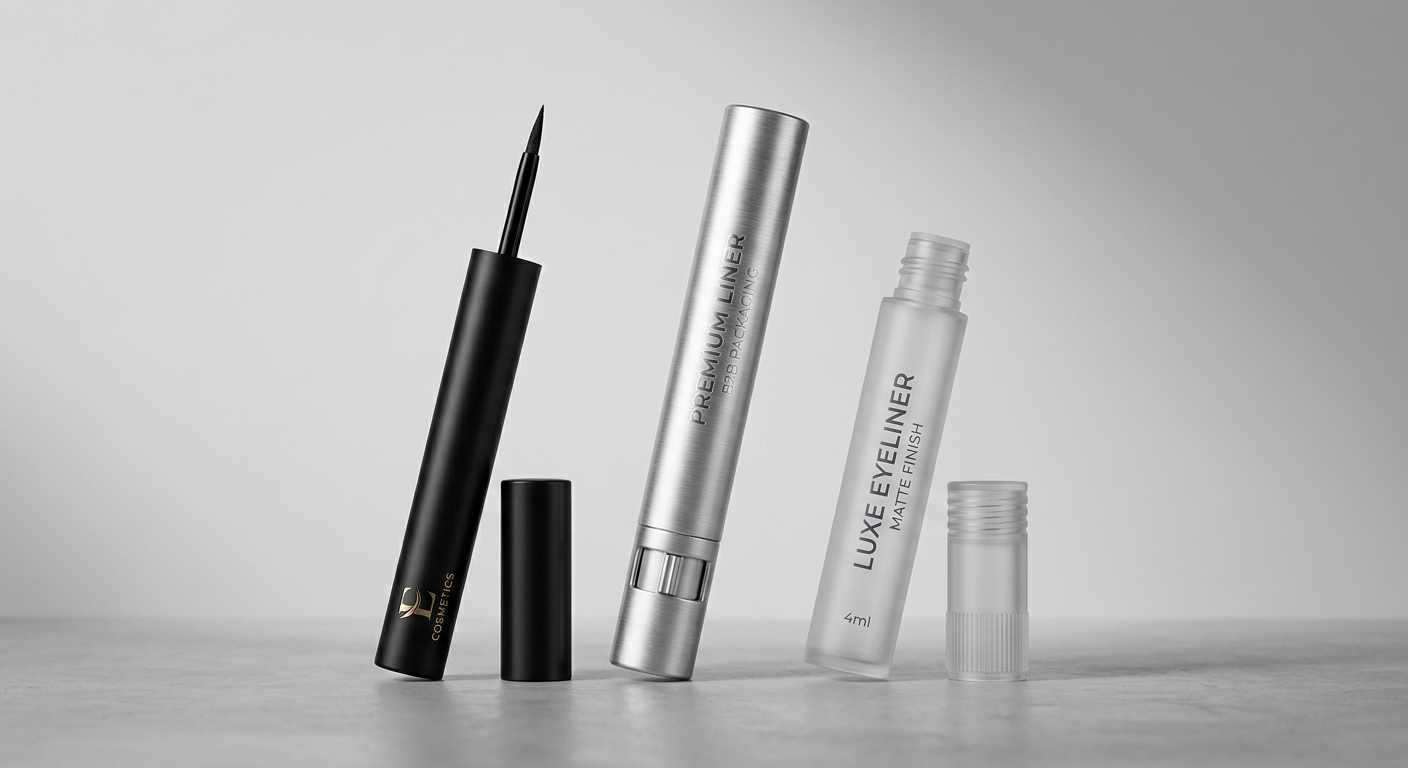
Visual differentiation drives conversion in measurable ways. A slim, matte-black precision eyeliner tube communicates professional performance to a makeup artist demographic. A rose-gold metallic finish with embossed branding signals premium positioning to a luxury skincare buyer. These are not superficial choices — they are deliberate signals that align product identity with target consumer psychology.
For B2B buyers, this translates into a clear commercial argument: brands that invest in distinctive eyeliner packaging consistently achieve higher sell-through rates, lower return rates, and stronger retailer placement. Custom packaging also reduces direct price comparison pressure, because a uniquely designed product is harder to commoditize against generic alternatives on the shelf.
1.2: Private Label vs. Custom Eyeliner Tubes — What Buyers Need to Know
Private label eyeliner tubes offer speed and low entry cost — typically available from stock with MOQs as low as 500–1,000 units and minimal lead time. However, they come with a critical limitation: every competing brand using the same supplier can access identical packaging. Brand ownership is effectively zero.
Custom eyeliner tubes require higher upfront investment — tooling costs typically range from $800 to $3,500 depending on complexity, with MOQs generally starting at 3,000–10,000 units. However, the cost-per-unit advantage compounds at scale, and the brand equity generated by proprietary packaging is a durable asset that private label cannot replicate.
For brands targeting retail distribution, DTC growth, or export markets, custom packaging is not optional — it is the foundation of defensible brand identity. Buyers should evaluate the true cost comparison not on unit price alone, but on the lifetime value of brand recognition, retailer preference, and consumer loyalty that custom design enables.
2: Key Design & Technical Specifications for Eyeliner Tubes
2.1: Materials, Applicator Types & Structural Options
The structural integrity and user experience of an eyeliner tube are determined by three intersecting decisions: substrate material, applicator type, and dispensing mechanism.
Substrate Materials:
- ABS (Acrylonitrile Butadiene Styrene): The most widely used material for cosmetic tubes. Offers excellent impact resistance, smooth surface for printing, and compatibility with a broad range of finishes. Cost-effective for high-volume production.
- Aluminum: Premium positioning, superior barrier properties, and a tactile weight that communicates quality. Preferred for luxury and professional-grade lines.
- PP (Polypropylene): Lightweight, chemically resistant, and increasingly specified for sustainability-focused formulations. Compatible with refillable tube architectures.
Applicator Types:
- Brush tip: Delivers variable line width; preferred for smoky or artistic applications.
- Felt tip: Consistent ink flow, precise lines; dominant in the liquid liner category.
- Precision nib: Ultra-fine tip for graphic liner and detailed work; high consumer demand in the professional segment.
Dispensing Mechanisms:
- Twist-up: Retractable formula exposure; eliminates cap-loss risk and reduces product waste.
- Cap-off: Traditional design; lower tooling cost, broader compatibility with viscous formulas.
2.2: Print, Finish & Compliance Considerations
Surface decoration choices directly affect perceived quality and shelf standout. Key techniques include:
- Hot stamping: Creates metallic foil effects with excellent durability; ideal for logo and brand name application on ABS and aluminum substrates.
- UV coating: Adds gloss or matte protection over printed surfaces; enhances scratch resistance during retail handling.
- Silk-screen printing: Cost-effective for multi-color designs on cylindrical surfaces; supports Pantone-matched brand color accuracy.
From a compliance standpoint, eyeliner packaging for EU market entry must align with EU Cosmetics Regulation (EC) No 1223/2009, which governs material safety and labeling requirements. US market products should meet FDA 21 CFR Part 700 guidelines. Suppliers operating under ISO 22716 GMP certification provide an additional layer of manufacturing quality assurance that is increasingly required by major retailers and distributors.
Custom Eyeliner Tube Specification Comparison
| Parameter | Standard Tube | Custom Tube Option A | Custom Tube Option B |
|---|---|---|---|
| Materiaal | ABS | Aluminium | PP (Recycled) |
| Applicator Type | Felt Tip | Precision Nib | Brush Tip |
| MOQ | 500 units | 5,000 units | 3,000 units |
| Levertijd | 2–3 weeks | 8–10 weeks | 6–8 weeks |
| Surface Finish | Gloss Print | Hot Stamp + Matte | UV Matte Coating |
| Compliance Cert. | ISO 22716 | ISO 22716 + EU Reg. | ISO 22716 + FDA |
3: Application Scenarios & Brand Growth Strategies
3.1: Target Market Fit — Retail, DTC, and Private Label Channels
Different sales channels impose distinct packaging requirements, and a one-size-fits-all tube strategy will underperform across all of them.
Retail (Mass & Specialty): Retailer planogram compliance demands precise dimensional specifications — tube diameter, cap height, and label placement must align with shelf slot requirements. Barcoding placement, tamper-evident features, and secondary packaging compatibility are non-negotiable for major retail buyers. Custom tubes engineered to these specifications reduce buyer friction and accelerate listing approvals.
Direct-to-Consumer (DTC): The unboxing experience has become a measurable brand asset. Custom eyeliner tubes with distinctive finishes, embossed logos, and premium cap designs generate social sharing, reduce return rates, and improve Net Promoter Scores. For DTC brands, packaging is marketing collateral — its ROI is captured in organic content reach and repeat purchase rates.
Private Label Channels: Contract manufacturers supplying house brands to retailers benefit from custom tube programs that allow differentiation across retailer accounts without formula changes. A single fill formula can be positioned at different price tiers through packaging variation alone.
3.2: How Custom Packaging Supports SKU Expansion & Seasonal Campaigns
Custom eyeliner tube programs offer structural flexibility that standard packaging cannot match. Key commercial applications include:
- Limited edition colorways: Seasonal tube finishes (holiday metallics, summer pastels) drive urgency and incremental purchase without reformulation investment.
- Co-branding programs: Custom tubes with dual-brand decoration support influencer collaborations and retail exclusives — high-margin revenue streams increasingly central to beauty brand growth.
- SKU architecture expansion: A modular tube design with interchangeable caps or tip configurations allows brands to extend a product line efficiently, reducing tooling costs across multiple SKUs.
The ability to execute these strategies depends entirely on having a supplier with flexible production capacity and short reorder lead times — a critical factor in supplier evaluation.
4: Evaluating Suppliers for Custom Eyeliner Tube Manufacturing
4.1: Critical Supplier Qualification Criteria
Selecting a manufacturing partner for custom eyeliner tubes requires structured due diligence beyond catalog review. Key qualification criteria include:
- Factory audit capability: Verified ISO 22716 GMP certification, on-site quality control processes, and documented material traceability.
- Sample lead time: Benchmark standard is 2–4 weeks for pre-production samples. Suppliers requiring longer timelines introduce significant product launch risk.
- Tooling ownership: Confirm that custom mold tooling is registered in your company’s name. Supplier-owned tooling creates dependency and limits reorder flexibility.
- NDA protocols: Any supplier handling proprietary formula or design specifications should execute a Non-Disclosure Agreement before technical briefings begin.
- Communication infrastructure: Dedicated account management, English-language technical documentation, and responsive sampling teams are operational necessities, not preferences.
4.2: Total Cost of Ownership Beyond Unit Price
Unit price is the least complete metric for evaluating custom eyeliner tube suppliers. A comprehensive Total Cost of Ownership (TCO) analysis must include:
- Tooling amortization: Spread initial tooling investment across projected production volume. A $2,000 mold amortized over 50,000 units adds $0.04/unit — often offset by brand premium pricing.
- Reorder flexibility: Suppliers with rigid high-MOQ reorder requirements create inventory risk. Negotiate tiered reorder thresholds aligned to your demand forecasting cycle.
- Packaging waste compliance costs: EU and UK Extended Producer Responsibility (EPR) regulations impose fees on non-recyclable packaging. Specifying PP or aluminum substrates with verified recyclability can reduce long-term compliance costs.
- Defect and rejection rates: A supplier with a 2% defect rate on 10,000 units costs you 200 tubes per order. Require documented AQL (Acceptable Quality Limit) standards in your supply agreement.
FAQ
Q1: What is the typical minimum order quantity (MOQ) for custom eyeliner tubes with branded printing?
MOQs vary by customization level. Standard tubes with silk-screen logo printing typically start at 1,000–3,000 units. Fully custom tube designs requiring new tooling generally require 5,000–10,000 units to amortize mold investment. Some suppliers offer lower MOQs (500–1,000 units) for semi-custom options using existing mold bases with custom decoration.
Q2: How long does the tooling and sampling process take for a fully custom eyeliner tube design?
The complete tooling-to-sample cycle for a new custom eyeliner tube design typically runs 6–10 weeks: 3–5 weeks for mold fabrication, 1–2 weeks for initial sample production, and 1–2 weeks for revision and approval. Brands should build this timeline into product launch planning to avoid compression pressure that compromises sample review quality.
Q3: What regulatory certifications should custom eyeliner packaging meet for EU and US market entry?
For EU distribution, packaging must comply with EU Cosmetics Regulation (EC) No 1223/2009, covering material safety and mandatory labeling. US market entry requires alignment with FDA 21 CFR Part 700 series guidelines. ISO 22716 GMP certification at the manufacturing level is the baseline quality standard expected by major retailers in both markets. For sustainable packaging claims, look for suppliers with verified PCR (Post-Consumer Recycled) material documentation.
Conclusie
Custom eyeliner tubes represent a measurable investment in brand equity, consumer conversion, and long-term market positioning. The evidence is consistent across retail, DTC, and private label channels: brands that control their packaging design command stronger shelf presence, higher perceived value, and more defensible pricing.
For B2B buyers and brand developers, the decision framework is clear. Evaluate suppliers not on unit price alone, but on tooling ownership terms, compliance certification depth, sample turnaround speed, and production flexibility. These operational factors determine whether a custom packaging program delivers its commercial promise at scale.
Strategic customization is not an added cost — it is a sales multiplier. In a category where formula differentiation is increasingly difficult to sustain, the tube that holds your product may be your most powerful brand asset.