

요약
For cosmetic brand managers and procurement leads, the eyeshadow box line item on a purchase order often looks like an obvious place to compress margin. Unit prices vary widely — sometimes by 40–60% between suppliers — and the logic of selecting the lowest compliant bid appears sound on a spreadsheet. It rarely holds up in the warehouse.
The hidden cost paradox of low-bid eyeshadow packaging is well-documented in reverse logistics data but systematically ignored at the point of purchase. Fragile pan inserts, substandard closures, and thin-wall paperboard that deforms under standard transit compression collectively drive breakage rates that exceed acceptable quality limits (AQL) — triggering returns, replacements, retailer chargebacks, and brand equity erosion that dwarf the original per-unit savings.
This article quantifies that gap. It maps the full cost chain from structural specification to end-customer experience, provides benchmark data on packaging tier performance, and equips B2B buyers with a practical framework for qualifying eyeshadow box suppliers on value rather than unit price alone. The goal is not to argue against cost discipline — it is to ensure that the cost being measured is the right one.
The Real Economics of Low-Cost Eyeshadow Packaging
What “Cheap” Actually Includes (and Omits)
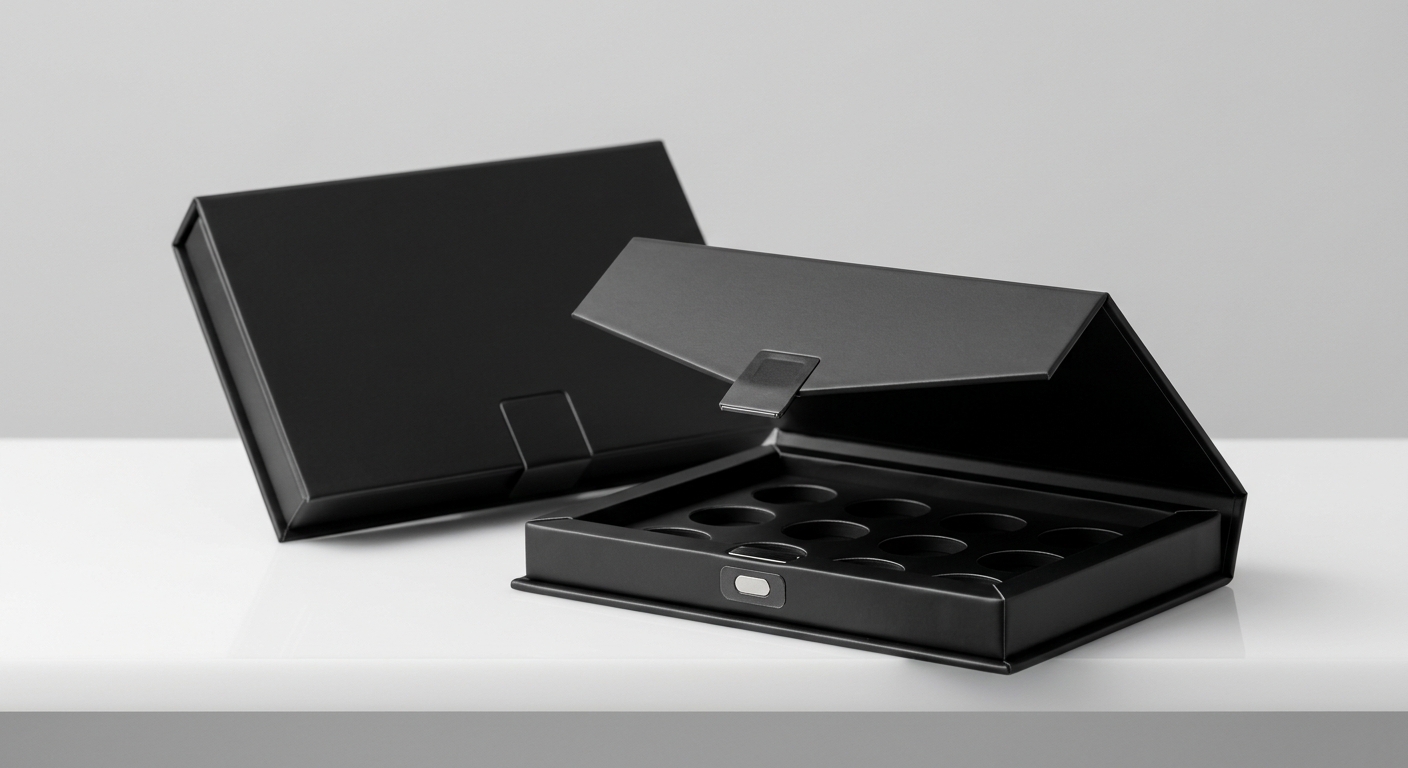
A quoted unit price for an eyeshadow box typically covers substrate material, printing, die-cutting, and basic assembly. What it frequently omits — or significantly downgrades — is material grade consistency, wall thickness tolerance control, and the mechanical reliability of closure systems.
Budget-tier eyeshadow boxes commonly use paperboard in the 250–300 GSM range with ±15% caliper variance, meaning individual units within the same production run can differ meaningfully in structural rigidity. Magnetic closure pull-force, when specified at all, may be quoted as a nominal figure without defined test methodology — a gap that translates directly to closures that fail during shelf display or transit. Hinge scoring on folding-style boxes is another frequent cost-reduction target: shallower score lines reduce tooling wear but increase the probability of cracking at the fold after 15–20 open/close cycles.
None of these trade-offs appear on the invoice. They appear in your returns data.
Industry Breakage Rate Benchmarks
Acceptable defect rates for cosmetic packaging are typically governed by AQL 1.5 for critical defects (structural failure, closure malfunction) and AQL 2.5 for major defects (print registration, surface deformation). Budget-tier suppliers operating on compressed margins routinely exceed these thresholds, with reported breakage and defect rates running 2–4× above mid-range benchmarks in transit simulation studies.
Table 1: Eyeshadow Box Packaging Tier Performance Comparison
| Packaging Tier | Avg. Material Thickness (mm) | Reported Breakage Rate (%) | Avg. Return Rate (%) | Est. Replacement Cost per 1,000 Units (USD) | Hidden Cost Index |
|---|---|---|---|---|---|
| Budget | 0.8 – 1.0 | 4.5 – 7.0 | 3.2 – 5.5 | $180 – $320 | High (1.8×) |
| Mid-Range | 1.1 – 1.4 | 1.5 – 2.5 | 1.0 – 2.0 | $60 – $120 | Moderate (1.2×) |
| Premium | 1.5 – 1.8 | 0.3 – 0.8 | 0.2 – 0.6 | $15 – $40 | Baseline (1.0×) |
Hidden Cost Index reflects total landed cost relative to premium tier after returns, replacements, and logistics overhead.
At scale — 50,000 units per quarter — a 5% breakage rate on a budget box generating $0.28 per-unit savings versus mid-range produces a net loss once replacement and logistics costs are applied. The math consistently favors the higher-spec option beyond approximately 10,000 units.
Structural & Material Standards That Determine Durability
Key Structural Specifications to Evaluate Before Ordering
Durability in an eyeshadow box is not a function of aesthetics — it is an engineering outcome determined by four measurable parameters:
- Paperboard GSM and caliper consistency: Specify 350–400 GSM for folding carton formats; require caliper tolerance of ±5% across production lots.
- Magnetic closure pull-force: A minimum of 500–800 gf (gram-force) measured via standard peel-force gauge ensures closures remain secure through standard handling without impeding user experience.
- Drop-test compliance: Require ISTA 2A or equivalent drop-test certification for the specific box weight and dimensions. This simulates real parcel delivery conditions across courier networks.
- Corner reinforcement geometry: Tuck-end and auto-bottom constructions with reinforced corner gluing points reduce corner crush failure — the most common transit damage mode for rigid eyeshadow boxes.
Suppliers unable to provide documented test data for these parameters should be treated as unqualified regardless of unit price.
Compliance and Safety Considerations for Cosmetic Packaging
Eyeshadow boxes in indirect contact with cosmetic product surfaces carry regulatory obligations that budget suppliers frequently underaddress. In the United States, FDA guidelines on indirect food and cosmetic contact materials apply to coatings and inks that may migrate through packaging into product. In the EU, Regulation (EC) No 1223/2009 includes packaging material safety requirements, with particular attention to heavy metal content in pigmented inks and UV-curable coating residuals.
Low-cost substrates sourced from unaudited mills present measurable ink and coating migration risk — particularly when boxes are stored in warm, humid conditions during sea freight. A compliance failure at the EU border or a product recall triggered by contamination is a cost that no per-unit price reduction can offset. Require material safety data sheets (MSDS) and third-party migration test reports as standard procurement documentation.
Calculating the True Cost of Returns and Replacements
Mapping the Full Return Cost Chain
A single damaged eyeshadow unit returned by a retail customer generates costs across at least five operational touchpoints:
- Reverse logistics: Return shipping, carrier fees, and processing labor — typically $4–$9 per unit in North American markets.
- Repackaging and inspection labor: Damaged units require inspection, repackaging, or disposal — $1.50–$3.00 per unit at standard warehouse labor rates.
- Customer service overhead: Each return contact averages 8–12 minutes of agent time; at scale, this becomes a measurable headcount cost.
- Retailer chargeback penalties: Major retail partners (department stores, specialty beauty chains) impose chargeback fees of 2–5% of invoice value for defect rates exceeding agreed thresholds.
- Inventory write-offs: Units with broken pans or deformed boxes cannot be resold; at a landed product cost of $8–$15 per unit, write-off accumulation is significant.
Aggregating these costs against a realistic 4–6% breakage rate on a 20,000-unit run consistently yields a total return cost that exceeds the original packaging unit price savings by a factor of 3–5×.
Brand Equity Damage as a Quantifiable Loss
Packaging failure does not stay in the warehouse. In the cosmetics category, unboxing content is a primary purchase driver — and a damaged eyeshadow box shared on social media generates negative impressions that paid media cannot efficiently counteract. Research on cosmetic consumer behavior indicates that a single negative unboxing experience reduces repeat purchase probability by 34–42% for the affected customer.
At the retail level, sustained defect rates above 2% risk SKU delisting — a consequence that eliminates revenue entirely from that channel. The cost of re-entry into a major retail account, including slotting fees and promotional investment, routinely exceeds $50,000. No procurement saving on packaging justifies that exposure.
How to Qualify an Eyeshadow Box Supplier on Value, Not Just Price
Supplier Audit Criteria and Sampling Protocol
Qualifying a supplier on value requires moving beyond catalog specifications to verified performance data. A structured pre-production protocol should include:
- Physical sample review: Minimum three production samples per SKU; evaluate GSM consistency, closure pull-force, hinge integrity after 25 open/close cycles, and print registration accuracy.
- Drop-test documentation: Request ISTA 2A test reports specific to your box dimensions and fill weight — not generic category data.
- Factory audit or third-party inspection: Verify caliper control processes, ink system compliance, and QC rejection rate documentation.
- MOQ flexibility assessment: Suppliers who offer MOQ flexibility without degrading material specs demonstrate process maturity; those who reduce specs to accommodate lower MOQs signal cost-cutting behavior that will recur at scale.
Negotiating Specs Without Inflating Unit Cost
Achieving mid-range or premium structural performance without proportional unit cost increases is achievable through value engineering:
- Structural dieline optimization: Efficient dieline design reduces substrate waste per unit, lowering material cost without reducing wall thickness or GSM.
- Material substitution with equivalent performance: Recycled-content paperboard at equivalent GSM and caliper to virgin stock can reduce material cost 8–12% while maintaining structural performance — and supports sustainability positioning.
- SKU consolidation: Reducing box size variants across a product line decreases tooling cost and enables higher-volume runs per SKU, improving per-unit economics without compromising specification.
These levers allow procurement teams to close the price gap between budget and mid-range tiers while retaining the structural performance that protects downstream costs.
1. 아이 라이너는 JY4027A/B 튜브에서 얼마나 안정적으로 유지되나요?
Q1: What breakage rate should I accept when sourcing eyeshadow boxes at scale?
For orders above 10,000 units, an AQL 1.5 critical defect standard — translating to a maximum acceptable defect rate of approximately 1.5% — is the appropriate threshold. Budget-tier suppliers frequently operate at 4–7%, which is commercially unacceptable once return costs are factored in. Contractually specify the AQL level and link it to chargeback or replacement obligations.
Q2: How do I calculate the true per-unit cost of cheap eyeshadow packaging after returns and replacements?
Apply this formula: True unit cost = (Unit price × total units) + (Breakage rate × units × [reverse logistics + repackaging + write-off cost]) ÷ total units. On a 20,000-unit run at a 5% breakage rate and $7 average return cost per unit, the true unit cost increases by $0.35 — often exceeding the original per-unit saving entirely.
Q3: What structural specifications should be non-negotiable in an eyeshadow box supplier contract?
Three specifications should be contractually fixed: minimum 350 GSM paperboard with ±5% caliper tolerance; magnetic closure pull-force minimum 500 gf (if applicable); and ISTA 2A drop-test compliance for the specific packed configuration. Ink and coating systems must be accompanied by migration test documentation meeting applicable FDA or EU standards.
결론
The procurement case for cheap eyeshadow boxes collapses when total landed cost replaces unit price as the decision metric. A 40% reduction in packaging unit cost that generates a 5% breakage rate, $0.35+ in per-unit return costs, retailer chargeback exposure, and measurable brand equity erosion is not a cost saving — it is a deferred liability.
Sustainable packaging procurement for eyeshadow boxes requires four disciplines: specifying structural performance parameters before soliciting bids, requiring verified test documentation from shortlisted suppliers, calculating true cost using a full return-chain model, and applying value engineering to close the gap between budget and performance tiers without accepting specification trade-offs.
Buyers who internalize these disciplines consistently find that the difference in unit price between a structurally sound eyeshadow box and a fragile one is smaller than the difference in total cost of ownership — often by an order of magnitude.