
要旨
For cosmetic manufacturers and OEM/ODM procurement teams, lipstick tube filling is far more technically demanding than it appears. A single degree of temperature deviation, a misaligned mold, or an incompatible tube diameter can translate into thousands of rejected units, material waste, and delayed shipments.
This article provides a systematic breakdown of the core filling workflow, critical process parameters, and waste-prevention operating standards that production teams need to maintain high yield rates and consistent product quality. Beyond the operational level, this guide also addresses packaging selection criteria, equipment benchmarks, and commercial strategies that B2B buyers can leverage to reduce total production costs. Whether you are scaling an existing lipstick line or onboarding a new OEM partner, the principles outlined here will serve as a practical reference for aligning your packaging specifications with your filling process from day one.
1. Understanding Lipstick Tube Structure Before Filling
1.1 Key Components That Affect Fill Accuracy
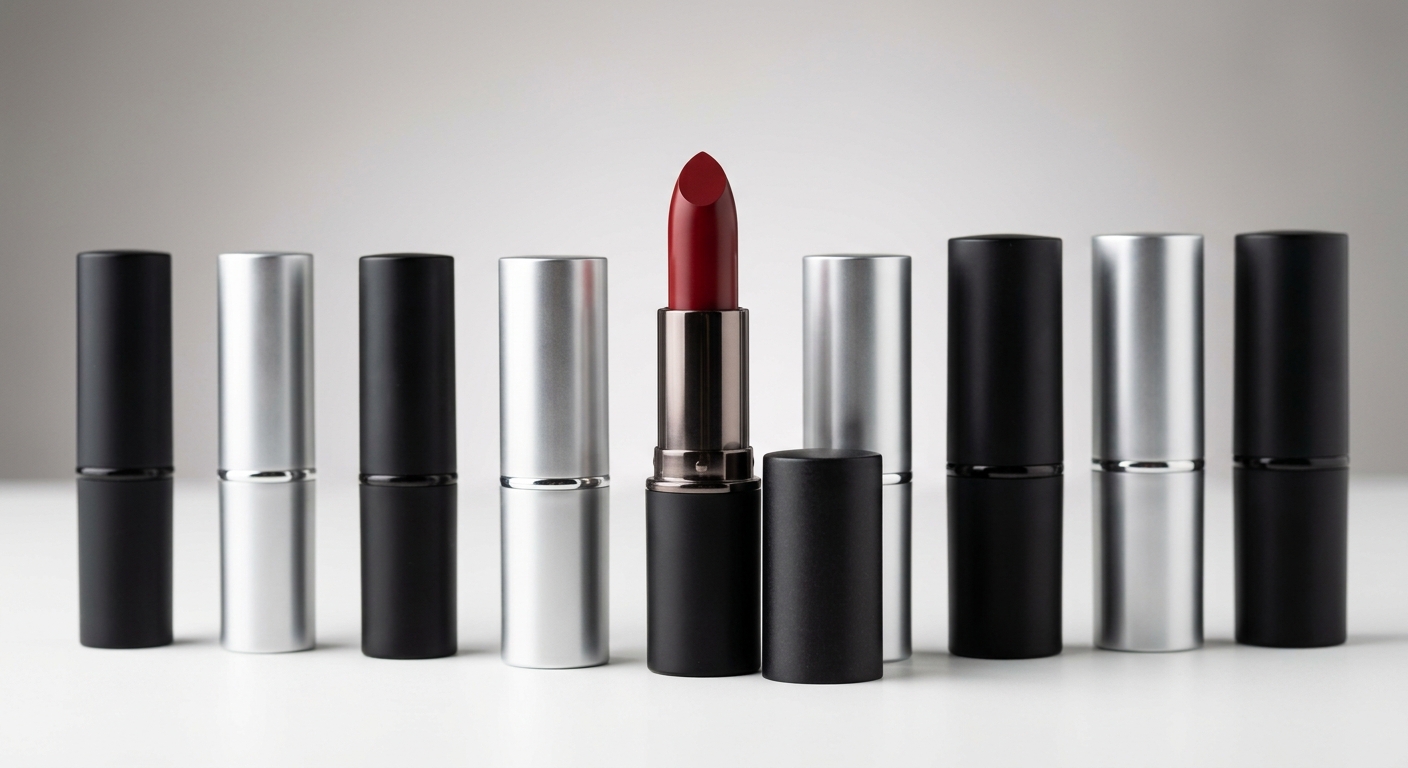
A lipstick tube is not a passive container — its mechanical architecture directly governs how accurately and cleanly a formula can be filled and retained. Three components are most critical: the base cup mechanism, the rotating column, and the inner cup tolerance.
The base cup mechanism controls vertical travel. Any play or inconsistency in its spring tension will cause the bullet to sit at variable heights post-fill, creating surface irregularities that fail cosmetic inspection. The rotating column must engage the inner cup with zero lateral wobble; even a 0.1 mm offset accumulates into visible misalignment across a production batch. The inner cup tolerance — typically held to ±0.05 mm in precision-grade tooling — determines how tightly the filled bullet seats within the tube wall. Loose tolerances allow micro-movement during cooling, which causes shrinkage voids and surface pitting.
For high-volume production, specifying tube components with documented dimensional tolerances from your supplier is non-negotiable. Request material test reports (MTRs) confirming inner cup roundness and column thread pitch consistency before committing to a production run.
1.2 Choosing the Right Tube Format for Your Formula
Tube diameter is the first and most consequential specification decision. The three standard formats — 12.1 mm, 12.7 mm, and 14 mm — are not interchangeable, and matching them to your formula’s rheological profile prevents both filling defects and structural failures in the finished product.
| 仕様 | 12.1 mm Tube | 12.7 mm Tube | 14 mm Tube |
|---|---|---|---|
| Inner Diameter | 12.1 mm ±0.05 mm | 12.7 mm ±0.05 mm | 14.0 mm ±0.05 mm |
| Formula Viscosity Range | High viscosity (>1500 cP) | Medium viscosity (800–1500 cP) | Low-to-medium (<1200 cP) |
| Recommended Fill Temp | 72–78°C | 70–80°C | 68–82°C |
| Material Compatibility | ABS / PP | ABS / PP / Aluminum | PP / Aluminum |
| Typical MOQ Reference | 10,000–20,000 pcs | 10,000–30,000 pcs | 15,000–50,000 pcs |
Material selection follows formula chemistry. ABS tubes offer superior dimensional stability and surface finish for premium retail positioning, but they have lower chemical resistance to high-alcohol or oil-rich formulas. PP tubes are lighter, cost-effective, and chemically inert across a broader range of lipstick bases, making them the preferred choice for mass-market OEM production. If your formula contains aggressive solvents or waxes above 85°C melt point, confirm material compatibility with your tube supplier before tooling investment.
2. Step-by-Step Filling Process: Clean & Efficient Operation
2.1 Temperature & Viscosity Control During Pouring
The filling temperature window for most lipstick formulas falls between 70°C and 85°C, but operating at the extremes of this range introduces distinct failure modes. Pouring above 85°C causes rapid wax crystallization during cooling, which traps air and creates subsurface voids visible after the bullet is raised. Pouring below 70°C increases viscosity prematurely, resulting in incomplete mold fill, surface drag marks, and poor adhesion to the inner cup wall.
The optimal approach is to maintain the formula at 75–80°C at the point of pour and control the cooling rate to no faster than 2°C per minute during the initial solidification phase. Rapid cooling — whether from ambient air drafts or cold mold surfaces — generates thermal stress that manifests as center cracks or surface pitting. Pre-warming molds to 35–40°C before filling significantly reduces this thermal differential.
For automated lines, inline viscosity monitoring using a rotational viscometer allows real-time adjustment of pump speed and nozzle temperature, preventing batch-to-batch variability. Manual filling operations should use a calibrated hot plate with ±1°C accuracy and standardized pour timing per cavity.
2.2 Mold Alignment & Overflow Prevention Techniques
Three operational variables determine whether overflow occurs and whether the resulting bullet surface is acceptable: mold alignment precision, injection rate, and scrape timing.
Mold cavities must be seated flush against the tube inner cup with zero angular tilt. A misaligned cavity — even at 0.5° — creates an asymmetric fill that pools on one side, producing a bullet with uneven tip geometry and a visible seam line. Use alignment jigs or fixed-position filling fixtures for any production volume above 500 units per shift.
Injection rate should be controlled to fill each cavity in 3–5 seconds for standard 3.5 g bullets. Faster injection traps air; slower injection allows surface skinning before the cavity is full. Overflow is best managed by slightly underfilling (95% of cavity volume) and allowing thermal expansion to complete the fill during the first 30 seconds of cooling. Any excess material should be scraped using a heated spatula at 60–65°C, applied in a single lateral pass no later than 45 seconds after pour completion. Delayed scraping causes tearing of the partially set surface.
3. Common Filling Mistakes & How to Avoid Them
3.1 Root Causes of Product Waste in High-Volume Production
Three waste scenarios account for the majority of material loss in lipstick filling operations. First, overfilling: without volumetric dispensing controls, operators tend to pour excess formula to ensure complete cavity fill, generating 8–12% material waste per batch on manual lines. At a formula cost of $15–$30 per kilogram, this represents measurable margin erosion at scale.
Second, demolding adhesion: when mold surfaces are not properly treated or when formula temperature drops too rapidly, the bullet bonds to the cavity wall. Forced extraction tears the bullet surface, rendering the unit non-sellable. This defect alone can account for 3–5% rejection rates on untreated aluminum molds.
Third, thermal shrinkage voids: as wax-based formulas cool, volumetric contraction of 2–4% is typical. Without controlled cooling and proper mold design (including shrinkage compensation in cavity depth), this produces sunken tips or internal voids that compromise structural integrity during application.
3.2 Equipment & Tooling Standards That Minimize Rework
Automated lipstick filling machines should be evaluated on three core metrics: volumetric dispensing accuracy (target: ±0.05 g per shot), nozzle temperature stability (±1°C across all heads), and cycle time per tray (benchmark: ≤8 seconds for 24-cavity trays).
For mold tooling, PTFE-coated cavity surfaces are the industry standard for release performance. PTFE coatings reduce adhesion force by 60–70% compared to uncoated aluminum, eliminating demolding defects without requiring mold release sprays that can contaminate the formula. Mold cleaning cycles should be scheduled every 500–800 fills, using a food-grade solvent wipe followed by compressed air purge to prevent wax buildup in cavity corners.
4. Compliance, Quality Control & Commercial Considerations
4.1 Quality Inspection Criteria for Filled Lipstick Tubes
Finished lipstick tube inspection should cover four appearance parameters: porosity (no visible pinholes or surface voids), color consistency (ΔE < 1.0 against master standard under D65 illumination), bullet height deviation (±0.3 mm from specification), and surface smoothness (no drag marks, cracks, or crystallization patterns).
Under ISO 22716 GMP guidelines, cosmetic manufacturers are required to maintain documented sampling plans for finished product inspection. A statistically valid AQL 1.0 sampling plan at a batch size of 10,000 units requires inspection of 200 units with a maximum of 5 defects accepted. Implementing this standard not only ensures regulatory compliance for EU and US market entry but also provides the data foundation for continuous process improvement.
Retain filled samples from each batch for a minimum of 12 months to support shelf-life validation and customer complaint resolution.
4.2 Cost-Saving Strategies for B2B Buyers & OEM Partners
The most impactful cost lever for B2B buyers is tube diameter standardization. Operating across two or more non-compatible tube diameters requires separate mold tooling sets, extended changeover times (typically 45–90 minutes per format change), and split inventory management. Consolidating to a single standard diameter — matched to your broadest formula range — can reduce tooling investment by 30–40% and increase line utilization by 15–20%.
Bulk packaging procurement at MOQs of 50,000+ units typically unlocks unit price reductions of 12–18% from tier-one suppliers, with further reductions available for annual volume commitments. When evaluating suppliers, prioritize those who provide dimensional inspection reports, material certifications (RoHS, REACH), and filling compatibility test data for your specific formula viscosity range. Supplier audits aligned with ISO 22716 or GMPC standards reduce qualification risk and accelerate new product launch timelines.
FAQ
Q1: What is the ideal pouring temperature to prevent air bubbles when filling lipstick tubes?
The optimal pouring temperature is 75–80°C for most standard wax-based lipstick formulas. Temperatures above 85°C accelerate crystallization during cooling, trapping air bubbles. Pre-warming molds to 35–40°C and controlling the cooling rate to no faster than 2°C per minute further minimizes void formation.
Q2: How do I select the correct lipstick tube diameter to match my existing formula and mold tooling?
Match tube inner diameter to your formula’s viscosity at fill temperature. High-viscosity formulas (>1500 cP) perform best in 12.1 mm tubes; medium-viscosity formulas suit 12.7 mm; lower-viscosity or larger-format products use 14 mm. Always confirm that your existing mold cavity dimensions correspond to the tube’s inner cup geometry before ordering packaging.
Q3: What minimum order quantities should I expect when sourcing lipstick tubes for OEM production?
Standard MOQs range from 10,000 to 20,000 pieces for stock tube formats, and 30,000–50,000 pieces for custom colors, materials, or engraved components. Suppliers offering lower MOQs typically apply tooling amortization surcharges. For new product development, request sample runs of 500–1,000 units to validate fill compatibility before committing to full production quantities.
結論
Clean, waste-free lipstick tube filling is the product of deliberate alignment between packaging specifications, process parameters, and quality systems — not operational improvisation. By selecting tube formats matched to your formula’s rheological profile, controlling fill temperature within a defined window, applying PTFE-coated tooling, and enforcing ISO 22716-aligned inspection protocols, production teams can realistically achieve rejection rates below 2% and material waste below 5% even at high volumes.
For B2B buyers and OEM partners, the strategic insight is straightforward: engage your packaging supplier at the specification stage, not after tooling is cut. Tube diameter standardization, supplier certification, and volume-based procurement planning are the commercial levers that convert process discipline into measurable cost advantage. The brands that win on margin in the lipstick category are those that treat filling efficiency as a supply chain priority, not an afterthought.