

要旨
詰め替え可能 lip balm containers sit at the intersection of sustainability mandates and operational pragmatism — a combination that makes them attractive on paper but technically demanding in practice. For B2B buyers, the promise of circular packaging quickly collides with reality: product spillage during filling, tolerance-driven fit failures, and formulation incompatibilities that only surface after a bulk order has landed.
This article addresses those failure points directly. We break down the mechanical principles that determine whether a refillable lip balm container performs cleanly across multiple fill cycles, compare six distinct container designs across procurement-critical variables, and outline the compliance and formulation-matching criteria that should govern supplier qualification. Whether you are launching a refillable SKU for the first time or auditing an underperforming packaging program, the frameworks here give you a defensible sourcing baseline — before the tooling deposit clears.
1. Why Refillable Lip Balm Containers Are a Procurement Priority
1.1 Market Drivers: Sustainability, Cost, and Brand Positioning
Circular packaging demand is no longer a niche signal. Major retail buyers now embed ESG compliance requirements into vendor scorecards, and end consumers increasingly treat refillable formats as a proxy for brand integrity. For lip balm specifically — a high-repurchase, low-unit-cost category — refillable packaging offers a structural SKU cost reduction over a product’s commercial lifetime. A single durable outer shell amortized across four to six refill pods can reduce per-unit packaging spend by 30–45%, depending on material selection and MOQ tier.
Brand positioning benefits compound this economics case. Refillable lip balm packaging enables tiered retail strategies: a premium outer container sold at full margin, followed by a recurring refill pod revenue stream at lower price points. This model mirrors what prestige skincare has executed successfully with foundation compacts and moisturizer jars, and it translates cleanly to the lip care segment.
For procurement teams, the implication is straightforward: refillable lip balm containers are not a sustainability gesture. They are a margin and loyalty mechanism that justifies dedicated sourcing effort.
1.2 The Real Problem: Why Most Refills Go Messy
The gap between a well-positioned refillable concept and a functional one almost always traces back to three root causes: dimensional tolerance gaps between the refill pod and outer shell, material mismatch that causes differential thermal expansion at fill temperature, and fill-temperature sensitivity in the formulation itself that the container geometry fails to accommodate.
Tolerance gaps are the most common failure. A 0.3 mm variance in inner diameter — within acceptable range for general cosmetic packaging — is sufficient to allow a wax-based lip balm to seep between the pod wall and the outer sleeve during hot-fill operations. Material mismatch compounds this: a PP refill pod seated in an ABS outer shell will behave differently at 75°C fill temperature than at ambient retail conditions, creating micro-gaps that did not exist during cold-fit testing. Procurement teams that screen for these variables at the sample stage avoid the rework costs that surface at production scale.
2. How Refillable Lip Balm Container Designs Actually Work
2.1 Core Mechanisms: Twist-Up, Snap-In, Screw-Base, and Sleeve Refill Systems
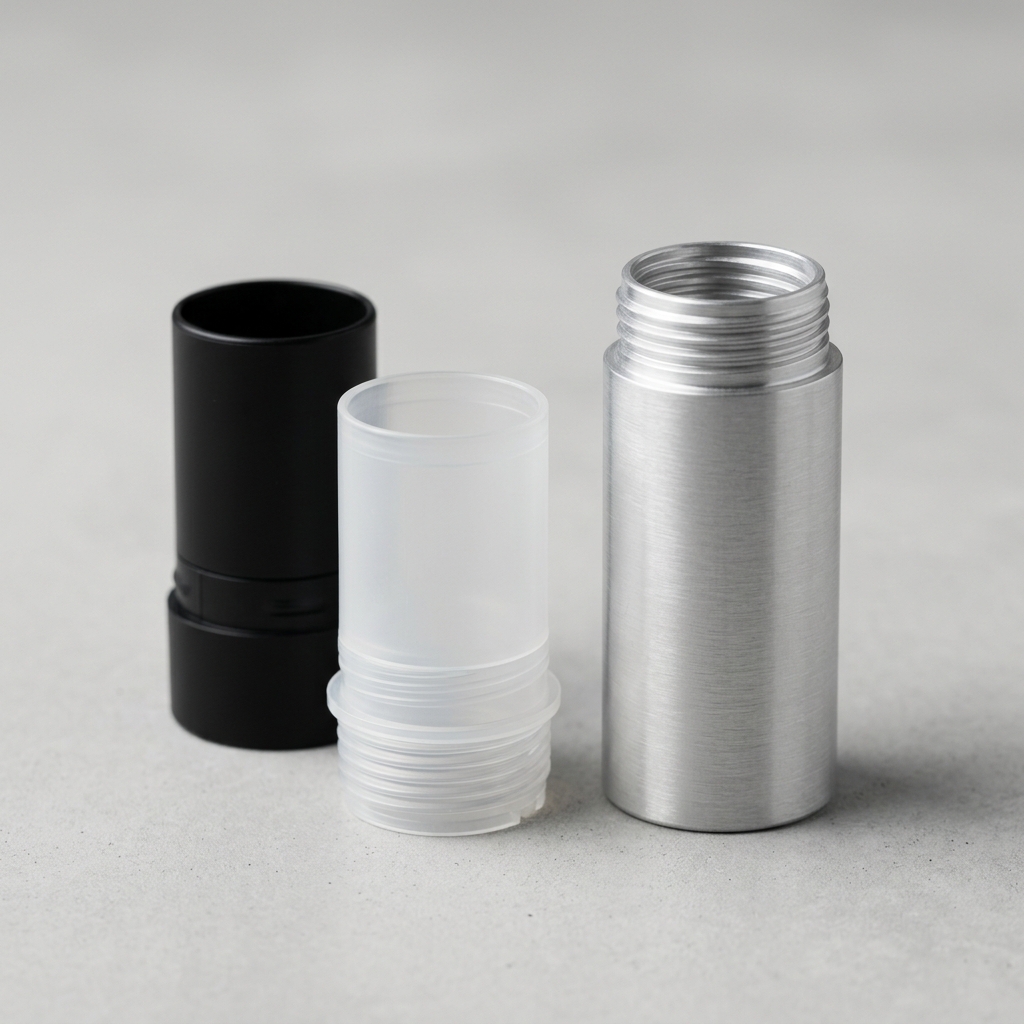
Four primary refill mechanisms dominate the current lip balm container market, each with distinct operational trade-offs:
- Twist-up refill systems use a threaded base collar to advance the product. Refillable versions accept a pre-filled twist mechanism as a drop-in pod. Retention force depends on thread pitch precision; coarser threads increase wobble and mess risk.
- Snap-in refill cartridges seat a pre-filled inner tube into a fixed outer shell via interference fit. Seal integrity is high when tolerances are tight, but snap fatigue after three or more cycles is a documented failure mode in lower-grade PP constructions.
- Screw-base systems thread the refill pod directly into the outer shell base. These offer the strongest mechanical seal and the cleanest refill process for end users, but require the highest dimensional consistency across production batches.
- Sleeve refill formats slide a pre-filled inner sleeve into an open outer tube. These are the simplest to manufacture but carry the highest mess risk unless the inner sleeve incorporates a positive-stop feature to prevent over-insertion.
For B2B buyers operating automated fill lines, screw-base and snap-in systems offer the best compatibility with standard filling equipment. Sleeve formats typically require manual or semi-manual assembly steps.
2.2 Material & Tolerance Specs That Determine Mess-Free Performance
Inner wall surface finish and material selection are the two variables most frequently underspecified in supplier RFQs. A surface roughness (Ra) value above 1.6 µm on the inner wall of a sleeve-format container creates sufficient friction to drag product during insertion, generating the smearing that makes refills messy in retail settings.
Material compatibility must be evaluated against fill temperature, not just ambient performance. PP tolerates repeated thermal cycling better than ABS but offers lower rigidity — a relevant trade-off for premium brand positioning. Aluminum outer shells paired with PP refill pods represent the current performance benchmark: aluminum provides dimensional stability across temperature ranges, while PP’s slight flex accommodates minor tolerance variation without cracking.
| Container Type | Refill Mechanism | 材料 | Inner Diameter Tolerance | Mess Risk Level | MOQ | Refill Cycle Rating | 最適な用途 |
|---|---|---|---|---|---|---|---|
| Standard Twist-Up | Twist pod drop-in | PP/ABS | ±0.3 mm | 中 | 5,000 | 3–4 cycles | 2. 漏れ防止エンジニアリング:構造設計と密封機構 |
| Snap-In Cartridge | Interference fit | PP | ±0.2 mm | Low–Medium | 10,000 | 4–5 cycles | Mid-tier retail |
| Screw-Base Pod | Threaded base | ABS/Aluminum | ±0.15 mm | 低 | 10,000 | 6+ cycles | Prestige/DTC |
| Sleeve Format | Slide-in inner | PP | ±0.25 mm | High | 3,000 | 3 cycles | Sampling/travel |
| Magnetic Snap | Magnetic retention | アルミニウム | ±0.1 mm | Very Low | 15,000 | 8+ cycles | Luxury/gift |
| Biodegradable Pod | Snap-in | PLA/Paper composite | ±0.35 mm | Medium–High | 8,000 | 2–3 cycles | Eco-positioned |
3. Compliance, Safety, and Formulation Compatibility
3.1 Regulatory Considerations for Refillable Cosmetic Packaging
Refillable formats introduce a compliance dimension that single-use packaging does not: cross-contamination risk across fill cycles. Under FDA cosmetic packaging guidelines, the brand owner bears responsibility for ensuring that the packaging does not compromise product safety through its intended reuse lifecycle. This means refillable containers must be evaluated not only for initial fill performance but for microbial resistance and cleanability across the stated number of refill cycles.
In the EU, Cosmetic Regulation 1223/2009 imposes similar obligations, with the added requirement that packaging materials in contact with the product must not transfer substances at levels that could affect human health. For refillable formats, this requires migration testing of the inner wall material — particularly relevant for PLA composites and recycled-content PP, where additive profiles vary between production batches. Buyers sourcing from new suppliers should request material safety data sheets and migration test reports as standard qualification documents, not optional additions.
3.2 Matching Container Design to Lip Balm Formulation Type
Formulation type is a hard constraint on container format selection, not a secondary consideration. Wax-based formulations (melting point 60–75°C) require containers with minimal internal void space to prevent pooling during hot-fill. Oil-heavy balms with lower viscosity demand tighter inner diameter tolerances to prevent seepage through any gap in the refill mechanism. SPF-infused formulations add a further complication: UV-filter compounds can interact with certain plasticizers in PP and ABS over time, degrading both the formulation and the container wall.
For brands formulating above 15% oil content, screw-base or magnetic snap mechanisms are the only formats that reliably prevent leakage across the fill and retail lifecycle. Sleeve formats should be eliminated from consideration for any formulation with a pour viscosity below 4,000 cP at fill temperature.
4. Sourcing the Right Refillable Lip Balm Container for Your Brand
4.1 Key Supplier Qualification Criteria
Tooling customization capability is the first differentiator among refillable lip balm container suppliers. A supplier who can adjust thread pitch, inner diameter, and surface finish within their existing tooling — rather than requiring new tool investment for each specification — compresses sample lead time and reduces qualification cost. Target suppliers who can deliver dimensioned samples within 15 business days and who provide documented fill-trial data from their own production environment.
Fill-line compatibility is the second criterion. Request confirmation that the container format has been validated on standard cosmetic filling equipment (rotary fill-and-seal lines, linear piston fillers) before committing to MOQ. Suppliers who offer fill-line simulation data or who have existing OEM relationships with filling equipment manufacturers reduce your integration risk substantially.
Batch-to-batch dimensional consistency — verified via Cpk values for inner diameter and wall thickness — should be a contractual specification, not an informal assurance.
4.2 Cost-Per-Fill Analysis: When Refillable Packaging Pays Off
The unit economics of refillable lip balm packaging follow a consistent pattern: high initial tooling and outer shell cost, offset by lower refill pod pricing at volume. A representative model:
- Outer shell (aluminum screw-base): $1.80–$2.40 per unit at 10,000 MOQ
- Refill pod (PP, pre-filled): $0.45–$0.65 per unit at 10,000 MOQ
- Equivalent single-use container: $0.55–$0.80 per unit
Breakeven occurs at the second refill cycle for most aluminum outer shell formats. At four cycles — a realistic consumer lifecycle for a daily-use lip balm — the total packaging cost per product delivered is 35–50% below single-use equivalents. This analysis should be presented to retail buyers as part of the sustainability and margin case for refillable SKU listings.
FAQ
Q1: What minimum wall thickness should a refillable lip balm container have to prevent cracking during repeated refill cycles?
For PP constructions, a minimum wall thickness of 1.2 mm is required to sustain six or more snap-in refill cycles without stress fracture at the retention lip. Aluminum outer shells are not subject to the same fatigue constraints but require a minimum 0.8 mm wall to maintain dimensional stability across thermal cycling.
Q2: Can standard lip balm filling lines handle refillable container formats, or is equipment modification required?
Screw-base and snap-in formats are generally compatible with standard rotary filling lines with minor fixture adjustments. Sleeve formats typically require a dedicated insertion station. Confirm fill-line compatibility with your contract manufacturer before finalizing container selection — equipment modification costs can eliminate the per-unit savings of a refillable format at lower volumes.
Q3: How do I verify that a supplier’s refillable container meets FDA and EU cosmetic packaging compliance before placing a bulk order?
Request migration test reports for all materials in product contact, material safety data sheets for inner wall components, and documentation of any recycled-content percentages in the resin. For EU distribution, confirm that the supplier can provide a Declaration of Compliance aligned with EU Regulation 10/2011 (plastic food contact materials is the applicable testing framework for cosmetic packaging migration assessment).
結論
Refilling a lip balm container without mess is operationally achievable — but it requires alignment across three variables that most buyers do not evaluate simultaneously: container mechanism, material tolerances, and formulation properties. Procurement teams that address these at the sourcing stage, rather than at the production trial stage, avoid the rework costs, product waste, and retailer complaints that characterize failed refillable packaging launches.
Use the comparison table in Section 2.2 as your initial format filter, apply the compliance checklist in Section 3.1 to your supplier qualification process, and run the cost-per-fill model in Section 4.2 before committing to any MOQ. The refillable lip balm container category rewards buyers who specify precisely — and penalizes those who treat it as a standard packaging procurement.