
Résumé
For cosmetics buyers and brand managers sourcing eyeshadow packaging at scale, material selection is one of the highest-leverage decisions in the procurement cycle. The substrate you specify determines how well the box protects fragile pressed-powder compacts in transit, how it performs under retail lighting, and whether the unboxing experience reinforces or undermines your brand positioning.
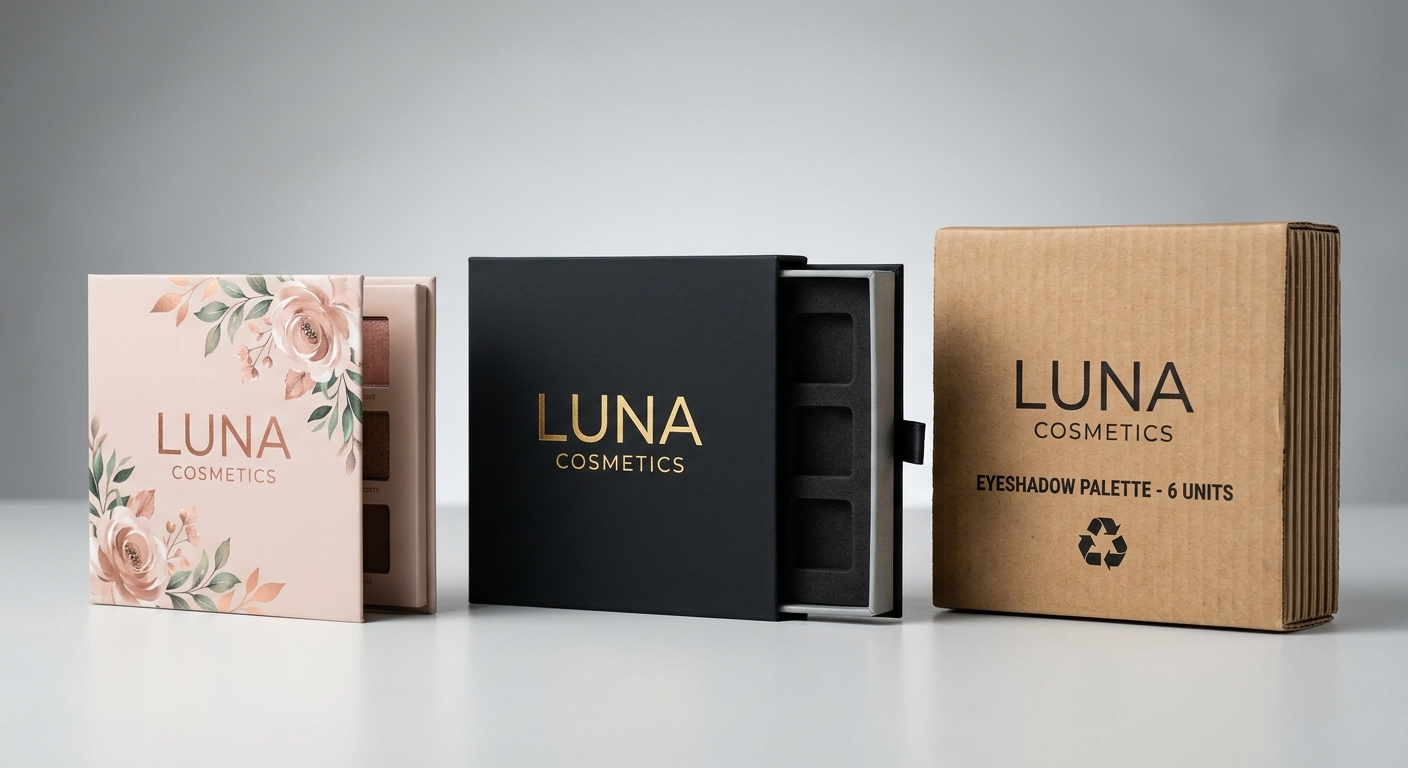
This guide provides a structured comparison of the three dominant substrate categories used in eyeshadow box manufacturing—cardstock (250–400 gsm), rigid paperboard (greyboard, 1,200–3,000 gsm), and corrugated board (single/double wall)—evaluated across the dimensions that matter most in B2B procurement: structural performance, printability, surface finish compatibility, MOQ economics, and channel fit. Whether you are specifying a mass-market folding carton or a luxury rigid box with magnetic closure, the framework below will help you match material to business requirements with precision.
1. Why Material Choice Defines Your Eyeshadow Box ROI
1.1 The Hidden Cost of Getting It Wrong
Material misspecification rarely shows up as a line item in a packaging budget—it surfaces later, as damage claims, rework orders, and lost retail placement. Eyeshadow palettes and compacts are inherently fragile: pressed pigment pans crack under point-load compression, mirror inserts shatter, and decorative foil toppers delaminate when packaging flexes during shipping. A cardstock box specified at 300 gsm where 350 gsm was required can increase in-transit damage rates by 15–25% on LCL ocean shipments, eroding the unit-cost saving that drove the downgrade in the first place.
Beyond transit, there are rework and re-inspection costs when packaging arrives at 3PL facilities with crush damage, delaminated lamination, or color shift from moisture absorption. These indirect costs—often invisible during supplier negotiation—are the primary reason experienced procurement teams invest in material qualification samples and third-party drop testing before committing to production MOQs.
1.2 How Material Affects Brand Perception at Point of Sale
Tactile quality communicates brand tier before a consumer reads a single word of copy. A rigid paperboard eyeshadow box with soft-touch lamination signals luxury through resistance and weight. A thin cardstock carton that flexes under thumb pressure signals mass-market, regardless of the graphics printed on it.
In retail environments, structural integrity also affects planogram performance. Boxes that warp under fluorescent heat or compress under shelf stacking lose facing alignment, reducing visual impact. For DTC brands, unboxing rigidity has become a measurable KPI—packaging that opens with controlled resistance and a satisfying magnetic snap generates higher social sharing rates. Material is not merely a cost input; it is an active component of the brand experience and a driver of repeat purchase intent.
2. Material Options Compared: Cardstock, Rigid Paperboard & Corrugated
2.1 Cardstock (250–400 gsm): The High-Volume Workhorse
Cardstock folding cartons represent the dominant format in mass-market and mid-tier eyeshadow packaging. The weight range of 250–400 gsm provides enough structural integrity for standard retail shelf conditions while remaining compatible with high-speed offset and digital printing lines. Die-cutting, scoring, and gluing are all highly automated at this substrate weight, which translates directly into lower tooling amortization and faster lead times—typically 15–20 working days for repeat orders.
The primary limitation is structural rigidity. Cardstock boxes are folded cartons: they rely on glue joints and tuck flaps for closure, which means they can be forced open or deformed under lateral pressure. For eyeshadow SKUs priced below $30 retail, this trade-off is commercially acceptable. For premium or gift-set configurations, it is not.
Key advantages: Lowest cost-per-unit, widest supplier base, full compatibility with CMYK/Pantone printing and most lamination types, recyclable without material separation.
2.2 Rigid Paperboard (1,200–3,000 gsm Greyboard): The Premium Tier
Rigid boxes are constructed from greyboard (chipboard) wrapped in printed or laminated paper, and they do not fold flat for shipping—a logistical consideration that affects freight cost and warehouse footprint. The structural density of 1,200–3,000 gsm greyboard delivers the crush resistance and tactile weight that defines luxury cosmetic packaging. Magnetic closure mechanisms, ribbon pulls, and foam or thermoformed inserts are all native to this format.
For eyeshadow palettes in the $40–$150+ retail tier, rigid paperboard is the specification standard. The higher per-unit cost (typically 3–5× cardstock at equivalent print spec) is offset by the premium price point it supports and the reduced damage rate in e-commerce fulfillment. MOQs are higher—typically 500–1,000 units minimum versus 1,000–3,000 for cardstock—but setup costs per unit are amortized differently due to the wrap-and-assemble production method.
Key advantages: Superior structural protection, premium unboxing experience, magnetic closure compatibility, high perceived value at retail.
2.3 Corrugated Board (Single/Double Wall): The E-Commerce Shipping Shield
Corrugated board is rarely specified as the primary retail eyeshadow box, but it plays a critical role in e-commerce supply chains as an outer shipper or transit carton. Single-wall corrugated (B or E flute) provides excellent crush resistance with relatively low weight, while double-wall construction is appropriate for bulk pallet shipments of finished goods.
The aesthetic limitations of corrugated—visible fluting, limited print resolution on kraft liner, and the industrial visual language of brown board—make it unsuitable for retail shelf presence. However, brands shipping direct-to-consumer can use corrugated outer cartons with branded tissue and insert cards to balance protection with unboxing experience without compromising the inner rigid or cardstock box specification.
Key advantages: Highest transit crush resistance, lowest damage rate for bulk e-commerce shipments, cost-effective for outer shipper applications.
Material Comparison Table
| Dimension | Cardstock | Rigid Paperboard | Corrugated |
|---|---|---|---|
| Weight Range | 250–400 gsm | 1,200–3,000 gsm | 125–200 gsm liner + fluting |
| Typical Thickness | 0.3–0.5 mm | 1.5–3.5 mm | 3–7 mm (single wall) |
| Crush Resistance | Modéré | Élevée | Très élevé |
| Printability | Excellent (offset/digital) | Good (wrap sheet) | Limited (flexo) |
| Surface Finish Compatibility | Full range | Full range (wrap) | Basic lamination only |
| Primary Use Case | Retail folding carton | Luxury retail / DTC gift | Outer shipper / transit |
| MOQ typique | 1,000–3,000 units | 500–1,000 units | 500–2,000 units |
| Relative Cost Index | 1.0× | 3.0–5.0× | 0.8–1.2× |
3. Compliance, Print Finishing & Structural Standards
3.1 Regulatory & Sustainability Compliance for Cosmetic Packaging
Sustainability compliance is no longer optional for brands selling into EU or major US retail channels. FSC (Forest Stewardship Council) certification is the baseline requirement for most category-A retailers and is available across all three substrate types from qualified mills. For EU market entry, packaging must also comply with the EU Packaging and Packaging Waste Regulation (PPWR), which sets recycled content targets and recyclability thresholds that will tighten through 2030.
Ink migration is a specific concern for cosmetic packaging: water-based and UV-cured inks are preferred over solvent-based formulations to prevent volatile compound transfer to product inserts. Buyers should request material safety data sheets (MSDS) and migration test certificates—particularly for rigid boxes where the greyboard core may contain recycled fiber with variable contamination profiles.
3.2 Surface Finishing Options and Their Material Dependencies
Surface finishing is where material choice creates the most visible brand differentiation. The compatibility matrix below guides specification decisions:
- Soft-touch lamination: Compatible with cardstock and rigid paperboard wrap sheets. Adds tactile premium at low incremental cost (~$0.08–0.15/unit). Not suitable for corrugated.
- UV spot coating: Works on cardstock and rigid wrap sheets. Creates contrast between matte and gloss zones—effective for logo highlighting.
- Hot stamping (foil): Fully compatible with cardstock and rigid paperboard. Requires flat, stable substrate surface; not recommended on corrugated.
- Embossing/debossing: Achieves best definition on rigid paperboard due to substrate density. On cardstock, requires heavier caliper (350+ gsm) to prevent reverse-side show-through.
- Aqueous coating: Suitable for all substrates; preferred for recyclability compliance as it does not impede paper fiber recovery.
4. Matching Material to Your Business Scenario
4.1 Retail Shelf vs. DTC E-Commerce: Different Performance Priorities
Retail shelf specifications prioritize planogram consistency, moisture resistance, and print accuracy under variable lighting. Cardstock with aqueous coating or matte lamination performs well in standard retail environments. Rigid paperboard is preferred for department store cosmetics counters and specialty beauty retailers where shelf dwell time is higher and tactile interaction drives purchase decisions.
DTC e-commerce specifications prioritize drop-test performance (ISTA 2A or ASTM D4169 compliance), photography appeal for product listing images, and unboxing video suitability. Rigid boxes with magnetic closures perform strongly on all three dimensions. For brands operating both channels, a dual-spec strategy—rigid inner box plus corrugated outer shipper—is the most common solution, balancing retail shelf presence with e-commerce transit integrity.
4.2 MOQ, Lead Time & Supplier Qualification Considerations
Material choice has a direct and often underestimated effect on supplier tier access. Cardstock folding cartons can be produced by a broad base of Tier 2 and Tier 3 packaging converters, giving buyers negotiating leverage and supply chain redundancy. Rigid paperboard boxes require specialized wrapping and assembly equipment, concentrating supply among Tier 1 and select Tier 2 factories—particularly relevant for buyers sourcing from China, Vietnam, or India.
At annual volumes below 10,000 units, rigid box tooling costs (die-cutting for greyboard, wrap sheet registration) can add $0.30–0.80 per unit to effective cost. Above 50,000 units annually, this premium compresses significantly. Sample lead times also diverge: cardstock samples typically run 5–7 working days; rigid box samples require 10–15 days due to the multi-step assembly process. Build this into your product development calendar to avoid launch delays.
FAQ
Q1: What is the minimum order quantity difference between cardstock and rigid paperboard eyeshadow boxes?
Cardstock folding cartons typically carry MOQs of 1,000–3,000 units depending on the converter and print complexity. Rigid paperboard boxes generally start at 500–1,000 units, but the per-unit cost is 3–5× higher. For brands under 2,000 units annually, cardstock offers better unit economics; above 5,000 units, the rigid box premium is more easily absorbed into the retail margin.
Q2: Can rigid paperboard eyeshadow boxes meet FSC or recyclable packaging requirements for EU retail compliance?
Yes. FSC-certified greyboard and FSC-certified wrap sheets are widely available from qualified suppliers. The key compliance variable is the lamination type: standard BOPP lamination impedes recyclability, while aqueous coating or PET-free laminates maintain fiber recovery compatibility. Specify FSC chain-of-custody documentation and recyclability certification in your supplier brief to ensure compliance with EU PPWR requirements.
Q3: How do I decide whether to use corrugated as the primary eyeshadow box or only as an outer shipping carton?
Corrugated should almost never be the primary retail eyeshadow box—its print resolution and aesthetic language are misaligned with cosmetic category expectations. The correct application is as an outer shipper protecting a cardstock or rigid inner box during transit. If your primary channel is B2B bulk supply (e.g., supplying hotels, spas, or private-label retail), E-flute corrugated with basic flexo printing is a cost-effective primary format.
Conclusion
Selecting the right material for an eyeshadow box is a multi-variable decision that connects unit economics, brand positioning, channel requirements, and regulatory compliance into a single specification choice. Cardstock (250–400 gsm) is the correct default for high-volume, cost-sensitive programs where print quality and folding carton flexibility are priorities. Rigid paperboard (1,200–3,000 gsm greyboard) delivers the structural integrity and premium tactile experience required for mid-to-high retail price points and DTC unboxing performance. Corrugated board serves transit protection needs as an outer shipper and should not be used as a substitute for retail-grade packaging aesthetics.
The most effective procurement approach is to define your channel, annual volume, and target retail price point first—then work backward to the material specification that optimizes packaging quality per dollar invested. Requesting material samples, migration test certificates, and FSC documentation from shortlisted suppliers before committing to production MOQs will eliminate the majority of downstream quality and compliance risk. Align material to strategy, and the eyeshadow box becomes a brand asset rather than a cost center.