
Zusammenfassung
Premature mascara drying is one of the most common — and most preventable — quality complaints in cosmetic packaging. For B2B buyers, formulators, and private-label brands, the root cause is rarely the formula itself. It is almost always the tube.
When a mascara dries out within weeks of opening, the instinct is to reformulate. In practice, the tube geometry, wiper tolerance, cap seal compression, and material permeability are the variables that determine how long volatile solvents remain active inside the barrel. A formula that performs perfectly in lab conditions can fail in market within 30 days if the packaging specification is mismatched.
This article breaks down the five structural and mechanical reasons mascara packaging accelerates drying. Each cause maps directly to a packaging specification that procurement teams, product developers, and private-label brand managers can act on during supplier qualification — before a single unit reaches a consumer.
1: The Real Culprit Behind Fast-Drying Mascara — It Starts With the Tube
1.1: How Air Infiltration Destroys Shelf Life From Day One
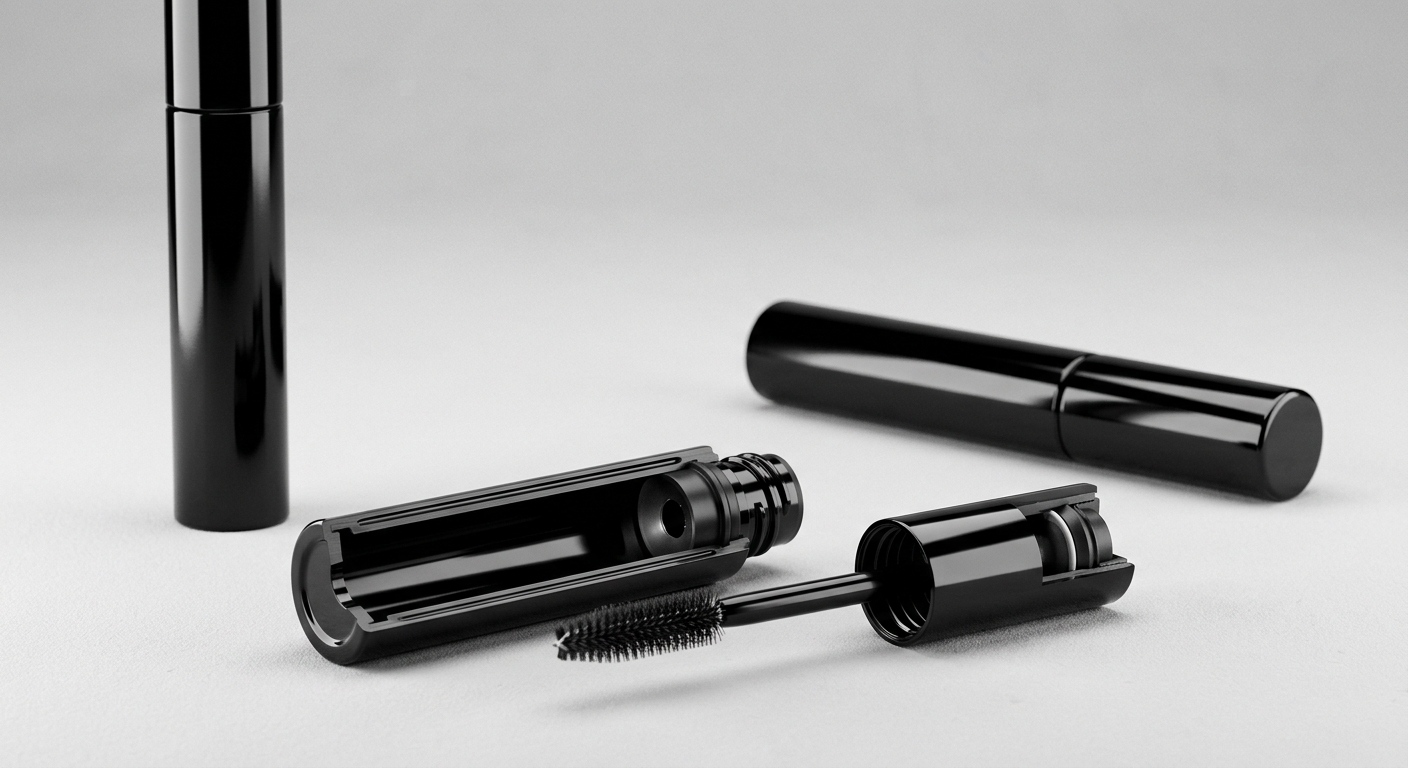
Mascara formulas rely on volatile solvents — typically water, alcohol, or light film-forming agents — to maintain workable consistency. Once those solvents begin evaporating, the formula thickens irreversibly. The primary driver of that evaporation is not ambient heat or storage conditions. It is micro air infiltration through gaps in the tube assembly.
Every mascara tube has at least four potential air entry points: the wiper-to-neck interface, the cap-to-neck thread seal, the inner cap gasket or plug, and the tube body itself if wall thickness is insufficient. Even a 0.1 mm gap at the wiper seat creates a continuous vapor exchange pathway. Over a 30-day period, this micro-leakage measurably reduces solvent content and increases formula viscosity beyond the functional range.
The oxidation mechanism compounds the problem. Oxygen infiltration does not just accelerate evaporation — it degrades certain film-forming polymers and wax emulsifiers, permanently altering texture. This is why two identical formulas stored in different tubes can show dramatically different shelf-life outcomes in accelerated stability testing.
1.2: Why Formula and Packaging Must Be Specified Together
Formula viscosity and solvent composition directly determine which tube geometry is appropriate. A low-viscosity, water-based formula requires a tighter wiper aperture and higher cap seal compression than a high-viscosity wax-dominant formula, because the thinner product migrates more easily through micro-gaps and loses its aqueous phase faster.
Mismatched tube geometry is the most common procurement error in mascara development. Buyers often select a tube based on aesthetics or MOQ, then hand it to a formulator who has no input on the mechanical specification. The result: a formula engineered for 4,000–6,000 cP viscosity placed in a tube designed for 8,000–12,000 cP products, with a wiper aperture 0.3 mm too wide and no inner cap seal. The formula dries out. The brand blames the lab.
Specifying packaging and formula in parallel — with shared viscosity targets, solvent volatility data, and wiper compatibility confirmation — eliminates this failure mode before tooling is committed.
2: 5 Structural Causes of Premature Drying — and the Packaging Fix for Each
2.1: Cause 1–3 — Wiper Design, Wall Thickness, and Cap Seal Integrity
These three factors are interdependent. Fixing one without addressing the others produces marginal improvement at best.
Cause 1 — Wiper Aperture Tolerance: The wiper controls how much product is deposited on the brush and, critically, how effectively it re-seals the tube after each withdrawal. A wiper aperture that is 0.2–0.4 mm oversized for the brush diameter leaves a continuous annular gap. Standard specification for a 6 mm brush wand is a wiper OD of 5.6–5.8 mm with ±0.05 mm tolerance. Many commodity tubes ship at ±0.15 mm — a threefold deviation that creates measurable air exchange with every use.
Cause 2 — Wall Thickness: LDPE tube walls below 0.8 mm exhibit meaningful vapor permeability at ambient temperature. For standard mascara formulas, a minimum wall thickness of 1.0–1.2 mm in LDPE or 0.85–1.0 mm in PP is recommended. Thinner walls reduce material cost but increase solvent transmission rate — a false economy that generates returns and reformulation cycles.
Cause 3 — Cap Seal Compression: The inner plug or gasket of a mascara cap must compress 8–12% against the tube neck to form an effective vapor barrier. Caps manufactured to lower compression ratios — common in unvalidated commodity supply chains — seal visually but allow continuous micro-vapor exchange. Specifying cap torque range (typically 8–14 N·cm for standard 13–14 mm neck finishes) and requesting compression ratio documentation from suppliers is a minimum quality gate.
| Cause | Affected Component | Recommended Spec | Common Defect Range | Fix |
|---|---|---|---|---|
| Wiper aperture | Wiper insert | ±0.05 mm OD tolerance | ±0.15 mm deviation | Tighten tooling spec; request CMM report |
| Wandstärke | Tube body | 1.0–1.2 mm (LDPE) | <0.8 mm | Upgrade wall spec; confirm with caliper QC |
| Cap seal compression | Inner plug/gasket | 8–12% compression | <5% compression | Specify torque range; request compression test data |
| Neck finish | Tube neck | Class 1 thread finish | Out-of-spec thread pitch | Specify neck finish class; validate cap fit |
| Material permeability | Tube body | MVTR <3 g/m²/day | LDPE thin-wall: >8 g/m²/day | Switch to PP or PET for solvent-heavy formulas |
2.2: Cause 4–5 — Neck Finish Tolerance and Material Permeability
Cause 4 — Neck Finish Tolerance: Thread mismatch between the tube neck and cap is one of the least-tested failure points in mascara packaging qualification. A neck finish that is 0.1–0.2 mm out of specification creates a helical gap along the thread path — invisible to visual inspection, but functionally equivalent to leaving the cap slightly ajar. Procurement teams should specify neck finish class (ISO 2859 or equivalent), request dimensional reports for neck OD, thread pitch, and finish height, and conduct cap-on/cap-off torque testing on every new tool qualification run.
Cause 5 — Material Permeability: LDPE, PP, and PET have significantly different moisture vapor transmission rates (MVTR). Standard LDPE at 1.0 mm wall thickness transmits approximately 5–8 g/m²/day. PP at equivalent thickness transmits 1–2 g/m²/day. PET, used in premium mascara tubes, drops below 1 g/m²/day. For waterproof and long-wear formulas with high solvent loads, LDPE is a liability. The material upgrade cost — typically 15–25% per unit — is recovered within one product cycle when returns and reformulation costs are factored in.
3: How to Audit Your Current Mascara Tube Specification
3.1: Key Parameters Procurement Teams Should Validate Before Ordering
Before placing a production order, procurement and product development teams should validate the following six parameters against formula requirements:
- Wiper OD and aperture tolerance — confirm against brush wand diameter with ±0.05 mm maximum deviation
- Cap torque range — specify minimum and maximum application torque (N·cm) and request production line torque records
- Wandstärke — verify with caliper measurement at tube shoulder, midpoint, and base; minimum 1.0 mm for LDPE
- Neck finish class — specify thread class and request dimensional inspection report for neck OD and thread pitch
- Material grade and MVTR — request resin grade certification and MVTR data sheet; confirm compatibility with formula solvent profile
- Seal compression ratio — request cap compression test data; minimum 8% compression against tube neck
3.2: Supplier Red Flags and Quality Documentation to Request
A qualified mascara tube supplier should provide, without hesitation: resin grade certificates, dimensional inspection reports (CMM or equivalent), cap torque test data, MVTR data for the specified wall thickness, and wiper aperture tolerance reports per production batch.
Red flags include: inability to provide wiper aperture CMM data, cap compression ratios below 6%, wall thickness specifications listed as nominal without tolerance range, and neck finish described only by thread diameter without pitch or class designation.
Request ASTM D3985 (oxygen transmission) or ASTM F1249 (moisture vapor transmission) test reports for any tube intended for waterproof or long-wear SKUs. Suppliers without this data on file are not qualified for solvent-sensitive formulas.
4: Application Scenarios — Matching Tube Design to Formula Type
4.1: High-Viscosity vs. Low-Viscosity Formulas — Different Tube Requirements
Formula viscosity determines wiper aperture sizing and brush compatibility. High-viscosity formulas (8,000–15,000 cP) require a wider wiper aperture — typically 6.0–6.5 mm for a standard brush — because the product does not flow freely through a tight wiper. Low-viscosity formulas (3,000–6,000 cP) require a tighter aperture, 5.4–5.8 mm, to prevent overloading the brush and to minimize the annular gap that drives air infiltration.
Fiber brushes and molded applicators also interact differently with tube bore diameter. A molded applicator with a defined spine diameter requires a bore-to-wiper fit within 0.1 mm to avoid wobble-induced air gaps. Fiber brushes are more tolerant of slight bore variation but require consistent wiper compression to prevent formula migration along the bristle bundle.
4.2: Waterproof and Long-Wear Formulas — Elevated Sealing Standards
Waterproof mascara formulas typically contain isododecane, cyclopentasiloxane, or other volatile silicone solvents with higher evaporation rates than water-based systems. These solvents permeate standard LDPE walls at measurably higher rates and are more sensitive to wiper gap leakage.
For waterproof and long-wear SKUs, the minimum recommended specification upgrade is: PP or PET tube body (MVTR <2 g/m²/day), inner cap gasket with documented 10–12% compression ratio, and wiper aperture tolerance tightened to ±0.03 mm. These upgrades add 18–30% to unit packaging cost but are non-negotiable for formulas that must maintain performance through a 12-month shelf life.
FAQ
Q1: What wiper aperture diameter should I specify to prevent my mascara from drying out between uses?
Wiper aperture should be sized to the brush wand OD minus 0.2–0.4 mm, with a manufacturing tolerance of ±0.05 mm. For a standard 6.0 mm brush wand, specify a wiper aperture of 5.6–5.8 mm. For low-viscosity formulas, use the tighter end of that range. Always request a CMM dimensional report from your supplier confirming production batch conformance — nominal specifications on a data sheet do not guarantee production accuracy.
Q2: How do I know if my current mascara tube supplier’s cap seal is causing premature drying — and what test should I request?
Request a cap compression ratio test and a cap-on torque report. The compression ratio should be 8–12% against the tube neck. If your supplier cannot provide this data, conduct an in-house leak test: fill tubes with formula, seal, store at 40°C/75% RH for 30 days, and measure weight loss against an unsealed control. Weight loss exceeding 2% indicates seal failure. Also request ASTM F2096 or equivalent pressure-decay leak testing documentation.
Q3: Does switching from LDPE to PP tubes actually extend mascara shelf life, or does it depend on the formula?
It depends on the formula, but the improvement is consistent for solvent-heavy systems. For standard water-based formulas, the MVTR difference between LDPE and PP at equivalent wall thickness is meaningful but not always the primary failure point — wiper and cap seal issues usually dominate. For waterproof and long-wear formulas with volatile silicone or alcohol solvents, switching to PP or PET delivers a measurable shelf-life extension, typically 20–35% improvement in accelerated stability testing. Material upgrade should always be accompanied by wiper and cap seal requalification.
Schlussfolgerung
Premature mascara drying is an engineering problem, not a formula problem. The five structural causes — wiper aperture deviation, insufficient wall thickness, inadequate cap seal compression, neck finish tolerance mismatch, and material permeability — each have defined, actionable packaging specifications that procurement and product development teams can validate before production commitment.
The cost of getting these specifications right at the tooling stage is a fraction of the cost of reformulation cycles, accelerated stability failures, and consumer returns. Brands that align packaging specifications to formula requirements — treating the tube as a functional component, not a commodity vessel — consistently outperform those that treat packaging as an afterthought.
Audit your current tube specification against the parameters in this article. If your supplier cannot provide wiper CMM data, cap compression ratios, and material MVTR certification, that is your answer.