

The global beauty industry generates an estimated 120 billion units of packaging annually, with a significant portion destined for landfill within months of purchase. Against this backdrop, refillable compact cases have shifted from a niche sustainability statement to a commercially viable packaging strategy. For B2B buyers — brand owners, private label manufacturers, and retail procurement teams — the question is no longer whether to consider refillable formats, but how to evaluate them systematically across technical, financial, and regulatory dimensions. This article provides a structured analysis of refillable makeup compact cases, examining their design architecture, total cost of ownership, compliance requirements, and market positioning potential for beauty brands navigating the sustainable packaging transition.
1. What Makes a Compact Case Truly Refillable? Technical Structure & Design Standards
1.1 Core Mechanical Components of a Refillable Compact
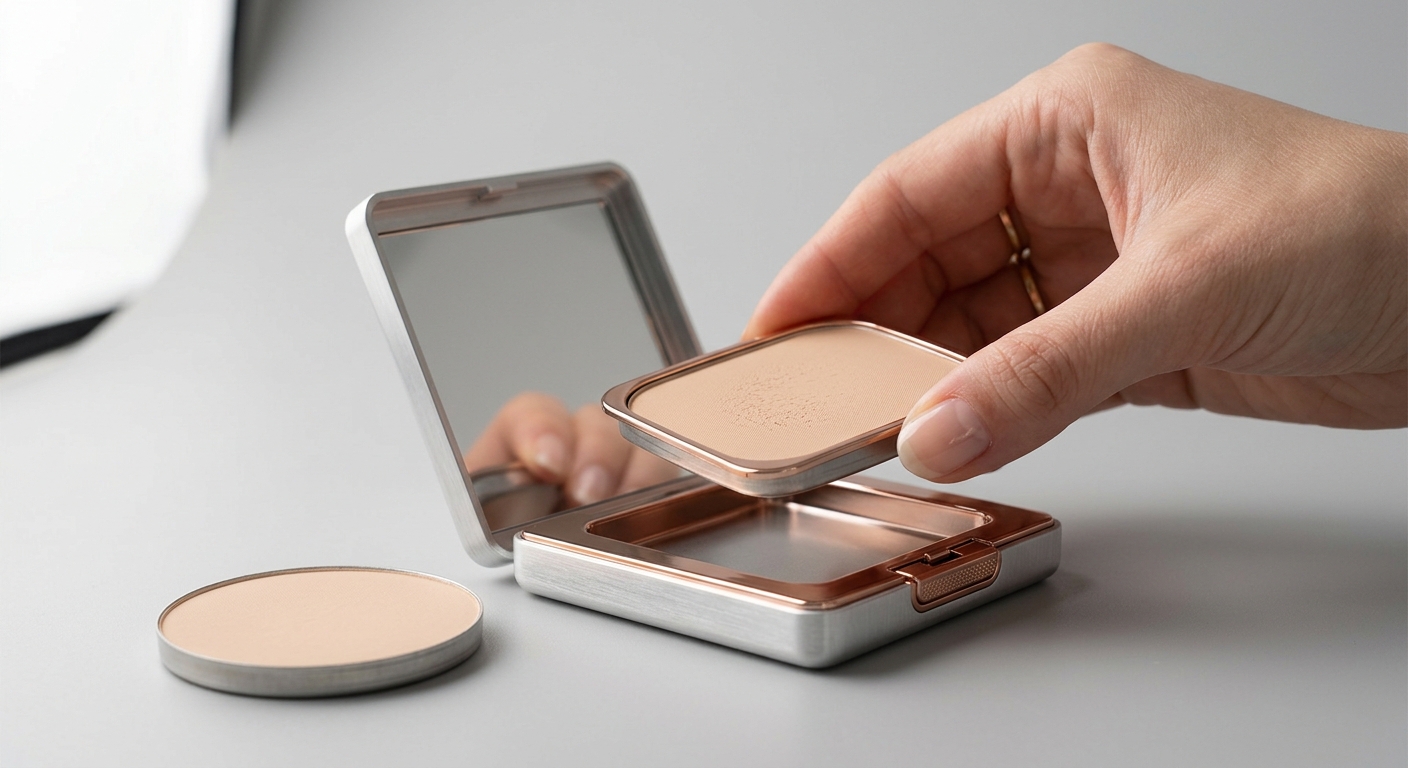
A genuinely refillable compact case is not simply a reusable shell — it is an engineered system built around three interdependent structural elements.
Magnetic closure mechanisms are the most commercially prevalent locking system, offering tool-free pan replacement with consistent retention force (typically 0.3–0.8 N·m). High-grade neodymium magnets embedded in the hinge or rim allow users to swap inner pans in seconds while maintaining a premium tactile experience. Snap-fit mechanical closures offer a cost-effective alternative but require tighter manufacturing tolerances to prevent pan loosening during transit.
Modular inner pan design is the defining feature that separates true refill systems from standard compacts. Inner pans are manufactured to standardized dimensional tolerances — commonly 52mm, 57mm, or 63mm diameters — allowing cross-collection compatibility. The pan-to-shell interface must maintain a gap tolerance of ±0.2mm to prevent powder migration while still enabling smooth extraction.
Shell material selection determines both aesthetic longevity and environmental credentials. Aluminum alloy shells offer superior durability (rated for 500+ refill cycles in stress testing), while bio-based polypropylene (bio-PP) and post-consumer recycled (PCR) plastics provide lighter-weight alternatives with lower embodied carbon. Zinc alloy die-cast options deliver premium weight and finish but carry higher unit costs and recycling complexity.
1.2 Material Specifications & Durability Benchmarks
Shell durability is measured not just by material hardness but by surface treatment resilience. UV-cured coatings provide scratch resistance rated at 3H–5H pencil hardness, maintaining cosmetic appearance through repeated handling. Electroplated finishes (gold, rose gold, gunmetal) add visual premium but require periodic quality auditing to ensure coating adhesion integrity beyond 200 refill cycles.
Inner pan compatibility standards are equally critical. Brands sourcing pressed powders, bronzers, or pigments from third-party formulators must confirm that pan geometry aligns with their compact shell’s receiver dimensions. A dimensional mismatch of even 0.5mm can compromise both product security and the user’s refill experience.
Compact Case Comparison: Key Parameters for B2B Buyers
Parameter Disposable Compact Standard Refillable Premium Refillable Shell Material Virgin plastic PCR plastic / bio-PP Aluminum / zinc alloy Average Lifespan (cycles) 1 50–100 300–500+ Pan Replacement Compatibility Keine Limited (brand-specific) Standardized (multi-SKU) MOQ (Einheiten) 3,000–5,000 2,000–5,000 1,000–3,000 Unit Cost Range (USD) $0,80–$2,50 $2.00–$5.00 $5.00–$15.00+ Eco-Certification Eligible Rarely PCR content / FSC PCR, FSC, ISO 14001
2. Cost Implications & Supply Chain Considerations for B2B Buyers
2.1 Total Cost of Ownership: Unit Economics Across Product Lifecycle
The initial unit cost of a refillable compact case is higher than its disposable counterpart — often 2–4× at equivalent MOQ. However, total cost of ownership (TCO) analysis across a 24-month product lifecycle consistently favors the refillable model for brands with established replenishment programs.
Consider a mid-tier brand launching a pressed powder line: a disposable compact at $1.80/unit requires full packaging repurchase with every product sale. A refillable compact at $4.50/unit, paired with a refill pan at $0.60/unit, reduces per-replenishment packaging cost by approximately 65%. Across 50,000 annual refill transactions, this generates $60,000 in packaging material savings before accounting for reduced shipping weight and warehousing volume.
Tooling amortization is a critical variable. Custom mold development for a proprietary refillable shell typically costs $8,000–$25,000 depending on complexity. Brands should model tooling cost against a minimum 18-month sales horizon and negotiate tooling ownership clauses with suppliers to protect long-term IP and manufacturing flexibility.
Packaging waste reduction also carries indirect financial value: brands with documented sustainability metrics increasingly access preferential terms from ESG-aligned retail partners and can reduce compliance reporting costs under extended producer responsibility (EPR) frameworks.
2.2 Supplier Qualification & MOQ Strategy for Refillable Packaging
Qualifying a supplier for refillable compact cases requires a more rigorous technical audit than standard packaging procurement. Key certification benchmarks include ISO 9001 (quality management), ISO 14001 (environmental management), and GMPC (Good Manufacturing Practice for Cosmetics) — the latter being a prerequisite for supplying to major beauty retailers in the EU and North America.
MOQ flexibility is a negotiation lever often underutilized by emerging brands. Suppliers offering tiered MOQ structures (e.g., 500 units for shell prototyping, 2,000 units for production runs) enable brands to validate market demand before committing to large inventory positions. Request separate MOQs for shells and inner pans, as pan replenishment cycles are typically 3–5× higher volume than shell reorders.
Lead time for custom refillable compacts ranges from 45–90 days for tooling and first production, with subsequent refill pan orders fulfillable in 20–35 days. Building a 60-day safety stock for inner pans is advisable given the demand volatility typical in beauty retail.
3. Regulatory Compliance & Eco-Certification Landscape
3.1 Key Global Standards for Sustainable Makeup Packaging
The regulatory environment for sustainable beauty packaging is tightening rapidly across all major markets. B2B buyers must navigate a layered compliance landscape:
- EU Packaging and Packaging Waste Regulation (PPWR) 2025: Mandates minimum PCR content thresholds for plastic packaging (30% by 2030) and introduces recyclability requirements that directly affect compact case design. Brands selling into the EU must ensure their packaging passes recyclability assessment under EN 13430.
- FSC Certification: Applies to paper-based components (outer cartons, inserts). Increasingly required by Sephora, Ulta Beauty, and major EU pharmacy chains as a shelf-listing condition.
- PCR Content Verification: Third-party mass balance certification (e.g., via ISCC PLUS or similar) is required to substantiate PCR claims on packaging and in marketing communications.
- California SB 54: Mandates that all plastic packaging sold in California be recyclable or compostable by 2032, with interim milestones beginning 2025.
3.2 How Certifications Impact Retail Buyer & Consumer Trust
Certifications function as commercial access credentials in the current beauty retail landscape. Sephora’s Clean at Sephora and Ulta’s Conscious Beauty programs both include packaging sustainability criteria that certified refillable compacts are better positioned to satisfy. Meeting these criteria can reduce retail buyer negotiation friction and accelerate shelf placement timelines by 2–4 months.
From an ESG reporting perspective, brands that can document packaging material reduction through refillable systems gain quantifiable metrics for Scope 3 emissions reporting under GHG Protocol standards — increasingly relevant for publicly traded brands and their retail partners. Third-party certification also reduces greenwashing litigation risk, which has resulted in FTC enforcement actions against several beauty brands in recent years.
4. Market Applications & Commercial Value for Beauty Brands
4.1 Target Consumer Segments & Retail Channel Fit
The primary consumer segment driving refillable compact adoption is the eco-conscious millennial and Gen Z beauty buyer — a demographic that represents 42% of prestige beauty spending in the US (NPD Group, 2023) and actively researches brand sustainability credentials before purchase. This segment responds to tangible refill mechanics over abstract sustainability claims.
Channel strategy matters significantly. DTC brands benefit most from refillable systems because they control the full replenishment journey — subscription refill programs, loyalty point incentives for returning empty compacts, and direct communication of the environmental impact story. Traditional retail channels require a simpler refill UX (ideally single-SKU pan replacement) and clear on-shelf communication to drive adoption without sales associate education.
Travel retail and specialty beauty boutiques represent an emerging channel where premium refillable compacts command meaningful price premiums, with consumers demonstrating higher willingness to pay for perceived luxury sustainability.
4.2 Brand Differentiation Through Eco-Friendly Beauty Products
Refillable compact cases function as a brand narrative asset that extends well beyond packaging functionality. Brands that architect their product line around a refillable platform — a signature shell design paired with a growing library of interchangeable pans — create a closed-loop loyalty ecosystem. Each refill purchase reinforces brand attachment and reduces customer acquisition cost compared to single-use formats.
Social media amplification is a measurable commercial benefit: the “refill reveal” moment — opening a premium compact shell and clicking in a new pan — generates organic UGC content with high engagement rates across Instagram and TikTok. Brands like Kjaer Weis and Ilia Beauty have demonstrated that refillable packaging can anchor a content strategy that drives both awareness and conversion without incremental media spend.
FAQ
Q1: What is the minimum order quantity (MOQ) for custom refillable compact cases, and how does it affect unit pricing?
MOQs for custom refillable compact cases typically start at 1,000–2,000 units for premium metal shells and 3,000–5,000 units for PCR plastic variants. Unit pricing decreases 15–30% between the minimum and 10,000-unit tiers. Negotiating separate MOQs for shells and refill pans is advisable to optimize inventory investment and cash flow.
Q2: How do I ensure my refillable makeup compact meets EU and US sustainability packaging regulations?
Engage suppliers who provide material composition documentation and third-party PCR content verification. For EU compliance, confirm EN 13430 recyclability assessment. For the US market, verify California SB 54 alignment and ensure any sustainability claims are substantiated to FTC Green Guides standards. Requesting ISO 14001-certified suppliers simplifies documentation for ESG reporting.
Q3: Are refillable compact cases compatible with existing powder/pressed pigment formulations from third-party manufacturers?
Compatibility depends on pan geometry standardization. Request dimensional specifications (diameter, depth, rim profile) from your compact supplier and cross-reference with your formulator’s pan specifications before finalizing tooling. Most established refillable compact suppliers offer standard pan sizes (52mm, 57mm, 63mm) that align with common third-party filling equipment.
Schlussfolgerung
Refillable compact cases represent a convergence of regulatory necessity, consumer demand, and long-term commercial logic for beauty brands and their packaging suppliers. The technical infrastructure — modular pan systems, durable shell materials, and standardized dimensional tolerances — is mature enough to support scalable B2B adoption. The TCO advantage becomes compelling within 18–24 months for brands with active replenishment programs, and the certification landscape, while complex, provides a structured pathway to premium retail access and ESG compliance.
For procurement teams evaluating sustainable makeup packaging, the strategic imperative is clear: assess refillable compact cases not as a premium add-on, but as a foundational packaging architecture decision that will define brand positioning, supply chain efficiency, and regulatory readiness through 2030 and beyond.