



Abstract
For B2B buyers sourcing custom eyeshadow boxes, overlooking technical specifications before placing an order leads to costly redesigns, shipment delays, and failed compliance audits. A single misaligned pan cavity or an undertested closure mechanism can trigger a full production recall—expenses that dwarf the cost of thorough pre-order verification.
This guide systematically covers the six critical checkpoints—dimensions, pan compatibility, closure design, decoration methods, sample approval, and MOQ—that procurement managers and brand developers must verify before committing to a packaging supplier. Whether you are launching a new cosmetics line or scaling an existing SKU, these checkpoints serve as a structured procurement framework, reducing rework risk and protecting brand integrity across retail and e-commerce channels. Each section provides actionable criteria, industry benchmarks, and decision-support data to help buyers communicate requirements clearly with manufacturers and avoid the most common sourcing pitfalls in eyeshadow packaging projects.
1. Structural Specifications: Dimensions & Pan Compatibility
1.1 Box Dimensions and Tolerance Standards
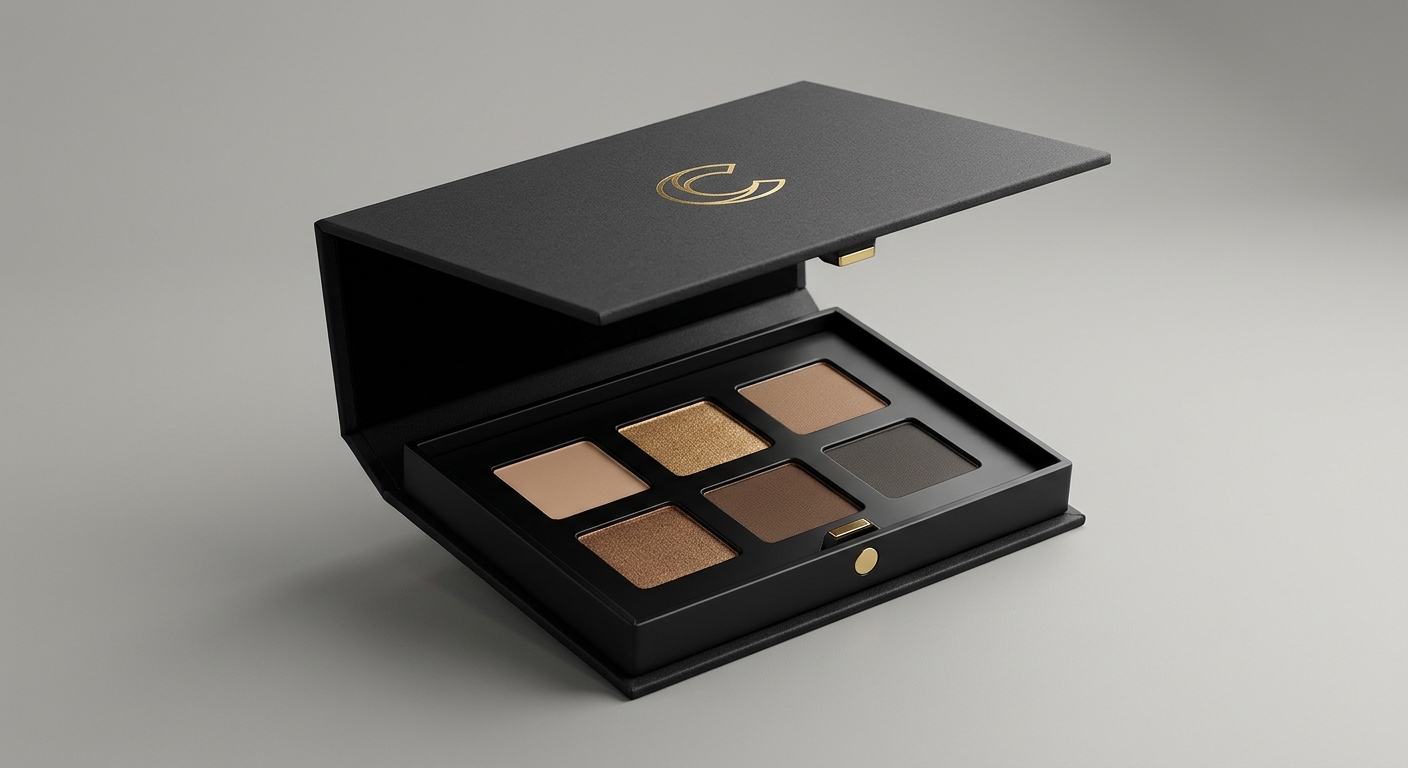
Dimensional accuracy is the foundation of any functional eyeshadow box. Interior cavity depth, footprint length and width, and wall thickness must all be specified in writing before tooling begins. The industry-accepted dimensional tolerance for injection-molded or die-cut paperboard eyeshadow boxes is ±0.2 mm on critical interior dimensions. Exceeding this tolerance—even by fractions of a millimeter—can cause pans to rattle during transit, crack under pressure, or fail to seat flush with the tray surface, undermining the unboxing experience and product protection.
Buyers should request a dimensional drawing (2D engineering file preferred) from the supplier, clearly annotating:
- Interior cavity depth: Must accommodate pan height plus a 0.3–0.5 mm clearance buffer.
- Footprint dimensions (L × W): Measured at the innermost wall surface, not the exterior shell.
- Wall thickness: Typically 1.2–2.0 mm for greyboard-laminated constructions; thicker walls improve structural rigidity but add weight and cost.
- Lid-to-base alignment gap: Should not exceed 0.3 mm on a closed box to prevent dust ingress.
Procurement teams should also confirm whether the supplier’s tolerance standard applies to the finished box or the die-cut blank, as post-lamination and folding can introduce additional variance of up to ±0.5 mm.
1.2 Pan Compatibility and Insert Configuration
Pan compatibility determines whether the eyeshadow box functions as intended at point of use. Buyers must specify pan geometry—round, square, or rectangular—along with exact pan diameter or edge length, and confirm that the insert tray is designed to match.
| Pan Size (mm) | Cavity Depth (mm) | Max Pan Count | Insert Material | Compatibility Rating |
|---|---|---|---|---|
| 26 mm round | 5.0–6.5 | 1–4 | EVA foam / ABS tray | ★★★★★ |
| 36 mm round | 6.0–7.5 | 1–2 | Flocked cardboard | ★★★★☆ |
| 26 × 26 sq. | 5.5–7.0 | 4–9 | Magnetic ABS tray | ★★★★★ |
| 52 × 26 rect. | 6.0–7.5 | 2–6 | Thermoformed PET | ★★★☆☆ |
| Custom die-cut | Variable | Variable | Bespoke EVA/foam | ★★★★☆ |
Magnetic pan retention is increasingly standard in professional-grade eyeshadow boxes. Neodymium magnets embedded in the tray base hold steel-backed pans securely without adhesive, allowing end users to swap or refill pans—a key feature for refillable packaging programs. Buyers should confirm magnet pull strength (typically 0.3–0.8 N per pan position) and verify that the magnetic field does not interfere with adjacent product labeling or retail security tags.
For multi-pan configurations, insert material selection directly affects cost and perceived quality. ABS plastic trays offer the highest dimensional consistency; EVA foam inserts provide better shock absorption at lower cost; flocked cardboard delivers a premium tactile finish but requires additional lead time for flocking application.
2. Closure Design and Structural Integrity
2.1 Closure Mechanism Types and Durability Ratings
The closure mechanism is the most mechanically stressed component of any eyeshadow box. Three primary mechanisms are used in commercial cosmetics packaging:
- Magnetic snap closure: Two opposing neodymium magnets embedded in lid and base edges. Opens and closes with a satisfying tactile response. Rated for 5,000–10,000 open/close cycles under standard fatigue testing. Preferred for mid-to-premium retail positioning.
- Friction-fit (press-fit) closure: Relies on dimensional interference between lid walls and base. Lower tooling cost but cycle durability is limited to approximately 2,000–3,000 cycles before noticeable loosening. Suitable for single-use or gift-set formats.
- Hinged latch closure: A mechanical latch—either metal or ABS—locks the lid in the closed position. Highest durability rating, often exceeding 15,000 cycles, but adds component cost and assembly complexity.
Buyers should request the supplier’s fatigue test report, specifying the test method (e.g., automated open/close cycling at a defined force) and the sample size tested. A credible supplier will provide data from a minimum of five samples per SKU.
2.2 Hinge and Seal Performance Under Transit Conditions
Transit performance is equally critical. Eyeshadow boxes shipped in bulk cartons must withstand compression, vibration, and drop events without the lid opening unintentionally or the hinge cracking.
Key benchmarks buyers should request:
- Drop-test compliance: ISTA 2A protocol (or equivalent) for packages up to 68 kg. Boxes should survive a minimum 60 cm free-fall drop on all six faces without lid separation or pan displacement.
- Hinge torque specification: For hinged designs, the opening torque should fall within 0.15–0.40 N·m to ensure the lid stays open during use without snapping shut unexpectedly.
- Compression resistance: Stacked carton compression of at least 200 N without permanent deformation of the box exterior.
If the supplier cannot provide documented test data for these parameters, buyers should factor in the cost of independent third-party testing before approving the design for mass production.
3. Decoration Methods and Surface Finish Options
3.1 Printable Surface Treatments and MOQ Impact
Decoration choices directly affect both brand perception and production economics. The three most commercially relevant processes for eyeshadow boxes are:
- Hot stamping (foil stamping): Applies metallic or holographic foil via heated die. Delivers premium shelf appeal. Requires a dedicated stamping die (tooling cost: $80–$250 per design). Minimum run: typically 1,000–3,000 units per SKU.
- UV spot coating: Applies a high-gloss or matte UV-cured varnish to selected design areas, creating tactile contrast. No tooling die required beyond the printing plate. Minimum run: 500–1,000 units.
- Silk-screen printing: Direct ink application onto the box surface. Best for bold, single-color brand marks. Highly durable; resists abrasion better than offset-printed surfaces. Minimum run: 500 units for standard colors.
Buyers combining multiple decoration processes on a single SKU should anticipate additive MOQ requirements and longer lead times. A box featuring both hot stamping and UV spot coating may require sequential production runs, adding 5–10 business days to the standard timeline.
3.2 Material Substrate and Regulatory Compliance
The structural substrate determines both the decoration outcome and the regulatory compliance profile of the finished box. Two primary substrates dominate the market:
- SBS (Solid Bleached Sulfate) paperboard: Bright white surface ideal for high-fidelity CMYK printing and UV coating. Caliper range: 350–600 gsm. FDA-recognized for food-contact adjacency; suitable for cosmetic packaging.
- Greyboard with laminated paper: Rigid, high-density core (1,200–2,000 gsm equivalent) laminated with coated art paper. Standard for premium rigid eyeshadow boxes. Provides superior structural stability for magnetic closures.
For regulatory compliance, buyers sourcing for EU or US markets must confirm:
- REACH compliance: No restricted substances (SVHCs) in substrate adhesives, foils, or coatings.
- RoHS alignment: Relevant if the box incorporates any electronic components (e.g., LED mirror inserts).
- Cosmetic-contact safety: Inner surfaces in direct contact with pans must be free of heavy metals and comply with applicable cosmetic packaging directives.
Request a Material Safety Data Sheet (MSDS) and supplier declaration of conformity before approving the substrate specification.
4. Procurement Process: Sample Approval and MOQ
4.1 Sample Approval Workflow and Lead Time Benchmarks
A structured sample approval workflow prevents the most expensive procurement error in custom packaging: approving a production run based on an unrepresentative prototype. The standard pre-production sample (PPS) process for eyeshadow boxes involves three stages:
- White mock-up (structural sample): Unprinted box in final dimensions and substrate. Purpose: verify fit, closure function, and pan compatibility. Lead time: 5–7 business days.
- Printed pre-production sample: Full decoration applied to production-grade substrate. Purpose: verify color accuracy (Delta E ≤ 2.0 against brand standard), foil registration, and surface finish. Lead time: 10–14 business days from artwork approval.
- Bulk production sample (BPS): Three to five units pulled from the first production run. Purpose: final sign-off before full shipment release. Lead time: concurrent with production.
Buyers should budget for two revision rounds between the white mock-up and printed PPS stages. Revisions beyond two rounds typically incur additional sampling fees ($50–$150 per round) and extend the timeline by 5–7 days per cycle. Document all revision instructions in writing, referencing specific dimensions, Pantone codes, or finish specifications to minimize ambiguity.
4.2 Minimum Order Quantities and Scalability Planning
MOQ thresholds vary significantly by decoration complexity and box construction type:
| Box Type | Decoration Level | Typical MOQ | Price Break Volume |
|---|---|---|---|
| Standard folding carton | Single-color print | 500 units | 2,000 units |
| Rigid greyboard box | CMYK + UV coating | 1,000 units | 3,000 units |
| Rigid box + hot stamp | Multi-process | 2,000 units | 5,000 units |
| Fully custom + magnet | Premium | 3,000 units | 10,000 units |
Buyers launching new SKUs should negotiate a development MOQ (typically 50% of the standard MOQ) for the initial order, with a contractual commitment to a follow-on production order within 6–12 months. This structure gives brands market-testing flexibility while protecting the supplier’s tooling investment. Confirm reorder lead times in the contract—reputable suppliers should commit to 15–20 business day turnaround for repeat orders using existing tooling and approved artwork.
FAQ
Q1: What is the standard tolerance for eyeshadow box interior dimensions, and how does it affect pan fit?
The industry-accepted tolerance is ±0.2 mm on critical interior dimensions for production-grade eyeshadow boxes. A tolerance exceeding ±0.5 mm risks pan rattle, uneven seating, and visible gaps between the pan and tray wall. Always request the supplier’s dimensional drawing and specify which surfaces the tolerance applies to—interior cavity walls, not the exterior shell.
Q2: Which closure mechanism offers the best balance between cost and durability for retail eyeshadow packaging?
Magnetic snap closures deliver the optimal cost-durability balance for most retail applications. Rated at 5,000–10,000 open/close cycles, they outperform friction-fit closures in longevity while remaining significantly less expensive than mechanical hinged latches. For premium or refillable product lines, the higher cycle rating justifies the modest cost premium over friction-fit designs.
Q3: How many sample revision rounds should buyers budget for before approving a custom eyeshadow box?
Budget for two revision rounds between the structural white mock-up and the printed pre-production sample. Revisions beyond two rounds typically incur additional fees and extend timelines. To minimize revision cycles, provide suppliers with complete technical briefs at project initiation—including dimensional drawings, Pantone color references, finish specifications, and pan compatibility requirements—before the first sample is produced.
Conclusion
Verifying these six checkpoints before order placement—dimensions and tolerances, pan compatibility and insert configuration, closure mechanism durability, decoration methods and substrate compliance, sample approval workflow, and MOQ structure—reduces rework risk, aligns packaging performance with product requirements, and protects brand integrity across retail and e-commerce channels.
The cost of thorough pre-order verification is measured in hours and modest sampling fees. The cost of skipping it is measured in rejected shipments, production delays, and brand credibility damage. Procurement managers who treat these checkpoints as non-negotiable requirements—not optional best practices—consistently achieve faster time-to-market, lower defect rates, and stronger supplier relationships on every eyeshadow packaging project.