


Abstract
Mechanism jamming is one of the most damaging quality failures in custom lipstick tubes. When a twist mechanism sticks, binds, or fails to retract cleanly, the consequences extend far beyond a single defective unit — they erode consumer trust, trigger product returns, and force costly remediation at the supply chain level.
For B2B buyers commissioning custom lipstick packaging, understanding why mechanisms fail is the prerequisite for specifying components that won’t. The root causes range from thread geometry errors and tolerance mismatches to material deformation under thermal stress. Each failure mode is preventable when engineering standards are correctly defined at the sourcing stage.
This article examines the mechanical and material factors behind lipstick tube sticking and twist mechanism failure, details the precision specifications that eliminate these risks, and provides procurement-ready guidance for brands, private-label manufacturers, and packaging engineers sourcing high-performance custom lipstick tubes.
Root Causes of Lipstick Tube Mechanism Jamming
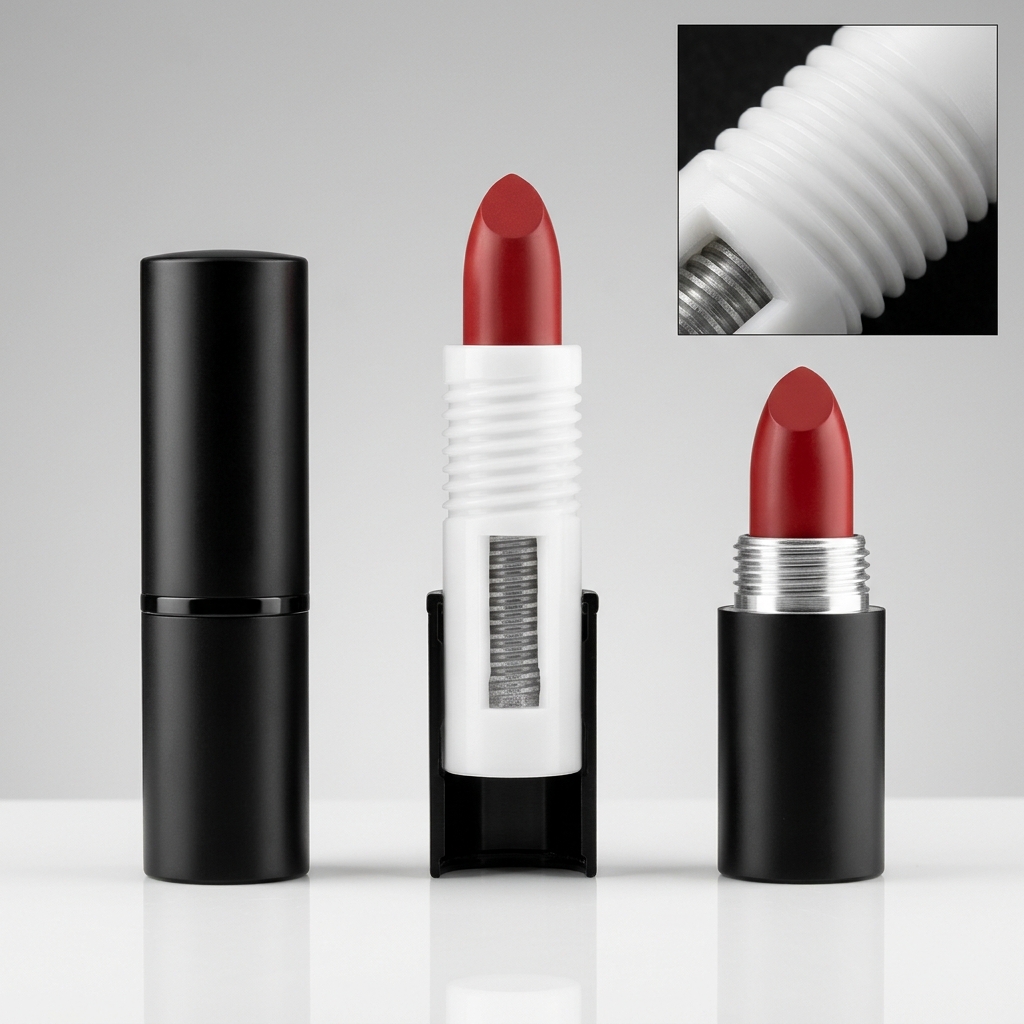
Mechanical Design Flaws in the Twist Mechanism
The helical lift mechanism inside a lipstick tube operates on a tightly coordinated relationship between the threaded inner cup, the rotating base, and the outer barrel. When any element in this system deviates from its design specification, jamming becomes inevitable.
The most common mechanical failure point is tolerance misfit in the screw thread interface. If the clearance between the male and female thread profiles is too tight — typically when dimensional deviation exceeds ±0.10 mm — friction increases exponentially with each rotation cycle. Users experience this as a progressively stiffer twist that eventually locks entirely. Conversely, excessive clearance creates lateral play, causing the bullet to wobble and shear under lateral load.
Thread lead angle is equally critical. An angle that is too shallow increases the mechanical advantage required to lift the bullet, raising operating torque beyond acceptable ergonomic limits. An angle that is too steep reduces self-locking capability, causing the lipstick to drift downward under its own weight during use. Industry best practice positions the lead angle between 8° and 14° for standard 12.1 mm diameter tubes.
Thread tooth profile defects — such as asymmetric flanks caused by worn injection molds — create uneven load distribution across the engagement surface. Over repeated use cycles, this accelerates wear at stress concentration points and is a primary cause of the lipstick twist mechanism not working after 60–90 days of consumer use.
Material Incompatibility and Thermal Deformation
Even a mechanically sound design will jam if the materials selected for the inner cup and outer barrel have mismatched coefficients of thermal expansion (CTE). When a lipstick tube is exposed to temperature swings — from a cold retail stockroom to a warm handbag — components expand and contract at different rates. If the inner cup material expands faster than the barrel, the thread interface tightens, producing the classic “stuck after summer storage” complaint.
Standard ABS resin, widely used in budget-tier lipstick tubes, has a CTE of approximately 70–90 × 10⁻⁶/°C and exhibits measurable dimensional creep above 60°C. In markets with high ambient temperatures or where products sit in vehicles, this translates directly to field jamming rates. Low-grade PP compounds compound this problem with poor dimensional stability under sustained mechanical load, causing thread deformation that is irreversible after the first thermal cycle.
Material selection must therefore treat the inner cup and barrel as a matched pair, not independent components.
Precision Engineering Standards That Prevent Jamming
Inner Cup Tolerance and Thread Geometry Specifications
Preventing lipstick tube sticking begins with defining non-negotiable dimensional tolerances in the product specification sheet. Three parameters govern anti-jamming performance:
- Thread tolerance grade: The mating thread pair should be manufactured to IT6/IT7 tolerance grades (ISO 286), with a diametral clearance of ±0.05 mm at the nominal engagement diameter. This provides consistent rotational feel across production batches.
- Thread lead angle: Specify 10°–12° for standard-weight bullets (3.5–4.5 g). For heavier formulations (5 g+), reduce to 8°–10° to maintain adequate self-locking.
- Inner cup wall thickness uniformity: Wall thickness variation must not exceed 0.15 mm across any cross-section. Non-uniform walls create oval deformation under injection molding cooling stress, which directly causes asymmetric thread engagement.
These specifications should appear explicitly in the supplier’s engineering drawing, not as verbal agreements.
Surface Finish and Lubrication Treatment Requirements
Thread geometry defines the structural envelope; surface finish determines the friction behavior within it. The inner cup bore and thread flanks should achieve a surface roughness of Ra ≤ 0.8 μm. Values above Ra 1.6 μm introduce micro-interlocking between thread surfaces that manifests as a gritty, resistant feel — the early symptom of impending jamming.
For premium custom lipstick tubes, two lubrication strategies are commercially viable:
- Food-grade silicone coating applied to thread surfaces post-molding reduces dynamic friction coefficient from ~0.35 (uncoated ABS) to ~0.12, extending smooth operation life beyond 1,000 rotation cycles.
- Self-lubricating base materials (POM or glass-fiber-reinforced PP) eliminate the need for post-process coating and maintain consistent friction characteristics across the product’s service life.
| Parameter | Recommended Specification | Rejection Threshold | Test Method |
|---|---|---|---|
| Thread Tolerance Grade | IT6/IT7 (±0.05 mm) | >±0.10 mm deviation | CMM dimensional inspection |
| Inner Cup Material | Medical-grade PP or POM | Standard ABS (unmodified) | Material certification review |
| Surface Roughness (Ra) | ≤ 0.8 μm | >1.6 μm | Profilometer measurement |
| Rotation Torque Range | 80–180 gf·cm | <60 or >220 gf·cm | Digital torque gauge, 10-cycle avg. |
| Thermal Stability Range | -10°C to +55°C (no jamming) | Failure at <45°C upper limit | Thermal cycling chamber test |
Material Selection and Quality Control for Custom Lipstick Tubes
Recommended Material Grades for High-Performance Mechanisms
The inner cup is the highest-stress component in any lipstick tube mechanism. Material selection here determines long-term reliability more than any other single decision.
POM (Polyoxymethylene / Acetal) is the benchmark material for precision lipstick mechanisms. Its inherent self-lubrication, dimensional stability (CTE: 110 × 10⁻⁶/°C — consistent and predictable), and wear resistance make it the preferred choice for luxury and professional-grade custom lipstick tubes. POM inner cups maintain thread geometry integrity through 500+ rotation cycles without measurable wear.
Medical-grade PP (Polypropylene homopolymer) offers a cost-effective alternative with superior chemical resistance to lipstick formulations containing castor oil, waxes, and pigments. Its CTE is higher than POM but remains manageable when the barrel is specified in compatible material grades.
Standard ABS should be avoided for inner cup components. While cost-attractive, its poor fatigue resistance, moisture absorption, and thermal instability make it a structural liability in any market where temperature control across the supply chain is imperfect.
In-Line QC Protocols and Acceptance Testing Standards
Specifying materials and tolerances is necessary but insufficient without structured acceptance testing. Buyers should mandate the following protocols in purchase agreements:
- Torque cycle test: 500 full extension/retraction cycles at ambient temperature. Torque must remain within the 80–180 gf·cm window throughout. Any binding event constitutes rejection.
- Drop test: 10 drops from 1.0 m onto a hard surface with bullet fully extended. Zero mechanism failures permitted.
- Thermal cycling test: 5 cycles between -10°C and +55°C (1-hour dwell at each extreme). Full mechanism operation must be confirmed after each cycle.
- AQL sampling level: Recommend AQL 1.0 for mechanism-related defects, inspected per ANSI/ASQ Z1.4.
Application Scenarios and Commercial Implications for B2B Buyers
High-Risk SKU Categories Prone to Mechanism Failure
Not all lipstick tube formats carry equal jamming risk. Three SKU categories warrant elevated engineering scrutiny:
- Ultra-slim tubes (≤9 mm diameter): The reduced thread engagement length and thinner wall sections amplify the impact of any dimensional deviation. Tolerance specifications should be tightened by 20–30% relative to standard 12.1 mm formats.
- Magnetic-closure styles: The additional axial force introduced by magnet attraction alters the load profile on the thread interface, requiring validation testing under combined magnetic + rotational load.
- Large-volume bullet formats (5 g+): Increased bullet mass raises the self-locking requirement. Mechanisms designed for 3.5 g bullets will exhibit downward drift under heavier formulations unless the lead angle is recalculated.
Brand and Supply Chain Cost Impact of Jamming Defects
The commercial cost of mechanism jamming extends well beyond the unit cost of defective tubes. A 2% field failure rate on a 500,000-unit production run generates approximately 10,000 consumer complaints. At an average handling cost of $8–15 per complaint (customer service, replacement, logistics), the direct cost reaches $80,000–$150,000 — before accounting for brand sentiment damage on social platforms where lipstick reviews are highly visible.
Re-tooling injection molds to correct a thread geometry error typically costs $3,000–$8,000 per cavity and introduces a 4–6 week delay. For seasonal collections with fixed launch windows, this delay alone can eliminate the commercial viability of an entire SKU. Defining correct specifications at the RFQ stage is categorically less expensive than correcting them post-tooling.
FAQ
Q1: What twist mechanism torque range should I specify when ordering custom lipstick tubes to avoid sticking?
Specify a target torque range of 80–180 gf·cm for standard 12.1 mm tubes with 3.5–4.5 g bullets. Below 60 gf·cm, the mechanism lacks sufficient resistance and the bullet will drift; above 220 gf·cm, consumers perceive the tube as defective. Request torque certification data averaged across 10 rotation cycles from your supplier.
Q2: How do I test whether a lipstick tube supplier’s inner cup tolerance meets anti-jamming requirements before mass production?
Request T0 samples (first-tool samples) and submit them to a third-party metrology lab for CMM (Coordinate Measuring Machine) inspection of thread diameter, pitch, and lead angle. Simultaneously conduct a 500-cycle torque test in-house using a digital torque gauge. Do not approve tooling for mass production without both datasets in hand.
Q3: Can the same lipstick tube mechanism design work across different formula weights (e.g., 3.5 g vs. 5 g bullets)?
Not without validation. A mechanism calibrated for 3.5 g will likely exhibit downward bullet drift with a 5 g formulation due to insufficient self-locking torque. If your product line spans multiple fill weights, specify this range explicitly in the RFQ and require the supplier to validate the mechanism at the maximum intended bullet weight before tooling approval.
Conclusion
Preventing mechanism jamming in custom lipstick tubes is an engineering discipline, not a quality inspection afterthought. The failure modes are well understood — thread tolerance misfit, material CTE incompatibility, inadequate surface finish — and each has a defined, testable solution.
B2B buyers who embed precise specifications (±0.05 mm thread tolerance, Ra ≤ 0.8 μm surface finish, POM or medical-grade PP inner cups) into their supplier briefs, and who mandate structured acceptance testing before mass production approval, consistently achieve defect rates below 0.3% in field performance. Those who treat mechanism design as a supplier default risk defect rates 5–10× higher and the associated brand and financial consequences.
The investment in specification rigor at the sourcing stage is the most cost-effective quality intervention available to packaging buyers. Define it clearly, test it thoroughly, and protect both your product and your brand.