
Abstract
For B2B buyers, cosmetic formulators, and packaging engineers, a lipstick tube is not merely a delivery vessel—it is a precision-engineered component that must maintain dimensional integrity, mechanical function, and formula containment across a global supply chain. Warehouses in Southeast Asia reach 45°C in summer. Retail shelves in Scandinavia drop below freezing during transport. A single cosmetic SKU may traverse six climate zones before reaching a consumer’s hands.
A 60-day temperature cycling test compresses this real-world exposure into a controlled, measurable protocol. It stress-tests every variable simultaneously: tube material behavior, swivel mechanism tolerance, cap seal retention, and lipstick formula stability. The results determine whether a packaging component is commercially viable or a liability waiting to surface in a retailer’s returns data.
This article breaks down what that 60-day protocol actually measures, how different tube materials and structural designs respond to sustained thermal stress, what formula-related failures look like inside the tube, and how to translate all of this into enforceable procurement specifications. Whether you are qualifying a new supplier or auditing an existing one, these benchmarks give you a technical foundation for confident sourcing decisions.
1. The Science Behind Lipstick Tube Temperature Testing
1.1 What a 60-Day Thermal Cycle Protocol Actually Measures
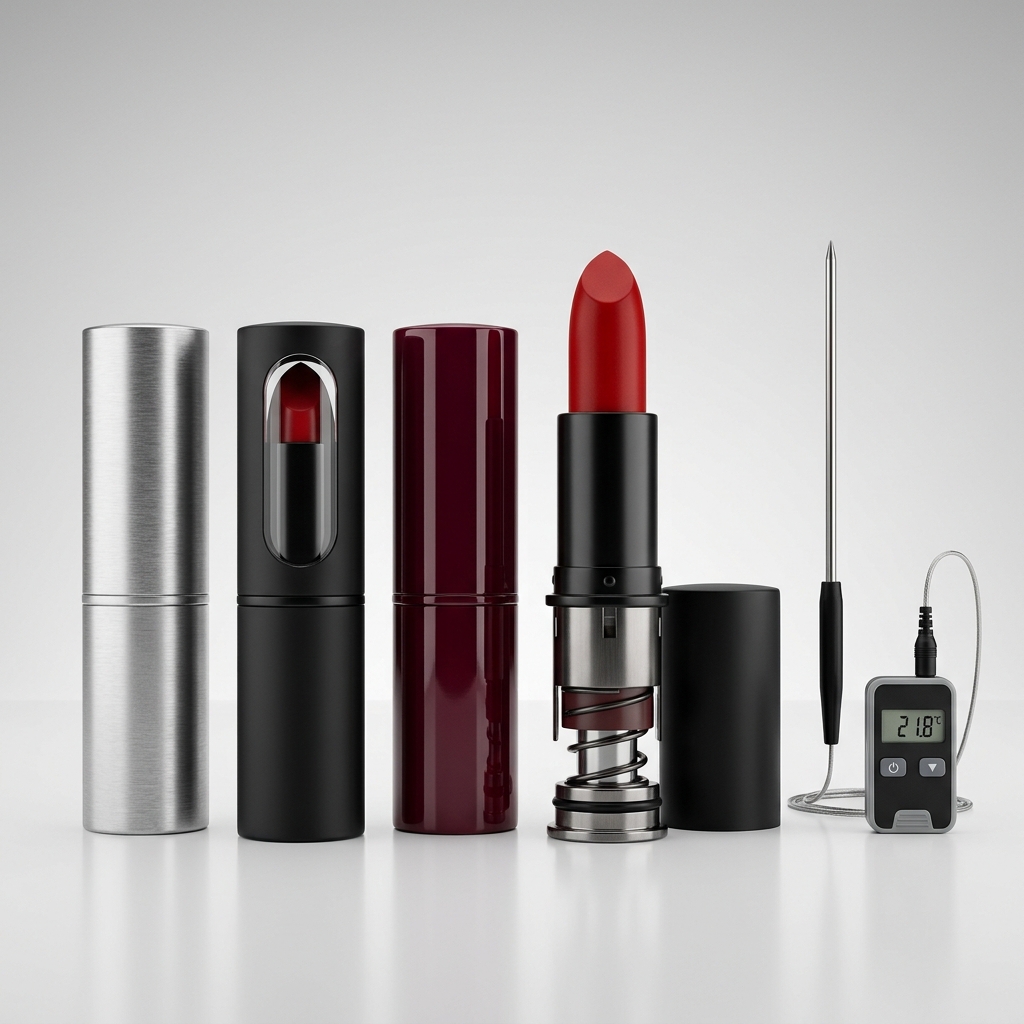
A 60-day thermal cycle test is not a single-temperature soak—it is a structured sequence of alternating thermal conditions designed to simulate cumulative stress. A standard protocol typically alternates between a high-temperature phase (45°C–55°C, 80% relative humidity) and a low-temperature phase (-10°C to -20°C), with each cycle lasting 24–48 hours. The 60-day duration allows for a minimum of 30 complete hot-cold cycles, which correlates with approximately 18 months of real-world distribution exposure in mixed-climate markets.
Key pass/fail metrics include:
- Dimensional stability: Cap fit tolerance must remain within ±0.15 mm post-cycling
- Mechanism torque: Swivel resistance must not deviate more than 20% from baseline
- Surface integrity: No visible cracking, delamination, or finish separation
- Formula retention: No bullet deformation, sweating, or migration visible on interior walls
Relevant reference standards include ASTM D5276 (drop and impact testing under temperature conditioning), ISO 22715 (cosmetic packaging labeling and performance), and individual retailer compliance briefs from major chains such as Sephora and Ulta Beauty, which specify shelf-stable performance up to 40°C for a minimum of 24 months.
1.2 Material Behavior Under Thermal Stress: Plastics, Metals, and Composites
Different tube materials respond to thermal cycling in fundamentally different ways, governed by their thermal expansion coefficients and glass transition temperatures.
- ABS (Acrylonitrile Butadiene Styrene): The most common lipstick tube material. Heat deflection temperature of approximately 80°C–100°C. Susceptible to surface gloss degradation above 55°C with repeated cycling. Low cold-brittleness risk down to -20°C.
- PP (Polypropylene): Higher chemical resistance, slightly lower rigidity. More prone to hinge fatigue in snap-fit designs under cold cycling. Cost-effective for mass-market SKUs.
- Aluminum/Metal Tubes: Near-zero deformation risk under thermal cycling, but susceptible to seam separation if adhesive-bonded construction is used. Preferred for premium and travel-retail formats.
- Biodegradable/PCR Composites: Emerging materials with variable thermal performance. Require supplier-specific test data; generalized benchmarks do not apply.
| Material Type | Heat Resistance (°C) | Cold Resistance (°C) | Deformation Risk | Typical Application | Cost Index |
|---|---|---|---|---|---|
| ABS | Up to 95°C | Down to -20°C | Low–Medium | Mass market, mid-tier | 1.0× |
| PP | Up to 100°C | Down to -15°C | Medium (hinge) | Budget, sustainable lines | 0.85× |
| Aluminum | Up to 150°C+ | Down to -40°C | Very Low | Luxury, travel retail | 2.5× |
| PETG | Up to 70°C | Down to -25°C | Medium–High | Transparent tubes | 1.2× |
| PCR Composite | Up to 75°C | Down to -10°C | High (variable) | Eco-positioned SKUs | 1.3–1.8× |
2. Structural Deformation & Mechanism Failure Analysis
2.1 High-Temperature Deformation: Cap Fit, Swivel Mechanism, and Barrel Integrity
At sustained temperatures between 45°C and 55°C—conditions routinely encountered in shipping containers, retail stockrooms, and vehicle glove compartments—lipstick tubes face three primary structural failure modes.
Cap fit loosening is the most commercially visible failure. As the barrel expands thermally, the cap’s internal diameter tolerance shifts. In poorly specified tubes, a cap that snaps securely at 23°C can become loose enough to detach at 50°C, exposing the formula to air and contamination. Acceptable dimensional drift for cap retention is typically ±0.10–0.15 mm; beyond this, re-engagement force drops below the 5N minimum required for reliable consumer use.
Swivel mechanism torque degradation occurs when the helical drive mechanism—the threaded column that raises and lowers the bullet—experiences differential expansion between the cup component and the outer barrel. If the two components are manufactured from materials with mismatched thermal expansion coefficients, the mechanism can either seize (over-tight) or slip (under-torque) after cycling. Specifying matched-material or co-engineered mechanism assemblies mitigates this risk.
Barrel deformation is less common in ABS and aluminum tubes but becomes a documented risk in PETG transparent tubes, where the lower heat deflection temperature can cause visible ovalization of the barrel cross-section after 15+ cycles above 50°C. This is particularly critical for display-format tubes where visual symmetry is a retail requirement.
2.2 Low-Temperature Brittleness and Snap-Fit Failure in Cold Cycles
Cold-cycle failures are less intuitive but equally damaging. Below -10°C, thermoplastic materials approach their brittle transition zones, where impact resistance drops sharply. For lipstick tubes, this manifests primarily in three areas:
- Snap-fit cap mechanisms: The small flex tabs that create audible cap engagement are the highest-stress geometry in the tube. At -15°C, PP snap-fits show documented failure rates 3–4× higher than at ambient temperature under standardized drop testing.
- Surface finish delamination: Vacuum-metallized or UV-coated finishes develop micro-cracking after repeated cold exposure, particularly if the coating and substrate have mismatched contraction rates. This is a quality-visible defect that triggers retailer returns.
- Seam and insert bonding failure: In multi-component tubes with adhesive-bonded inserts, cold cycling accelerates adhesive embrittlement. Mechanical fastening or ultrasonic welding is strongly preferred for cold-chain distribution channels.
3. Formula Stability Inside the Tube: Melting Point and Migration Risk
3.1 Lipstick Melting Point Standards and Acceptable Softening Ranges
The lipstick bullet itself is a semi-solid emulsion with its own thermal behavior profile, independent of—but critically interactive with—the tube structure. Industry standard formulations are engineered to a melting point range of 55°C–75°C, with a softening point typically 8°C–12°C below the full melt threshold.
For 60-day thermal testing, the relevant criterion is not full melting but bullet deformation under sustained sub-melt temperatures. A formula with a 60°C melt point can still exhibit measurable slump, surface tackiness, or dimensional change at 45°C after 30+ days of exposure. Acceptable bullet deformation is typically defined as less than 0.5 mm height change and no visible surface cratering or edge rounding after the full test duration.
Formula-tube compatibility is a procurement variable that is frequently overlooked. High-castor-oil formulas with lower structural wax content are more susceptible to thermal slump and require tubes with tighter cup-to-bullet clearance to prevent lateral deformation. Buyers specifying private-label or co-manufactured products should require formula-specific thermal test data, not generic material certifications.
3.2 Formula Migration, Sweating, and Oil Separation Under Thermal Cycling
Thermal cycling accelerates phase separation in complex lipstick emulsions. The primary failure modes are:
Oil sweating: Free oils (castor, jojoba, vitamin E) migrate to the bullet surface during high-temperature phases and resolidify as visible droplets or a greasy film during cooling. After multiple cycles, this creates a consumer-visible defect and can compromise pigment adhesion on application.
Pigment migration onto tube walls: Highly mobile pigments—particularly certain red and orange dyes—can migrate from the formula into the interior cup and barrel walls under sustained heat, creating permanent staining that signals formula instability to quality inspectors.
Wax-oil phase separation: The most structurally damaging failure. When wax and oil components separate under repeated thermal stress, the bullet loses structural cohesion, resulting in crumbling on application or visible internal voids. This is a formulation engineering problem but is often first identified during tube-level thermal testing, making the 60-day protocol a useful early-warning system for formula validation.
4. Compliance Standards and Procurement Specifications
4.1 Relevant International Standards and Retailer Requirements
The compliance landscape for lipstick tube thermal performance spans multiple frameworks:
- ISO 22715: Defines cosmetic packaging performance requirements including stability under storage conditions. Requires documented testing at 40°C/75% RH for a minimum of 12 weeks for stability claims.
- ASTM D5276: Drop testing standard used in conjunction with temperature conditioning to validate packaging integrity post-thermal exposure.
- EU Cosmetics Regulation (EC) No 1223/2009: Requires product stability data covering temperature extremes as part of the Product Information File (PIF).
- Retailer-specific requirements: Sephora’s supplier standards specify packaging stability at 40°C for 24 months. Ulta Beauty requires third-party lab verification for new supplier qualification. Amazon’s FBA program has documented heat-exposure requirements for fulfillment center storage.
Regional climate considerations also drive specification: products distributed in the Middle East, Southeast Asia, or Sub-Saharan Africa require higher heat resistance thresholds than those sold exclusively in Northern European markets.
4.2 How to Define Temperature Testing Specs in a Supplier Contract
Translating thermal performance requirements into enforceable procurement language requires specificity at the RFQ stage:
RFQ checklist for thermal performance:
- Specify test protocol: temperature range, cycle duration, total test days, and humidity conditions
- Define pass/fail criteria numerically (dimensional tolerance, torque range, surface defect classification)
- Require third-party lab reports from accredited facilities (SGS, Intertek, Bureau Veritas)
- Set AQL (Acceptable Quality Level) thresholds: typically AQL 1.0 for critical defects (mechanism failure, cap loss), AQL 2.5 for major defects (surface delamination, visible deformation)
- Include formula-loaded test samples, not empty tubes—thermal behavior differs significantly between the two conditions
Contractually, require that test reports be dated within 24 months and reflect the specific material batch and colorway being procured, not a generic platform tube.
FAQ
Q1: What temperature range should lipstick tubes be tested at to simulate real-world logistics and retail environments?
A minimum range of -10°C to 50°C covers the majority of global distribution scenarios. For Middle East, South Asian, or Sub-Saharan African markets, extend the upper limit to 55°C. For cold-chain or Nordic distribution, test down to -20°C. Always test under loaded conditions (formula-filled tubes) to capture formula-tube interaction effects.
Q2: How do I identify whether deformation after heat testing is a tube material issue or a formula compatibility issue?
Run parallel tests: one set of tubes filled with formula, one set empty. If empty tubes pass but filled tubes show deformation, the failure is formula-driven (likely oil migration or low-melt-point wax). If both fail, the tube material or structural design is the primary variable. This diagnostic approach should be written into your supplier qualification protocol.
Q3: What certifications or test reports should I request from a lipstick tube supplier to verify heat resistance claims?
Request ISO 22715 compliance documentation, third-party thermal cycling test reports (SGS or Intertek preferred), material data sheets with heat deflection temperature values, and any retailer-specific compliance letters if the supplier has existing approvals with major chains. Batch-specific reports are more defensible than platform-level certifications.
Conclusion
A 60-day temperature cycling test is the most reliable predictor of lipstick tube performance across real-world supply chain conditions. It surfaces material selection weaknesses, structural design tolerances, and formula compatibility risks before they become retail returns or brand reputation events. For B2B buyers, the key takeaway is integration: tube material, mechanism engineering, and formula melting point must be evaluated as a system, not as independent variables.
Specifying thermal performance requirements at the RFQ stage—with numerical pass/fail criteria, third-party verification mandates, and formula-loaded test protocols—transforms a quality aspiration into an enforceable commercial standard. In a category where consumer trust is built on tactile consistency and visual perfection, thermal resilience is not a premium specification. It is the baseline.