

Аннотация
Packaging decisions for lip balm containers are rarely cosmetic in the superficial sense — they are structural, chemical, and regulatory choices that directly affect product performance and shelf life. A wax-based stick behaves entirely differently from a vitamin E-enriched gloss or a medicated SPF balm, and the container must accommodate each formula’s unique physical properties without compromising stability or user experience.
For cosmetic brands and procurement managers, selecting the wrong lip balm containers creates compounding problems: formula degradation from incompatible materials, leakage from inadequate sealing, and compliance failures from insufficient labeling surface area. Conversely, the right packaging decision reduces production risk, supports brand positioning, and streamlines regulatory approval.
This guide provides a systematic framework for matching lip balm formulas to container types. It covers formula viscosity, material chemistry, closure engineering, and procurement variables — giving B2B buyers the technical foundation to make confident packaging selections across product lines ranging from mass-market sticks to premium retail pots and medicated OTC formats.
How Formula Consistency Determines Container Type
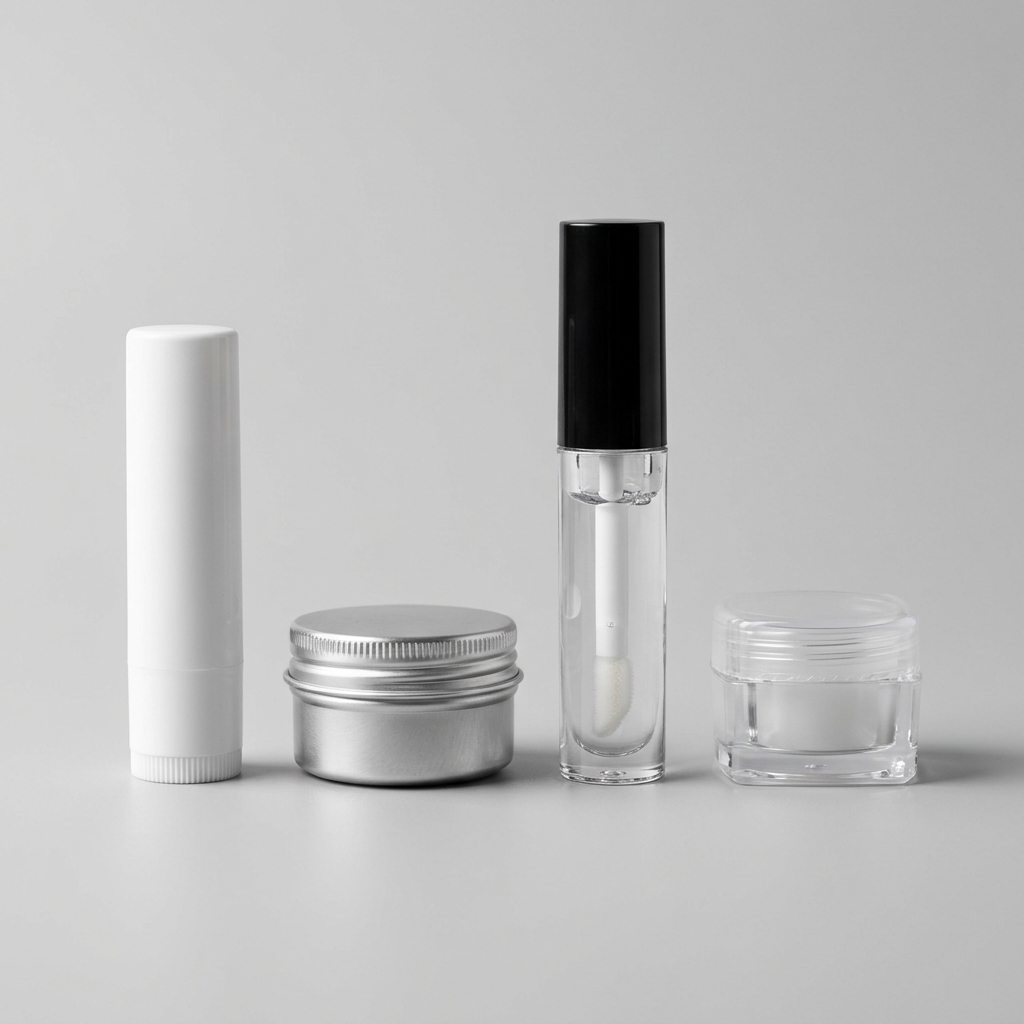
Solid & Semi-Solid Formulas vs. Twist-Up Tubes
Solid and semi-solid lip balms — typically formulated with beeswax, carnauba wax, or synthetic wax blends — have viscosities that allow them to be hot-filled into cylindrical tubes and retain their form at ambient temperatures. The twist-up tube mechanism is the industry-standard container for this category, and for good reason.
Key technical parameters that govern this pairing include:
- Melt point alignment: Most solid lip balm formulas have melt points between 55°C and 70°C. Containers must tolerate fill temperatures up to 75°C without deformation, making PP (polypropylene) and ABS (acrylonitrile butadiene styrene) the preferred substrate materials.
- Structural rigidity: The tube barrel must resist lateral pressure during application without flexing, which requires a minimum wall thickness of 1.0–1.2 mm for standard 4.5 g retail formats.
- Mechanism precision: The twist-up carriage must advance the product column evenly without slippage or cracking at the formula interface — a quality variable that separates commodity tubes from precision-engineered components.
Semi-solid formulas with softer consistencies (e.g., shea butter-dominant balms) may require a slightly wider tube diameter or a reduced fill height to prevent product breakage during transport.
Liquid & Gloss Formulas vs. Pots and Doe-Foot Applicators
Low-viscosity lip products — including glosses, conditioning oils, and tinted balms with high oil content — cannot be contained in twist-up tubes without leakage risk. These formulas require either sealed pots with screw or snap closures, or wand-applicator bottles fitted with doe-foot or brush tips.
Critical considerations for this format pairing include:
- Leak prevention: Liquid formulas demand a positive seal at the closure interface. Screw-cap pots should include an inner PE liner or silicone gasket; wand applicators require a wiper insert calibrated to the formula’s viscosity to prevent over-dispensing.
- Oxidation risk management: Oil-rich formulas containing unsaturated fatty acids (e.g., rosehip, marula) are susceptible to oxidative rancidity. Containers with minimal headspace and UV-blocking pigmentation extend shelf life without requiring formula-level antioxidant loading.
- Dosage control: Doe-foot applicators provide more consistent per-application dosage than open pots, which is commercially relevant for SPF-rated gloss products where under-application affects efficacy claims.
Table 1: Formula Consistency vs. Recommended Container Type
| Formula Type | Viscosity Range | Recommended Container | Fill Method | Min. Wall Thickness |
|---|---|---|---|---|
| Solid wax stick | High (paste) | Twist-up tube | Hot fill (65–75°C) | 1.0–1.2 mm |
| Semi-solid balm | Medium-high | Wide-bore tube or pot | Hot fill (55–65°C) | 0.9–1.1 mm |
| Liquid gloss | Низкая | Wand applicator bottle | Cold/ambient fill | 0.8–1.0 mm |
| Conditioning oil | Very low | Sealed pot or dropper | Cold fill | 1.0 mm + gasket |
| Medicated balm | Средняя | Sealed tube or pot | Hot or cold fill | 1.2 mm minimum |
Container Materials and Their Compatibility with Lip Care Ingredients
PP, ABS, and PCR Plastics — Chemical Resistance & Sustainability
Polypropylene (PP) dominates lip balm tube production due to its excellent chemical resistance, low moisture vapor transmission rate (MVTR), and cost efficiency at scale. It tolerates the essential oils, fragrance compounds, and emollient esters common in lip care formulations without stress cracking or surface degradation.
ABS offers superior rigidity and a higher-quality surface finish, making it the preferred material for premium twist-up mechanisms and decorative outer shells. However, ABS has lower resistance to certain solvents and aggressive fragrance concentrations — a variable that should be validated during compatibility testing before production commitment.
Post-consumer recycled (PCR) plastic content is increasingly specified by brands targeting sustainability certifications. PCR-PP and PCR-ABS are available in 30–50% recycled content grades and are mechanically comparable to virgin resins for most lip balm applications. Procurement teams should confirm that PCR-content containers meet the same migration testing standards as virgin-material equivalents, particularly for direct-contact components.
Ingredient-specific compatibility flags:
- Retinol and vitamin A derivatives: Require opaque containers to prevent UV-induced degradation; PP with carbon black pigmentation is standard.
- SPF actives (zinc oxide, titanium dioxide): Generally inert toward PP and ABS; verify compatibility with any metallic interior coating.
- Essential oils at >1%: Conduct immersion testing per ASTM D543 before finalizing material selection.
Aluminum and Glass Containers — Premium Positioning and Barrier Performance
For brands targeting prestige retail or professional spa channels, aluminum and glass containers offer barrier properties and tactile quality that plastic cannot replicate. Aluminum provides near-total oxygen and UV impermeability, making it the optimal substrate for sensitive formulas containing antioxidant actives or natural preservative systems.
Glass pots and tubes deliver premium shelf presence and are chemically inert across virtually all cosmetic ingredient categories, including high-acid formulations and alcohol-based products. The trade-off is weight, fragility during shipping, and a significantly higher unit cost — typically 3–5× the cost of equivalent plastic formats.
For B2B buyers, the business case for aluminum or glass hinges on retail price point and brand architecture. At MSRP above $18–20 for a lip care product, premium material packaging typically delivers a positive ROI through perceived value and retailer placement advantages.
Closure Design, Application Method, and User Experience
Screw Caps, Snap Lids, and Magnetic Closures — Sealing Integrity by Use Case
Closure selection must be matched to distribution channel, use frequency, and regulatory requirements. Screw caps provide the highest sealing torque and are standard for liquid-formula pots and medicated products where tamper evidence is required. Snap lids offer faster one-handed access, making them preferable for on-the-go retail formats. Magnetic closures are reserved for premium positioning where the tactile engagement supports brand differentiation — they are not appropriate for OTC-classified products requiring child-resistant packaging.
Tamper-evident features — shrink bands, breakaway rings, or induction-sealed foil liners — are mandatory for certain OTC lip care categories and are increasingly expected in mass-market retail. Brands should specify tamper-evidence requirements at the tooling stage, as retrofitting adds cost and lead time.
Twist-Up Mechanism vs. Direct-Application Pot — Hygiene and Dosage Control
The twist-up tube minimizes direct finger contact with the product surface, significantly reducing cross-contamination risk in single-use and personal-care contexts. For medicated lip balms (e.g., antiviral, SPF 30+), this hygiene advantage has regulatory relevance — some markets require applicator-based delivery to support efficacy claims.
Direct-application pots are appropriate for conditioning balms and overnight treatments where finger application is part of the intended use ritual. For shared-use professional formats, disposable spatulas or single-dose sachets should be specified as companion accessories to address hygiene compliance in spa and clinical settings.
Compliance, Customization, and Procurement Considerations
Regulatory Standards for Lip Balm Packaging (FDA, EU Cosmetics Regulation)
In the United States, lip balms classified as OTC drug products (SPF claims, antiviral actives) must comply with FDA 21 CFR requirements, including child-resistant closure mandates under the PPPA and material migration limits for direct-contact packaging. Labeling surface area is a practical constraint — standard 4.5 g tubes provide limited printable area, which may require supplementary outer carton labeling for full OTC compliance.
Under EU Cosmetics Regulation (EC) No 1223/2009, packaging materials in contact with lip products must comply with EU plastics regulation (EU) 10/2011 for migration limits. Brands exporting to both markets should specify dual-compliant materials from suppliers with documented testing records.
MOQ, Lead Time, and Private Label Customization Options
Standard stock lip balm containers are available with MOQs from 5,000–10,000 units, suitable for emerging brands and product line extensions. Custom tooling — required for unique shapes, proprietary mechanisms, or brand-specific dimensions — typically carries MOQs of 50,000–100,000 units with tooling amortization costs of $8,000–$25,000 depending on complexity.
Decoration options for B2B customization include:
- Hot stamping: Premium metallic finish; ideal for ABS shells and aluminum components.
- Silk screen printing: Cost-effective for multi-color graphics on cylindrical surfaces.
- Shrink sleeve labeling: Maximum design flexibility; compatible with all container geometries.
- In-mold labeling (IML): Durable, high-resolution decoration integrated during molding.
Standard lead times for stock containers run 2–4 weeks; custom tooling projects require 10–16 weeks from design approval to first production sample.
1. Как долго подводка для глаз остаётся стабильной в тубе JY4027A/B?
1. What lip balm container works best for a high-SPF formula that requires airtight protection?
A sealed aluminum tube or a PP tube with an induction-foil liner and screw cap provides optimal protection for high-SPF formulas. The airtight seal prevents oxidative degradation of UV filters, and the opaque substrate blocks UV exposure that can reduce SPF active efficacy over time.
2. How do I choose between a lip balm tube and a pot for a medicated or OTC lip care product?
Tubes are generally preferred for OTC products because they minimize contamination, support tamper-evidence features, and provide adequate labeling surface for required drug facts panels. Pots may be used for topical OTC applications where finger application is clinically appropriate, but they require stricter hygiene guidance on labeling.
3. What is the standard fill volume range for retail lip balm containers, and how does it affect labeling compliance?
Standard retail lip balm tubes range from 3.5 g to 5 g (approximately 4–6 mL). Pots typically range from 5 mL to 15 mL. Fill volume directly affects the net weight declaration on packaging and determines whether a product qualifies for the FDA’s small-package labeling exemptions under 21 CFR 701.9 — a critical consideration for OTC formats with extensive required copy.
Заключение
Selecting the right lip balm container is a multi-variable decision that intersects formula chemistry, application engineering, material science, and regulatory compliance. Solid wax formulas belong in precision twist-up tubes; liquid glosses require sealed pots or wand applicators; medicated products demand tamper-evident, hygiene-forward formats. Material selection must be validated against specific ingredient profiles, not assumed from general compatibility data.
For procurement teams, the practical path forward is to map formula specifications against container parameters before engaging suppliers — this prevents costly compatibility failures and compresses the development timeline. Brands that treat packaging as a strategic variable rather than a commodity decision gain measurable advantages in product stability, regulatory approval speed, and retail shelf differentiation.