


Аннотация
Liquid eye makeup formulas — mascaras, eyeliners, and eyeshadow bases — rank among the most contamination-sensitive products in the cosmetics industry. Unlike rinse-off or skin-barrier formulas, these products are applied in direct proximity to the ocular mucosa, where microbial contamination, formula degradation, or packaging failure can result in serious consumer harm and significant regulatory exposure.
For B2B buyers, product developers, and packaging procurement teams, selecting the wrong primary packaging is not merely a quality issue — it is a liability risk. Evaporation-driven formula thickening, pigment-binder separation triggered by oxygen ingress, and applicator-mediated cross-contamination are all packaging-origin failures that translate directly into product returns, regulatory scrutiny, and brand erosion.
This guide provides a structured technical framework for evaluating safe eye makeup packaging across four critical dimensions: seal engineering, material-formula compatibility, applicator hygiene design, and regulatory supplier qualification. Each section is calibrated for procurement decision-makers who need actionable specifications, not general overviews.
Why Packaging Safety Is Critical for Liquid Eye Makeup
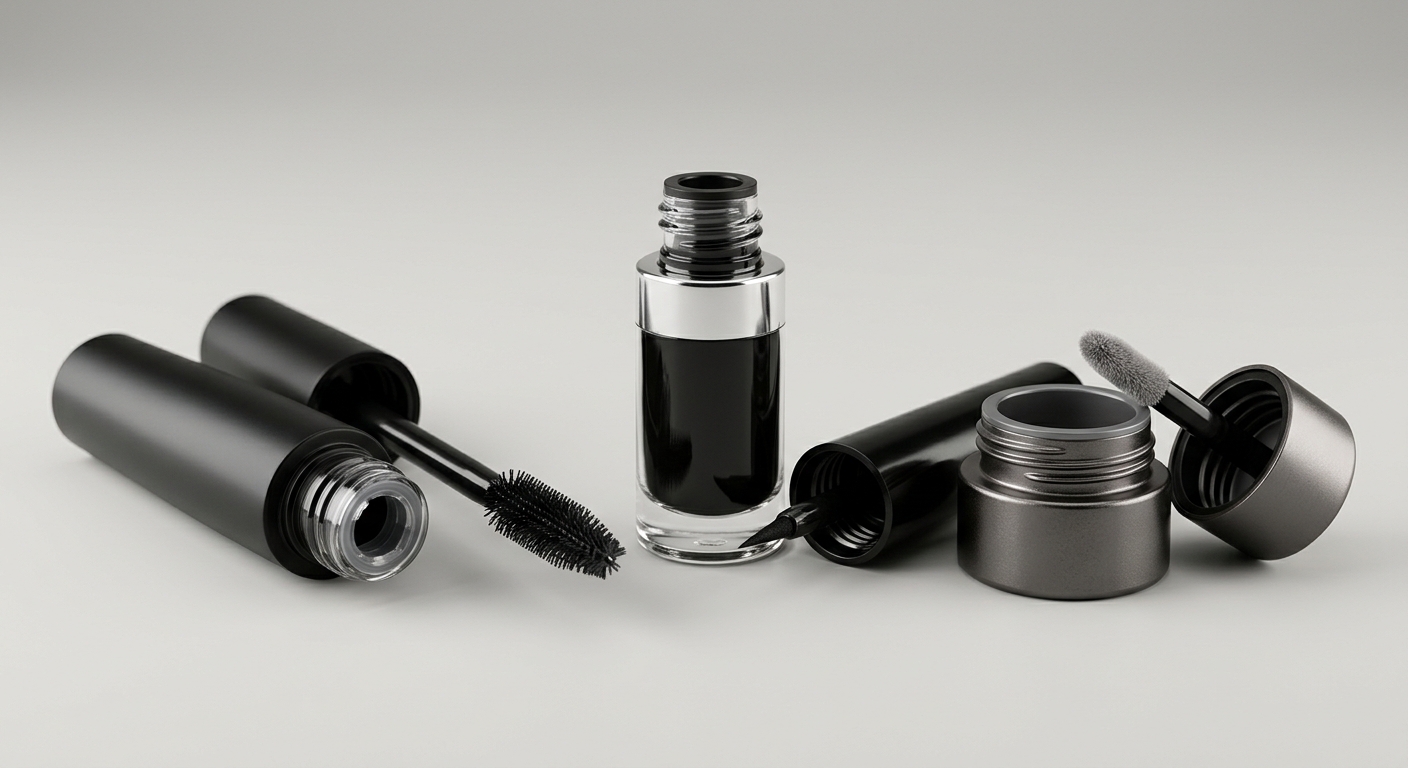
The Risk Profile of Liquid Eye Formulas
Liquid eye makeup formulas carry a uniquely elevated risk profile compared to other cosmetic categories. Three primary mechanisms drive this risk:
Oxidation sensitivity: Many liquid eyeliners and mascara formulas contain film-forming polymers and carbon-black or iron-oxide pigments that are susceptible to oxidative degradation when exposed to ambient air. Even micro-level oxygen ingress through a compromised seal accelerates viscosity loss and color shift within weeks of manufacture.
Microbial vulnerability: The periocular area is a high-risk application zone. Liquid formulas with aqueous phases — particularly water-based eyeliners and eyeshadow bases — provide a hospitable medium for Pseudomonas aeruginosa, Staphylococcus aureus, and Candida species. Packaging that allows backflow of used formula into the reservoir creates a direct contamination pathway.
Evaporation and formula concentration: Volatile solvents and water in liquid eye formulas evaporate rapidly through inadequate closures. This concentrates preservatives and active ingredients beyond intended levels, altering both safety and performance profiles — a regulatory compliance issue, not just a sensory one.
These characteristics explain why eye-area products face stricter post-market surveillance under EU Cosmetics Regulation and FDA guidelines than most other cosmetic categories.
Common Packaging Failures and Their Business Impact
Packaging failures in liquid eye makeup packaging manifest in predictable patterns, each with measurable commercial consequences:
- Seal failure and leakage: Insufficient torque on threaded closures or degraded inner liner seals cause product leakage during transit, generating returns and warehouse waste. For export shipments, this also triggers customs inspection flags.
- Applicator wand degradation: Wand fibers that absorb solvent components swell, deform, and lose dimensional accuracy, resulting in inconsistent application and consumer complaints that are often misattributed to formula quality.
- Formula separation in the reservoir: Packaging materials that leach plasticizers or residual monomers into oil-based formulas disrupt emulsion stability, causing visible phase separation on shelf — a direct brand credibility risk.
For brands operating at scale, a single packaging-origin failure across a 50,000-unit production run can generate returns, reformulation costs, and regulatory notification obligations that far exceed the cost differential between compliant and non-compliant packaging.
Core Technical Requirements for Safe Eye Makeup Packaging
Airtight Seal Mechanisms and Closure Engineering
Seal integrity is the single most critical performance parameter for airtight eye makeup containers. Procurement teams should evaluate closures across three engineering dimensions:
Valve and closure type: For mascara tubes, the wiper ring (also called the collar or seal ring) controls both product dosage and air exchange. Wiper ring tolerances should be specified to ±0.1 mm to ensure consistent wand wiping without excessive formula stripping. For liquid eyeliner bottles, inner-seal liners made from LDPE or foam-backed foil provide a secondary barrier against evaporation and oxygen ingress.
Torque and pressure resistance standards: Closure torque should be validated during supplier qualification. A minimum application torque of 8–12 cN·m for mascara caps and 6–10 cN·m for eyeliner closures is a common industry benchmark. Pressure resistance testing (e.g., 15–20 kPa internal pressure for 60 seconds without deformation) should be a contractual specification, not an optional test.
Leak rate metrics: Acceptable leak rates for primary liquid eye makeup packaging are typically ≤0.1 g/year under ambient storage conditions. Suppliers should provide helium leak test data or equivalent vacuum decay test results as part of their qualification package.
Chemical-Resistant Material Selection
Material-formula compatibility is a non-negotiable requirement for chemical-resistant makeup packaging. The four primary material categories used in liquid eye makeup packaging each carry distinct performance profiles:
| Material Type | Химическая стойкость | Airtight Performance | Applicable Formula Type | MOQ Range | Regulatory Compliance |
|---|---|---|---|---|---|
| ПП (полипропилен) | High vs. water-based; moderate vs. solvents | Good with inner liner | Mascara, water-based liner | 10,000–50,000 units | FDA 21 CFR, EU 10/2011 |
| HDPE | High vs. solvents & pigments | Moderate (requires seal liner) | Oil-based liner, eyeshadow base | 10,000–100,000 units | FDA 21 CFR, EU 10/2011 |
| Borosilicate Glass | Excellent (inert to all formula types) | High with metal/PTFE closure | Precision liquid liner, serums | 5,000–20,000 units | ISO 4802, EU Cosmetics Reg. |
| Алюминий | Excellent vs. solvents; requires lining | High with crimped seal | Solvent-based formulas | 20,000–100,000 units | FDA 21 CFR, ISO 22715 |
Key compatibility rules for procurement teams: PP is suitable for aqueous formulas but requires compatibility testing with glycol-based solvents. HDPE offers broader solvent resistance but has higher oxygen permeability than glass. Borosilicate glass is chemically inert across all formula types and the preferred material for precision applicator bottles, though it adds weight and fragility risk. Алюминий is optimal for solvent-heavy formulas but requires internal lacquer lining to prevent metal ion migration — a critical regulatory consideration.
Applicator Design and Contamination Control
Precision Applicator Specifications for Eye Formulas
Applicator geometry directly controls dosage accuracy and cross-contamination risk. For mascara wands, fiber density (typically 200–400 fibers per cm² for volumizing formulas) and helix pitch determine product loading and release. For liquid eyeliner, the choice between doe-foot applicators, micro-tip felt nibs, and brush-tip wands affects both line precision and formula transfer rate.
Critical specification parameters for procurement:
- Wand diameter tolerance: ±0.15 mm to ensure consistent wiper ring engagement
- Fiber material: Nylon 6.6 or PBT fibers offer superior solvent resistance over natural fibers
- Micro-tip nib density: 0.3–0.5 mm tip diameter for precision liner applications; felt nibs should be pre-compressed to ≥85% of final density before filling
Doe-foot applicators present a higher cross-contamination surface area than micro-tip designs and are better suited to eyeshadow base or primer formulas where precision is secondary to coverage.
Hygienic Design Standards and Anti-Backflow Features
Contamination control in safe eye makeup packaging depends on preventing formula re-entry into the primary reservoir after applicator contact. Key engineering features include:
One-way valve systems: Used in airless pump formats for liquid eyeshadow bases, one-way valves prevent backflow entirely. These systems maintain formula sterility through the product’s use period but require compatibility testing with high-viscosity formulas (>5,000 cP).
Wiper ring anti-backflow geometry: A correctly engineered wiper ring with a reverse-taper inner profile creates a mechanical barrier that prevents formula on the wand exterior from re-entering the tube. Suppliers should provide cross-section drawings confirming this geometry.
Clean-fill manufacturing: Packaging components should be manufactured in ISO Class 8 (or better) cleanroom environments and supplied in sealed, sterile-barrier packaging to prevent pre-fill contamination.
Regulatory Compliance and Supplier Qualification
Key Standards Governing Eye Makeup Packaging
Three regulatory frameworks govern primary packaging for liquid eye makeup in major markets:
Регламент ЕС по косметике (EC) № 1223/2009 requires that primary packaging materials do not transfer substances to the formula in quantities that could compromise product safety. Annex I stability and compatibility testing is mandatory before market authorization.
FDA 21 CFR Parts 700–740 govern cosmetic labeling and safety, with specific provisions under 21 CFR 700.13 prohibiting the use of certain coal-tar colors in eye-area products. Packaging material compliance falls under 21 CFR Parts 174–186 for food-contact analogues.
ISO 22715 provides packaging labeling requirements applicable to cosmetics exported across multiple jurisdictions, ensuring symbol consistency for consumer safety communication.
How to Qualify a Packaging Supplier for Liquid Eye Products
A rigorous supplier qualification process for liquid eye makeup packaging should include the following audit checklist items:
- ✅ Material certifications: FDA food-contact compliance letters or EU 10/2011 migration test reports for all polymer components
- ✅ Stability testing data: 12-week accelerated stability data (40°C/75% RH) demonstrating no formula-packaging interaction
- ✅ Seal integrity test reports: Helium leak test or vacuum decay data meeting specified leak rate thresholds
- ✅ Cleanroom manufacturing certification: ISO 14644-1 Class 7 or 8 documentation for primary component production
- ✅ NDA/IP protection protocols: Signed non-disclosure agreements covering formula-packaging compatibility data and proprietary applicator geometries
- ✅ MOQ and lead time transparency: Confirmed production capacity for initial orders and scale-up runs
1. Как долго подводка для глаз остаётся стабильной в тубе JY4027A/B?
Q1: What seal integrity test should I require from a supplier before approving liquid eyeliner packaging for mass production?
Require vacuum decay testing per ASTM F2338 or helium leak testing per ASTM F2391. Specify a maximum leak rate of ≤0.1 g/year and request test reports from a minimum of three production batches. Do not accept visual inspection alone as a seal integrity qualification method.
Q2: Which packaging materials are incompatible with water-based vs. oil-based liquid eye formulas?
For water-based formulas, avoid unlined aluminum (corrosion risk) and standard PET without barrier coating (oxygen permeability). For oil-based formulas, avoid standard PP without compatibility testing (solvent stress cracking risk) and natural rubber seals (swelling and extractable migration). HDPE and borosilicate glass are broadly compatible with both formula types when properly specified.
Q3: How do I ensure my eye makeup packaging meets both EU and FDA compliance requirements simultaneously?
Select materials with dual-compliance documentation: EU 10/2011 migration test reports and FDA 21 CFR food-contact letters cover most polymer substrates. For colorants in packaging components, cross-reference EU Annex IV permitted colorants against FDA 21 CFR 73/74/82 listings. Engage a third-party regulatory consultant to review your material dossier before filing in both jurisdictions.
Заключение
Choosing safe eye makeup packaging for liquid formulas is a multi-dimensional procurement decision that integrates material science, mechanical engineering, applicator design, and regulatory compliance into a single sourcing framework. The technical stakes are high: packaging failures in this category directly affect consumer ocular safety, formula efficacy, and brand regulatory standing.
By prioritizing validated airtight closure performance, chemically inert and compatible materials, precision applicator specifications, and a rigorous supplier qualification process anchored in certifiable documentation, B2B buyers can substantially reduce formula-origin failures, downstream liability exposure, and product return rates.
The most effective procurement teams treat eye makeup packaging not as a commodity input but as a critical quality component — one that warrants the same technical diligence applied to the formula itself. A structured qualification framework, applied consistently across suppliers and production runs, is the most reliable path to scalable, compliant, and commercially resilient liquid eye makeup packaging.