

Аннотация
For cosmetic brand owners and procurement managers, lipstick tube shape is rarely a purely aesthetic decision. The cross-section geometry of a lipstick tube directly influences tooling investment, filling line compatibility, retail display density, and perceived brand equity — all of which carry measurable cost and revenue implications before a single unit reaches the shelf.
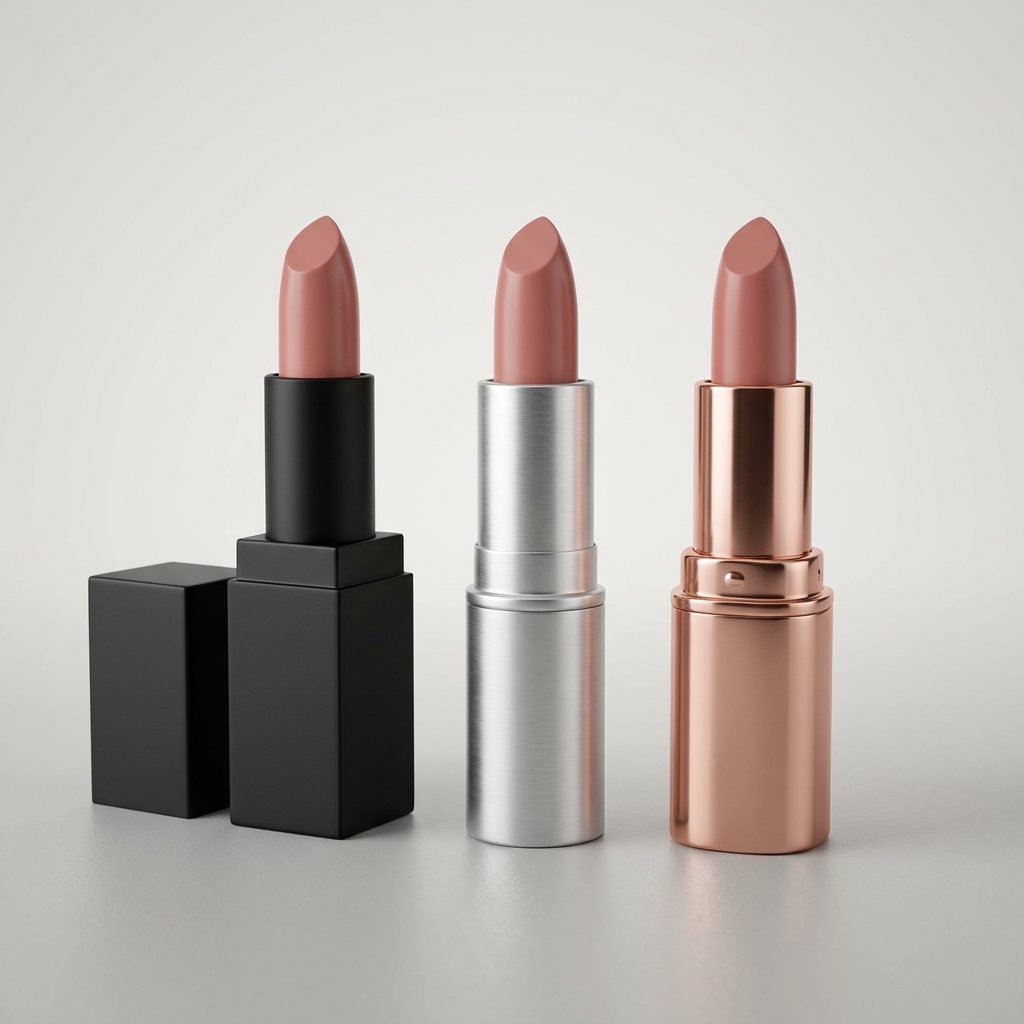
Square lipstick tubes command a visible presence in the prestige and masstige segments, appearing prominently in EU, Chinese, and Japanese markets where angular form factors signal premium positioning. Yet that brand equity comes with real trade-offs: higher mold complexity, potential filling line reconfiguration, and tighter component sourcing. Round tubes remain the industry workhorse for exactly the opposite reasons — standardized tooling, universal filling equipment compatibility, and broad supplier availability.
This article provides a structured, data-referenced comparison of square, round, and oval lipstick tubes across four critical dimensions — structural engineering, tooling and manufacturing cost, retail performance, and compliance. The goal is to give procurement teams and brand developers a defensible, cost-justified framework for selecting tube geometry before committing to a production run and tooling spend.
1. Geometry & Structural Engineering: What Shape Actually Means for a Lipstick Tube
1.1 How Cross-Section Geometry Affects Mechanism Precision
The internal mechanism of any lipstick tube — the cup-rotation assembly that drives the bullet up and down — must maintain consistent rotational torque regardless of outer shell geometry. For round tubes, the cylindrical inner bore is concentric with the mechanism, making tolerance management straightforward. Wall runout is predictable, and minor dimensional variation during injection molding rarely affects mechanism performance.
Square tubes introduce a fundamentally different engineering challenge. The four corners of the outer shell create stress concentration points during the injection or die-casting process. More critically, the inner bore must still be circular to accommodate the standard rotating cup mechanism, which means the mold must simultaneously achieve tight dimensional control on a square exterior and a round interior — two geometries with different shrinkage behaviors in ABS or zinc alloy.
In practical terms, square lipstick tube molds typically require multi-slide tooling configurations with corner inserts machined to tolerances of ±0.05 mm or tighter. Any deviation at the corners translates into binding during bullet rotation or inconsistent torque feel — a quality failure that is both costly to diagnose and damaging to brand perception at the consumer level.
1.2 Material Distribution & Wall Thickness Implications
Round aluminum shells distribute forming stress uniformly during deep drawing, enabling consistent wall thickness of 0.4–0.6 mm across the entire circumference. Square aluminum tubes, by contrast, accumulate material at corners during drawing, creating localized thickening that adds marginal weight and can affect anodizing or electroplating uniformity — a visible quality concern for premium finishes.
For ABS injection-molded tubes — the dominant material in mid-tier and masstige segments — square geometry requires carefully gated mold designs to prevent sink marks at corner junctions. Zinc alloy (Zamak) die-cast square tubes offer better corner definition and superior surface hardness, but add 15–25% to per-unit material weight compared to equivalent round ABS tubes, with corresponding cost implications for shipping and secondary packaging.
2. Tooling Cost & Manufacturing Complexity Breakdown
2.1 Mold Complexity and Initial Tooling Investment by Shape
Tooling cost is where shape selection has its most immediate financial impact. A standard round lipstick tube mold — single-cavity, two-plate design in P20 tool steel — typically costs USD 3,000–6,000 for the outer shell component. Multi-cavity round molds (4–8 cavity) scale to USD 8,000–15,000 but dramatically reduce per-unit cost at volumes above 50,000 units.
Square tube molds require multi-slide or side-action tooling to form the corner geometry and release the part cleanly. This increases base mold cost by 40–70% over a comparable round mold, placing single-cavity square shell tooling in the USD 5,000–10,000 range. For a complete square tube assembly (outer shell, inner mechanism housing, cap), total tooling investment commonly reaches USD 18,000–35,000 — versus USD 10,000–18,000 for a full round tube toolset.
Minimum order quantities (MOQs) are also shape-sensitive. Most suppliers set round tube MOQs at 10,000–20,000 units. Square tubes, due to slower cycle times and higher setup cost amortization requirements, typically carry MOQs of 20,000–50,000 units, which represents a meaningful inventory commitment for emerging brands.
2.2 Filling Line Compatibility & Production Efficiency
Standard rotary lipstick filling machines are engineered around cylindrical tube geometry. Round tubes load, index, and eject on these lines without modification, achieving production rates of 60–120 units per minute (UPM) with reject rates below 1% under normal operating conditions.
Square tubes do not self-orient on rotary fixtures. They require either custom nest fixtures that lock tube orientation during filling, or a reconfigured inline (linear) filling system. Fixture adaptation typically costs USD 2,000–8,000 per filling line and reduces throughput to 40–80 UPM — a 25–35% efficiency reduction. Reject rates from misalignment can reach 3–5% during initial production runs before fixture calibration is optimized.
Lipstick Tube Shape Comparison Matrix
| Размер | Квадрат | Круглый | Oval |
|---|---|---|---|
| Typical Tooling Cost (Full Set) | USD 18,000–35,000 | USD 10,000–18,000 | USD 12,000–22,000 |
| Standard MOQ | 20,000–50,000 | 10,000–20,000 | 15,000–30,000 |
| Filling Line Compatibility | Custom / Modified | Стандартный | Modified |
| Shelf Packing Density (units/tray) | High (flush stacking) | Средняя | Medium-Low |
| Perceived Tier Positioning | Masstige / Prestige | Mass / Masstige | Masstige |
| Lead Time Delta vs. Round | +2–4 weeks | Базовая линия | +1–2 weeks |
3. Retail Performance & Brand Positioning ROI
3.1 Shelf Standout and Planogram Efficiency
Square lipstick tubes deliver a measurable planogram advantage that partially offsets their cost premium. Because flat sides butt flush against adjacent units with zero gap, square tubes pack at 15–22% higher density per linear shelf foot compared to round tubes, which leave interstitial dead space between cylinders. For retail buyers managing shelf productivity KPIs — particularly units-per-linear-foot and revenue-per-shelf-inch metrics — this packing efficiency is a quantifiable argument for square format adoption.
In display trays and point-of-sale fixtures, square tubes also resist tipping and rotation, reducing the need for tray dividers and simplifying restocking. This operational benefit is increasingly valued by high-volume specialty retailers and department store cosmetics counters managing large SKU counts.
3.2 Consumer Perception & SKU Tier Signaling
Shape functions as a non-verbal price anchor at the point of purchase. Market research across EU and Asia-Pacific beauty segments consistently identifies angular, square-format packaging with prestige and luxury positioning, while cylindrical forms are associated with accessibility and mass-market value. This perception gap has measurable commercial impact: brands launching in square tubes in the CN and JP markets report 8–15% higher initial retail price acceptance compared to functionally identical products in round tubes, according to category management studies from major cosmetic retailers.
For mid-tier brands seeking to trade up without reformulating, switching to a square lipstick tube is one of the lowest-risk premiumization levers available — provided volume thresholds justify the tooling investment.
4. Compliance, Compatibility & Supplier Qualification
4.1 Component Interoperability: Caps, Bullets & Secondary Packaging
One underappreciated constraint of square tube adoption is component sourcing flexibility. Round lipstick tube components — caps, bullet cups, inner mechanisms — are produced by dozens of suppliers globally to near-standardized dimensions, enabling multi-source qualification and competitive pricing leverage. Square tube components are produced by a narrower supplier base, and dimensional standards vary significantly between manufacturers.
This means brands adopting square tubes typically must qualify all components — outer shell, cap, and mechanism — from a single supplier or a tightly coordinated supplier set. Cross-supplier bullet compatibility testing against internal fit-check protocols (analogous to ISO 8317 closure performance requirements) becomes mandatory, adding 3–6 weeks to the qualification timeline. Secondary packaging — cartons, display boxes — must also be redesigned to square tube footprint specifications, adding further development cost.
4.2 Regulatory & Sustainability Considerations
EU Packaging Regulation 2025 introduces recyclability scoring criteria that affect material and geometry selection. Square ABS tubes with metal components present the same recyclability challenges as round equivalents, but the larger flat surface area of square tubes offers a labeling advantage: more printable surface for mandatory recycling symbols, material identification codes, and ingredient disclosures without requiring separate inserts.
For brands committed to PCR (post-consumer recycled) material integration, round tube geometry currently offers broader PCR ABS and PCR aluminum supplier availability. PCR material formability in square geometries is technically achievable but requires tighter process controls to maintain corner definition, adding cost and complexity to sustainable sourcing programs.
1. Как долго подводка для глаз остаётся стабильной в тубе JY4027A/B?
Q1: What is the typical tooling cost premium for a square lipstick tube, and how does it amortize? Square tube tooling runs approximately 60–90% higher than round tube equivalents on a full-set basis. At a 50,000-unit run, the tooling delta of ~USD 15,000 adds USD 0.30 per unit — a premium that typically amortizes within the first two production runs for brands with established retail distribution and a justified price-point increase.
Q2: Can square tubes run on existing rotary filling equipment? Not without modification. Rotary fillers require custom nest fixtures for square tubes, costing USD 2,000–8,000 per line and reducing throughput by 25–35%. Brands with high-volume filling infrastructure should factor this capital cost into the total cost of ownership before switching formats.
Q3: At what volume does the brand-equity uplift justify the cost premium for a mid-tier brand? For mid-tier brands targeting masstige positioning, the square tube premium becomes commercially defensible at annual volumes of 30,000–50,000 units or above, assuming a retail price uplift of USD 1.50–3.00 per unit and a two-season tooling amortization horizon.
Заключение
Square lipstick tubes are not universally the right choice — but for the right brand profile, they are a commercially sound investment. The cost premium is real: tooling runs 60–90% higher, filling line adaptation adds capital and reduces throughput, and component sourcing flexibility is reduced. However, these costs are offset by measurable gains in shelf packing density, prestige tier signaling, and retail price acceptance in key markets.
The decision framework is straightforward: if your brand targets masstige or prestige positioning, operates in EU, CN, or JP retail channels, projects annual volumes above 30,000 units, and can absorb a 3–5 week extended lead time, the square lipstick tube’s cost premium is commercially justified and strategically defensible. For mass-market brands, high-velocity SKUs, or launches with uncertain volume projections, round tubes remain the lower-risk, higher-efficiency choice. Oval tubes occupy a middle ground — moderate tooling premium, differentiated shelf presence — worth considering when square geometry feels too bold for the brand aesthetic but round feels too generic.
Align shape selection with volume projections, filling infrastructure, and retail channel requirements before tooling commitment. The geometry decision is recoverable only at high cost once molds are cut.