


要旨
Transit damage is one of the most persistent and underestimated cost drivers for cosmetic brands sourcing eyebrow pencil packaging at scale. Unlike bulkier cosmetic formats, eyebrow pencils combine a slim cylindrical profile with fragile mechanical components — a combination that makes them disproportionately vulnerable to impact, compression, and vibration during shipping.
For procurement managers and packaging engineers, the consequences are concrete: elevated return rates, retailer chargebacks, rework labor, and reputational exposure when products arrive off-shelf-standard. Yet the root causes are almost always structural — poor fitment tolerances, inadequate insert selection, and under-specified outer cartons — rather than carrier mishandling alone.
This article examines the full protective packaging stack for eyebrow pencil products: from inner cavity design and insert material selection, through to corrugated carton grade and compliance testing. Each section provides actionable criteria that procurement teams can apply directly to supplier evaluation, specification documents, and sample validation protocols. The goal is to reframe transit protection not as an aftermarket fix, but as an upstream engineering decision with measurable commercial returns.
1: Why Eyebrow Pencil Packaging Is Vulnerable to Transit Damage
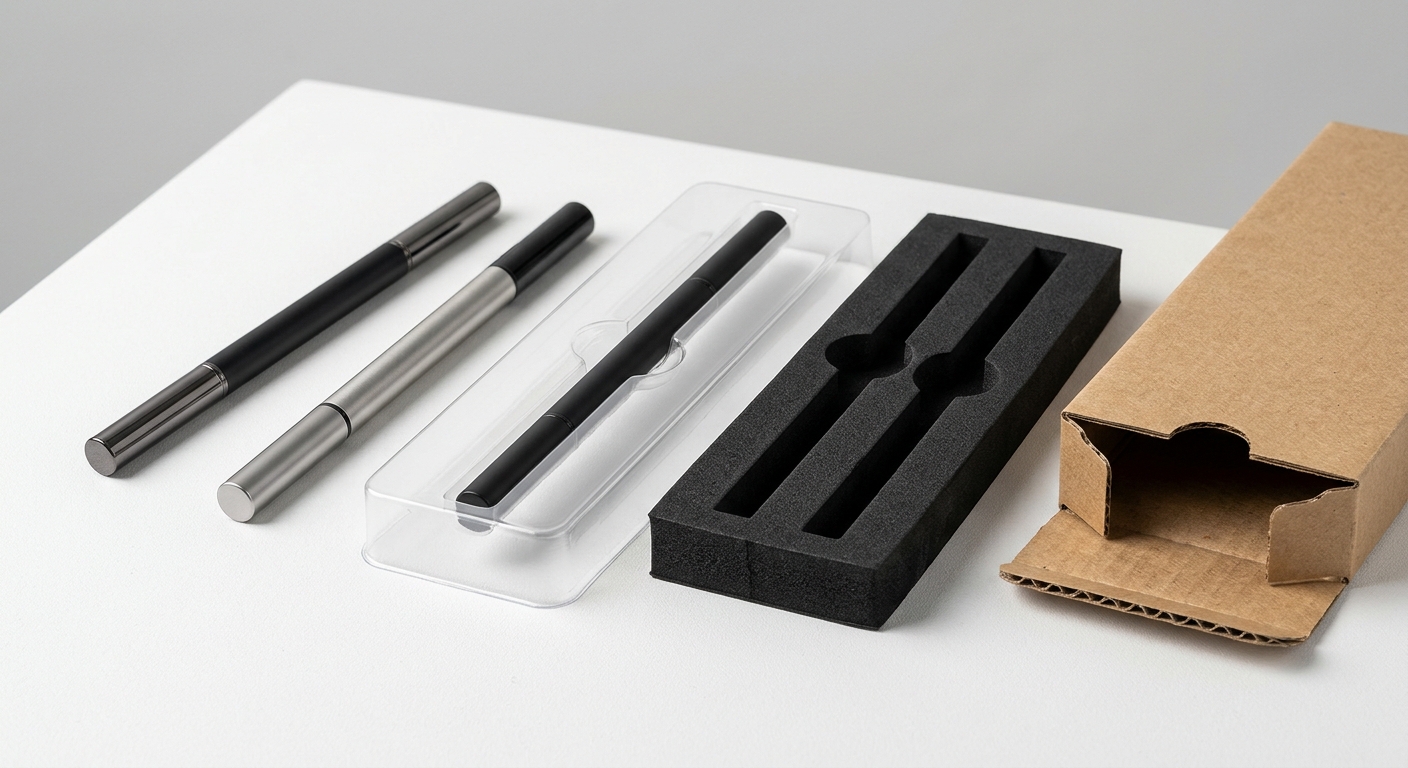
1.1: Physical Characteristics That Create Shipping Risk
The structural vulnerability of eyebrow pencil packaging begins with geometry. A standard eyebrow pencil measures between 75mm and 90mm in length with a barrel diameter of 8mm to 11mm — a slim cylindrical form that generates an unfavorable mass-to-surface-area ratio. In practical terms, this means the product has significant surface exposure relative to its weight, making it susceptible to lateral impact forces that heavier, denser products would absorb more effectively.
Cap retention is a second structural weakness. Most eyebrow pencil formats rely on friction-fit or snap-fit caps that engage over a narrow barrel section. When products move freely inside packaging cavities — even by 2mm to 3mm — repeated micro-impacts during long-haul freight gradually fatigue the cap engagement zone, leading to detachment before the product reaches the end consumer.
Twist-up mechanisms introduce additional risk. The internal lead-advance assembly contains small-tolerance plastic components that can fracture under axial compression. Without fitment that constrains movement along both the lateral and longitudinal axes, these mechanisms are exposed to cumulative stress across every handling event in the supply chain.
1.2: Common Damage Patterns Reported by Cosmetic Brands
Field data from cosmetic logistics audits consistently identifies four primary damage patterns in eyebrow pencil shipments:
- Cap detachment: The most frequently reported issue, typically caused by free lateral movement within packaging cavities.
- Barrel cracking: Occurs along the barrel seam or at the cap engagement zone when products are exposed to point-load compression.
- Tip breakage: Particularly common in wood-cased sharpener-end pencils where the exposed pigment core contacts adjacent units or cavity walls.
- Surface scuffing: A finish-quality issue that triggers retailer rejection even when the product remains functionally intact, particularly for premium matte or metallic barrel finishes.
Each damage pattern maps directly to a specific packaging design failure — a fact that supports the case for treating protection as a design-stage specification rather than a post-production concern.
2: Structural Design Factors That Reduce In-Transit Damage
2.1: Accurate Inner Sizing and Fitment Tolerance
Cavity-to-product clearance is the single most controllable variable in transit damage prevention. Industry best practice for slim cosmetic pencils specifies a radial clearance of no more than 0.3mm to 0.5mm between the barrel outer diameter and the inner cavity wall. Tolerances beyond this range allow lateral movement that generates the repetitive micro-impacts responsible for cap fatigue and surface scuffing.
Achieving consistent fitment at this tolerance level requires precision tooling — typically CNC-machined mold inserts with documented dimensional records — and a supplier capable of maintaining those tolerances across production runs. Procurement teams should request tooling inspection certificates and first-article inspection (FAI) reports as standard qualification documents.
Longitudinal constraint is equally important. Packaging cavities should be sized to the pencil’s actual length with a maximum axial clearance of 1mm, preventing tip-to-wall contact during vertical drop events. For products with exposed pigment tips, a recessed cavity design that positions the tip 1.5mm to 2mm above the cavity floor provides additional protection without requiring a separate tip guard.
2.2: Protective Inserts — Materials, Types, and Placement Logic
Insert selection should be driven by pencil format, order volume, and target protection level. The three primary insert materials used in cosmetic pencil packaging are EVA foam, thermoformed plastic trays, and blister fitments.
| Insert Type | Suitable Pencil Format | Cushioning Level | Unit Cost Range | MOQの影響 | リサイクル性 |
|---|---|---|---|---|---|
| EVA Foam Die-Cut | All formats | High | $0.08–$0.18 | 低 | Moderate (PE-based) |
| Thermoformed PET Tray | Twist-up, fixed-tip | Medium–High | $0.12–$0.25 | 中 | High (PET) |
| PVC Blister Fitment | Sharpener-end, retail display | 中 | $0.06–$0.14 | Low–Medium | 低 |
| Pulp Molded Tray | All formats | 中 | $0.10–$0.22 | 中 | High |
EVA foam provides the highest cushioning coefficient and conforms precisely to irregular barrel profiles, making it the preferred choice for premium SKUs and long-haul international freight. Its primary limitation is cost at low volumes.
Thermoformed PET trays offer dimensional precision and are well-suited to twist-up formats where the advance mechanism requires rigid lateral support rather than compressible cushioning. They also support retail-ready presentation, reducing secondary packaging requirements.
Blister fitments are cost-effective for high-volume sharpener-end pencils destined for retail display, but provide limited protection against axial compression and are not recommended for bulk master-carton configurations without an additional foam layer.
Placement logic matters as much as material selection. Inserts should be designed to suspend the pencil — particularly the cap and tip zones — away from cavity walls, distributing impact energy across the barrel body rather than concentrating it at the most vulnerable points.
3: Outer Carton Specifications and Stacking Performance
3.1: Corrugated Board Grade Selection for Cosmetic Pencil Shipments
Outer carton selection for eyebrow pencil shipments involves balancing compression strength against weight efficiency. Given the low individual unit weight of eyebrow pencils, master cartons are typically loaded by count rather than mass — meaning stacking height and pallet column integrity become the primary structural concerns.
For standard international shipments of 500 to 2,000 units per master carton, B-flute single-wall corrugated board with an Edge Crush Test (ECT) rating of 32 ECT provides adequate compression resistance for three-high pallet stacking under ambient conditions. For ocean freight or high-humidity distribution environments, upgrading to C-flute single-wall at 44 ECT or BC-flute double-wall is advisable, as moisture absorption can reduce corrugated compression strength by 30% to 50% under sustained humidity exposure.
Carton dimensions should be specified to minimize void space. Excessive internal volume allows master-carton contents to shift during transit, concentrating load on individual inner boxes and defeating the protection provided by inner inserts.
3.2: Carton Compression, Stacking Tests, and Compliance Standards
Major retail and e-commerce channels increasingly require documented carton performance data before approving inbound shipments. The two most widely referenced test protocols are:
- ISTA 2A: Covers packaged products weighing up to 68kg, including drop, vibration, and compression test sequences. Widely required by North American mass-market retailers.
- ASTM D4169: A performance test standard that simulates a complete distribution cycle, including vehicle vibration, atmospheric conditioning, and handling drops. Preferred by premium and specialty retail buyers.
Procurement teams should require suppliers to provide ISTA 2A or ASTM D4169 test reports for the specific carton configuration proposed, not generic material certifications. Drop-test thresholds for eyebrow pencil cartons typically require survival at 600mm to 900mm drop heights across all six faces and two edges.
Retailer-specific requirements — such as Amazon’s SIOC (Ships in Own Container) program or Walmart’s supplier packaging standards — may impose additional compression and labeling requirements that should be confirmed during the supplier qualification phase.
4: Commercial and Operational Value of Damage-Proof Packaging
4.1: Quantifying Damage-Related Costs for Procurement Teams
The true cost of transit damage extends well beyond the replacement value of damaged units. A realistic cost model for cosmetic brands should include:
- Return processing and rework labor: Industry benchmarks suggest rework costs of $0.40 to $1.20 per unit for cosmetic products requiring repackaging.
- Retailer chargebacks: Major retailers typically levy chargebacks of 2% to 5% of invoice value for shipments that fail receiving inspection, with some contracts specifying per-unit penalties for damaged goods.
- Inventory write-offs: Damaged units that cannot be reworked represent a full landed-cost loss, including product, packaging, freight, and duties.
- Brand reputation exposure: For premium eyebrow pencil brands, a single high-profile damage incident on a retail floor or in an unboxing review can generate disproportionate reputational cost.
Brands that invest in validated protective packaging consistently report damage rate reductions from industry-average levels of 3% to 6% down to below 1% — a return that typically offsets the incremental packaging cost within two to three shipment cycles.
4.2: Supplier Qualification Criteria for Protective Packaging Capability
Evaluating a supplier’s protective packaging capability requires going beyond material specifications. Key qualification criteria include:
- Tooling precision records: Request dimensional inspection reports for cavity tooling, confirming tolerance compliance against the product specification.
- Drop-test certification: Suppliers should be able to provide or facilitate ISTA/ASTM testing for proposed configurations, not simply reference generic material data.
- Sample validation process: A structured sample-approval workflow — including a pre-production sample, a production-equivalent sample, and a shipping simulation test — reduces the risk of specification drift between approval and mass production.
- NDA-protected design iteration: For brands developing proprietary insert or carton configurations, confirm that the supplier operates under a non-disclosure framework that protects design IP during the development phase.
FAQ
Q1: What inner insert material offers the best balance between protection and cost for high-volume eyebrow pencil orders?
For orders exceeding 50,000 units, thermoformed PET trays typically offer the optimal cost-protection balance. They provide precise dimensional control, support retail-ready presentation, and are recyclable. EVA foam delivers superior cushioning for premium or fragile formats but carries a higher per-unit cost that becomes significant at scale.
Q2: Which international shipping test standards should eyebrow pencil packaging meet before entering major retail channels?
ISTA 2A is the baseline requirement for most North American retail channels and covers the core hazards of drop, vibration, and compression. ASTM D4169 provides a more comprehensive distribution-cycle simulation and is increasingly required by specialty and premium retailers. Brands targeting e-commerce fulfillment should also verify Amazon SIOC or equivalent platform-specific requirements.
Q3: How does packaging cavity tolerance directly affect cap retention and tip integrity during long-haul freight?
Cavity clearances beyond 0.5mm allow lateral movement that generates repetitive micro-impacts against cap engagement zones, progressively fatiguing the friction or snap-fit retention. Over a 20-day ocean freight journey involving thousands of vibration cycles, even small clearances accumulate sufficient fatigue to cause cap detachment rates of 5% or higher. Tight-tolerance cavities — held to 0.3mm to 0.5mm radial clearance — eliminate this movement and reduce cap-related damage to near-zero in controlled shipping tests.
結論
Reducing transit damage in eyebrow pencil packaging is fundamentally an engineering and procurement decision, not an aftermarket correction. The damage patterns that drive return costs and retailer penalties — cap detachment, tip breakage, barrel cracking, surface scuffing — each trace back to specific, addressable design gaps: insufficient fitment tolerance, mismatched insert selection, or under-specified outer carton grades.
Brands that approach protective packaging as a specification discipline — defining cavity tolerances, validating insert materials against their specific pencil format, and requiring documented carton performance against ISTA or ASTM standards — systematically lower damage rates and convert packaging investment into measurable supply chain resilience. The incremental cost of precision fitment and validated inserts is consistently recovered within a small number of shipment cycles through reduced returns, eliminated chargebacks, and protected brand equity.
The supplier selection process should reflect this priority: tooling precision records, sample validation workflows, and test certification capability are as commercially relevant as unit price when evaluating eyebrow pencil packaging partners.