
Abstract
For B2B cosmetic packaging buyers, a visually appealing compact case means nothing if it fails in the field. A cracked shell on a retail shelf, a mirror that peels after two weeks, or a powder pan that rattles loose in transit — each failure carries a direct cost in returns, rework, and brand credibility.
This article breaks down the four critical quality benchmarks that every makeup compact case must pass before it enters your supply chain: hinge durability, mirror adhesion, powder pan fit, and drop resistance. These are not aspirational metrics — they are the baseline specifications separating reliable suppliers from high-risk ones.
Whether you are qualifying a new cosmetic compact case manufacturer, renegotiating supplier contracts, or building a tighter QC checklist for private-label production, the test thresholds, failure modes, and evaluation criteria outlined here give you a practical framework to apply immediately in your next RFQ process.
1. Why Quality Testing Is Non-Negotiable in Compact Case Sourcing
1.1 The Cost of Compact Case Failures in B2B Supply Chains
A single batch of defective compact cases triggers a cascade of costs that extend well beyond the unit price. Return logistics, rework at MOQ scale, retailer chargebacks, and the reputational damage of a product recall can collectively exceed the original order value several times over.
Industry data consistently shows that cosmetic packaging defects — particularly structural failures in hinges and pan retention — account for a disproportionate share of post-delivery complaints in the beauty sector. For private-label brands, where the packaging is the brand identity, a compact case that fails in the consumer’s hands is indistinguishable from a brand that failed them.
The financial math is straightforward: investing in rigorous pre-production quality testing costs a fraction of the expense associated with a 5,000-unit return and rework cycle. Buyers who build quality gate requirements into their supplier contracts — with documented test thresholds and rejection criteria — consistently report lower defect rates and stronger long-term supplier performance.
1.2 Industry Standards and Compliance Benchmarks
While there is no single global standard exclusively governing makeup compact cases, several established frameworks inform best-practice testing protocols. ASTM D4169 provides guidance on packaging performance under distribution conditions, including vibration and drop simulation. EU cosmetic packaging compliance requirements under Regulation (EC) No 1223/2009 indirectly enforce material safety and structural integrity standards for any compact entering European retail.
For structural durability, buyers sourcing for premium or mid-market segments should reference internal benchmarks aligned with ISO 11608 principles — particularly around cyclic mechanical stress and material fatigue. Suppliers operating to these standards will typically have documented test procedures, traceable batch records, and defined pass/fail criteria that you can audit before committing to production.
2. The 4 Core Quality Tests Explained
2.1 Test 1 & 2 — Hinge Durability and Mirror Adhesion
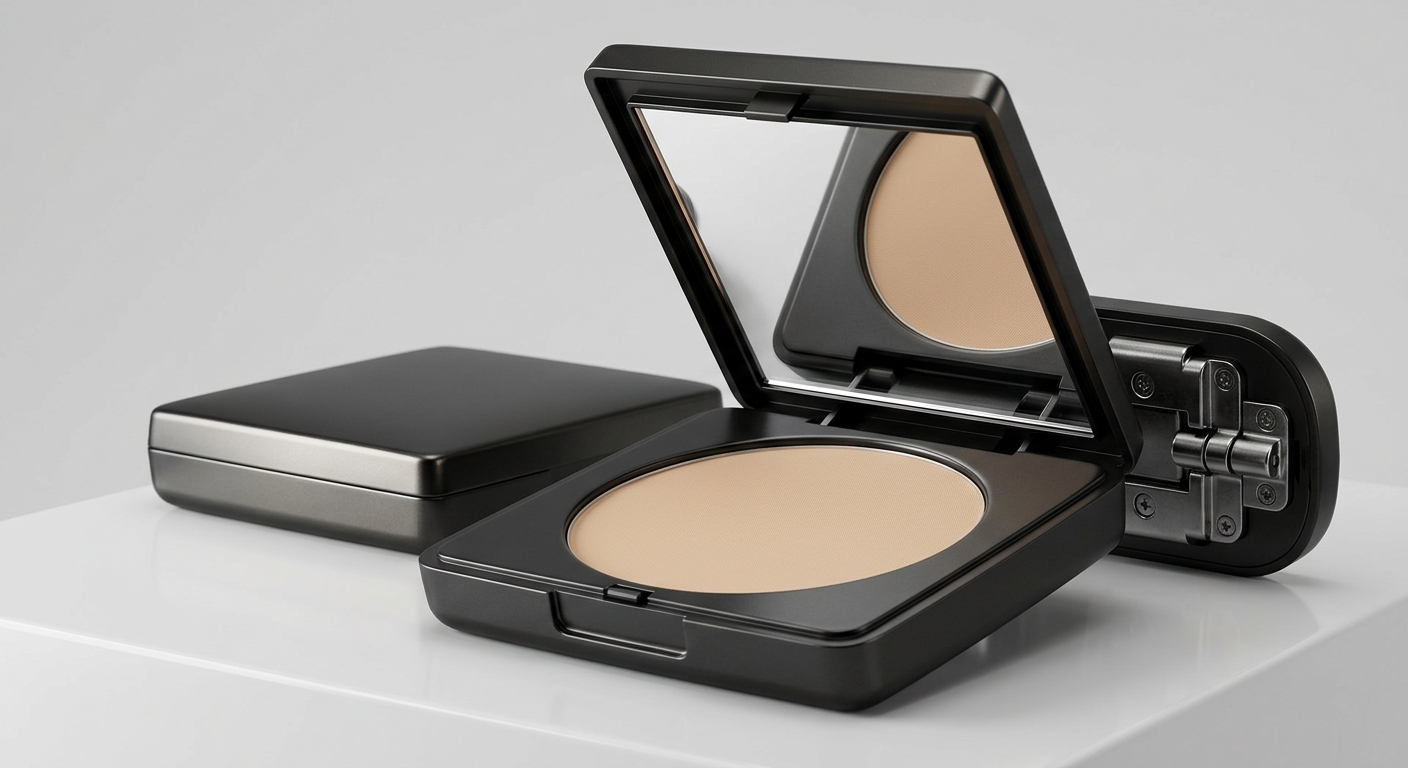
The hinge is the single most mechanically stressed component in any compact case. Every open-and-close action applies torsional load to the hinge pin and surrounding shell material. A reliable makeup compact case should sustain a minimum of 3,000 open/close cycles without deformation, loosening, or cracking at the hinge mount. Premium-tier products targeting department store or specialty retail channels should target 5,000+ cycles.
Mirror adhesion failures are among the most visually damaging defects a consumer encounters. The mirror — typically float glass at a minimum thickness of 1.8mm — must be bonded to the lid using pressure-sensitive adhesive (PSA) or double-sided structural tape rated for both temperature variation and repeated mechanical vibration. Adhesive bond strength should be tested via a 90-degree peel test, with a minimum threshold of 3 N/cm to resist delamination under normal use conditions.
| Test Type | Industry Benchmark | Pass Threshold | Common Failure Cause | Recommended Test Method |
|---|---|---|---|---|
| Hinge Durability | ASTM D4169 / Internal | ≥3,000 open/close cycles | Thin hinge pin, brittle shell at mount point | Automated cyclic open/close fixture |
| Mirror Adhesion | PSA Bond Standard | ≥3 N/cm peel strength | Insufficient adhesive coverage, contaminated bonding surface | 90° peel test at ambient temperature |
| Powder Pan Fit | Internal tolerance spec | ±0.2mm dimensional tolerance | Warped pan, inconsistent injection molding | Caliper measurement + rattle/shake test |
| Drop Resistance | ASTM D5276 | ≥1.0m onto hard surface, no crack/separation | Thin shell wall, poor corner geometry | Free-fall drop test on concrete or steel plate |
Hinge material grade is equally critical. Zinc alloy hinges offer cost efficiency but are susceptible to stress fracture under repeated loading if casting quality is inconsistent. Stainless steel hinges provide superior fatigue resistance and are recommended for compact cases targeting premium positioning or high-frequency-use formats such as pressed powder or bronzer compacts.
2.2 Test 3 & 4 — Powder Pan Fit and Drop Test
Pan fit precision is a functional and aesthetic requirement simultaneously. A powder pan that fits too loosely will rattle — a tactile quality signal that immediately communicates low grade to the consumer. A pan fitted too tightly risks cracking the shell during assembly or creating stress fractures that propagate under drop conditions. The accepted dimensional tolerance for pan-to-shell fit is ±0.2mm, achievable only through consistent injection molding with well-maintained tooling.
Two retention mechanisms are standard in the industry: snap-fit e friction-fit. Snap-fit designs use a defined mechanical lock that requires deliberate force to release — preferred for refillable compact formats. Friction-fit designs rely on dimensional interference for retention — simpler to manufacture but more sensitive to tooling wear over production runs. Buyers should confirm which mechanism their supplier uses and request dimensional inspection reports from at least three separate production batches.
Drop test protocols simulate the most common real-world failure scenario: the compact falling from a bathroom counter or vanity surface. The standard drop height is 1.0 meter onto a hard surface (concrete or steel plate), tested across all six faces and two diagonal corners. Pass criteria require no cracking of the shell, no mirror separation, and no pan displacement. ABS shell material generally outperforms AS (acrylonitrile styrene) in drop scenarios due to its higher impact resistance, though AS offers superior surface gloss for high-end finishes.
3. How to Evaluate Supplier QC Capabilities Against These Tests
3.1 Key Questions to Ask Your Compact Case Manufacturer
Before approving a supplier for production, request direct answers to the following:
- Do you conduct hinge durability testing in-house, or through a third-party lab? In-house testing is acceptable if equipment is calibrated and records are traceable. Third-party lab reports (SGS, Intertek, BV) provide an independent verification layer.
- What is your standard sample approval workflow? A credible supplier provides pre-production samples with test data attached — not test data generated after buyer complaint.
- At what frequency do you conduct batch inspection? AQL 2.5 is the standard acceptance quality limit for cosmetic packaging; anything less rigorous warrants scrutiny.
- Can you provide historical defect rate data by failure category? Suppliers with mature QC systems track defect root causes — not just defect totals.
3.2 Red Flags in Supplier Test Reports
Incomplete or vague test documentation is a reliable indicator of weak QC infrastructure. Specific red flags include:
- Missing cycle count data in hinge durability reports — a pass/fail result without cycle count is meaningless
- Vague adhesion specifications such as “mirror firmly attached” with no quantified bond strength measurement
- No drop test documentation at all, or drop test results that specify only one face rather than the full six-face-plus-corner protocol
- Single-batch test data presented as representative of ongoing production — QC data should span multiple production runs
- Reluctance to provide raw test data or allow buyer-side third-party audits
4. Spec Parameters That Directly Impact Test Performance
4.1 Material and Hardware Selection for Test Compliance
Material selection at the specification stage is the most cost-effective point at which to ensure test compliance. Key decisions include:
- Hinge metal grade: Zinc alloy (Zamak 3 or 5) is industry standard; stainless steel (304 grade) is recommended for premium or high-cycle applications
- Mirror glass thickness: A minimum of 1.8mm float glass is required for adequate rigidity; 2.0mm is preferred for larger compact formats (≥70mm diameter)
- Shell material: ABS provides the best balance of impact resistance, surface finish compatibility, and cost; PC/ABS blends offer enhanced drop performance for thin-wall designs
4.2 Structural Design Considerations for Pan Fit Precision
Tooling quality is the upstream determinant of pan fit consistency. Single-cavity molds with controlled cooling channels produce tighter dimensional consistency than multi-cavity molds running at high throughput. Buyers should request tooling qualification reports (First Article Inspection or equivalent) confirming dimensional compliance before full production release.
Corner geometry on the compact shell also directly affects drop test outcomes. Rounded interior corners distribute impact stress more effectively than sharp-angle designs. Wall thickness uniformity — achievable through proper gate placement and flow simulation in the mold design phase — prevents localized stress concentrations that cause cracking on impact.
FAQ
1. What is the minimum hinge cycle count a reliable makeup compact case supplier should guarantee?
A minimum of 3,000 open/close cycles is the baseline for standard retail compact cases. Suppliers targeting premium or professional-use segments should guarantee 5,000 cycles or above. Always request the test report specifying the equipment used, cycle rate, and observed failure mode — not just the pass/fail outcome.
2. How do I verify mirror adhesion test results from a supplier’s QC report before placing a bulk order?
Request the quantified peel strength value (in N/cm) rather than a qualitative description. If the supplier cannot provide a numerical result from a 90-degree peel test, commission an independent lab test on pre-production samples before approving the order. SGS and Intertek both offer standard PSA bond testing services with turnaround times compatible with most sourcing timelines.
3. Which compact case materials perform best in drop tests without significantly increasing unit cost?
ABS (Acrylonitrile Butadiene Styrene) is the most cost-effective material for drop resistance in compact case shells. It absorbs impact energy more effectively than AS or standard PS, and it is compatible with all standard surface finishing processes (electroplating, UV coating, soft-touch coating). The cost premium over AS is typically marginal at scale and is offset by reduced breakage claims.
Conclusione
Sourcing a makeup compact case that passes all four quality tests — hinge durability, mirror adhesion, powder pan fit, and drop resistance — is the operational baseline for protecting your brand and reducing supply chain risk. These are not premium requirements reserved for luxury packaging; they are the minimum standards any professional B2B buyer should enforce regardless of price tier.
Use the test thresholds, material specifications, and supplier evaluation criteria outlined in this guide as a working checklist in your next RFQ process. Request documented test data before sample approval, apply AQL 2.5 as your batch inspection standard, and treat missing or vague QC documentation as a disqualifying signal rather than a negotiable gap. The compact case your customer holds in their hands is a direct reflection of the sourcing decisions you made months earlier — make them count.