



Résumé
Packaging format is one of the most consequential purchase drivers in the lip care category. A consumer’s decision to pick up a product—and return for a second purchase—is shaped as much by how the packaging feels in hand as by what’s inside it. For brand owners, private label buyers, and procurement managers, choosing the wrong format can mean misaligned shelf positioning, regulatory hurdles, or elevated unit costs that erode margin.
This article evaluates four dominant lip care packaging formats—squeeze tubes, aluminum tins, rollerballs, and PCR plastic sticks—across structural mechanics, material compatibility, compliance requirements, consumer usability, and commercial performance. The goal is to give procurement and product development teams a structured, data-informed framework for making packaging decisions that drive measurable sales outcomes. Whether you are launching a new SKU, reformulating an existing line, or transitioning to sustainable packaging, the format-level analysis below provides actionable guidance grounded in technical and market realities.
1. Understanding the Four Core Lip Care Packaging Formats
1.1 Format Overview & Structural Mechanics
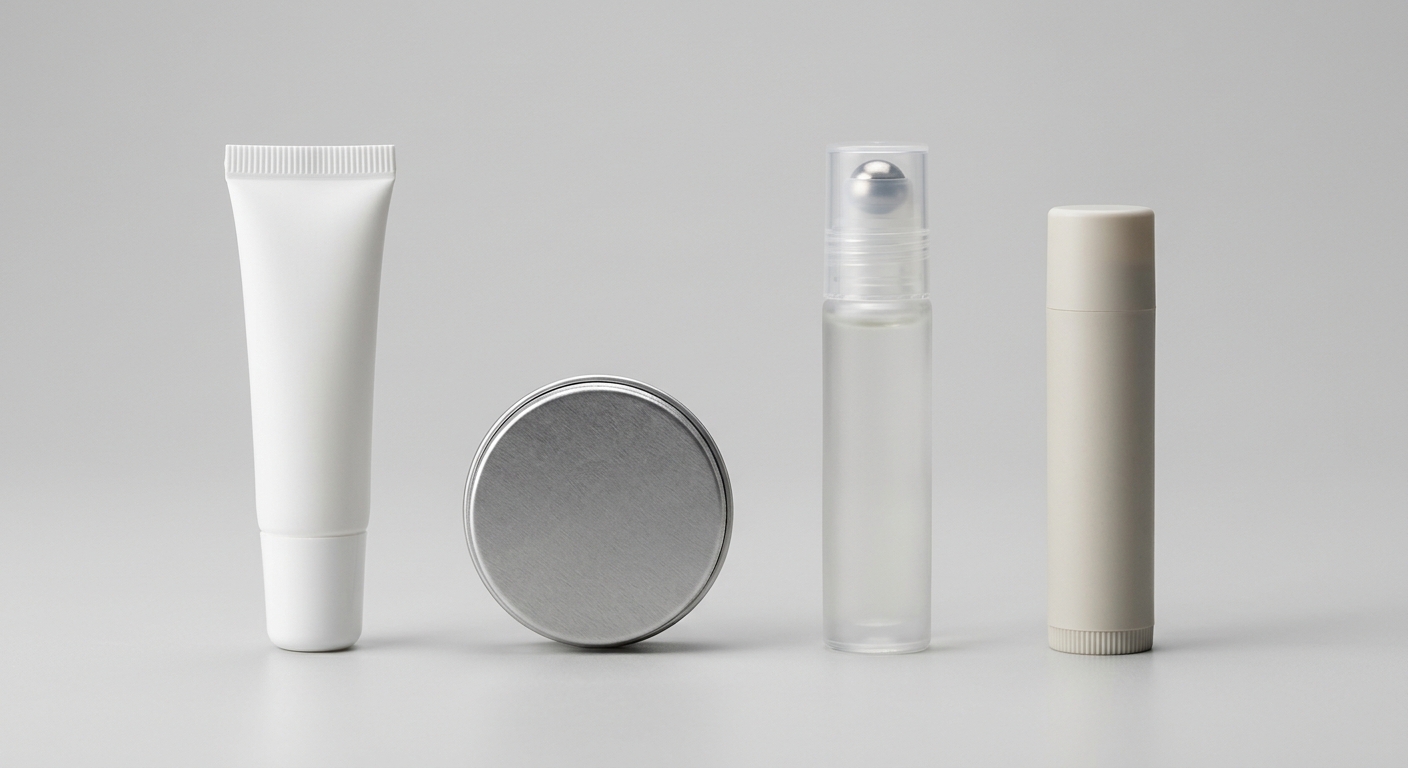
Each lip care packaging format operates through a distinct dispensing mechanism that directly influences consumer interaction and formula integrity.
Squeeze Tubes are constructed from flexible LDPE or laminate bodies with a sealed crimped base and a screw or snap cap. The user applies directional pressure to dispense product, making them well-suited for balms, serums, and tinted formulas requiring controlled output. Nozzle aperture diameter—typically 3–8 mm—determines dose precision.
Aluminum Tins are two-piece containers (base and lid) formed from food-grade aluminum. The open-access format requires finger application, offering a tactile, premium experience. The hermetic fit of the lid provides strong barrier protection, making tins especially effective for wax-heavy or oil-rich anhydrous formulas.
Rollerballs feature a PP or PET outer shell housing a stainless steel or plastic ball applicator seated in a precision-fit socket. The rolling mechanism delivers product from a reservoir directly to the lip surface, enabling hygienic, no-touch application. This format is gaining traction in lip serum and medicated lip care segments.
PCR Plastic Sticks mirror the classic twist-up lip balm stick in form factor but use post-consumer recycled resin (typically PCR-PP or PCR-HDPE) for the outer shell and inner carriage mechanism. The push-up dispensing column is calibrated to advance product incrementally, minimizing waste.
1.2 Material Composition & Compatibility with Lip Care Formulas
Material selection is inseparable from formula performance. LDPE squeeze tubes offer excellent flexibility and chemical inertness, compatible with water-based, oil-based, and emulsion formulas across a wide viscosity range (500–50,000 cP). However, they provide limited oxygen barrier performance without a foil laminate layer.
Aluminum tins deliver superior barrier properties against oxidation, UV, and moisture—critical for formulas containing vitamin C derivatives or unsaturated fatty acids. They are incompatible with highly acidic formulas unless internally lacquered.
Rollerball reservoirs in PP or PET are compatible with low-to-medium viscosity serums and liquid balms (under 5,000 cP). Ball socket tolerances must be matched to formula viscosity to prevent leakage or dispensing failure.
PCR plastic sticks are mechanically comparable to virgin PP sticks but require formula compatibility testing due to potential trace contaminants in recycled resin. High-SPF or medicated formulas should undergo additional migration testing per regulatory requirements.
2. Technical Specifications & Compliance Standards
2.1 Key Dimensional & Fill-Weight Parameters
Standard specifications vary meaningfully across formats, affecting both production economics and retail shelf fit.
| Format | Common Capacity Range | Primary Material | Closure Type | MOQ typique | PCR Option Available | Applicable Compliance Standard |
|---|---|---|---|---|---|---|
| Squeeze Tube | 5 ml – 30 ml | LDPE / Laminate | Screw Cap / Flip Top | 5,000–10,000 pcs | Yes (PCR-LDPE) | FDA 21 CFR 177, ISO 22715 |
| Aluminum Tin | 5 g – 50 g | Food-Grade Aluminum | Press Lid | 3,000–5,000 pcs | N/A (recyclable) | EU Reg. 1223/2009, FDA 21 CFR |
| Rollerball | 5 ml – 15 ml | PP / PET + Steel Ball | Snap Cap | 5,000–10,000 pcs | Partial (PCR-PP shell) | ISO 22715, REACH |
| PCR Plastic Stick | 3.5 g – 8 g | PCR-PP / PCR-HDPE | Twist-Up Cap | 10,000–25,000 pcs | Yes (30–100% PCR) | FDA 21 CFR, EU Reg. 1223/2009 |
Wall thickness tolerances for squeeze tubes typically run ±0.05 mm; aluminum tin wall gauges range from 0.20–0.35 mm. Closure torque for screw-cap tubes is specified at 8–15 N·cm to prevent both leakage and consumer difficulty. PCR stick carriage mechanisms require tighter dimensional control (±0.02 mm) due to the variability inherent in recycled resin flow properties.
2.2 Regulatory & Sustainability Compliance
All four formats must satisfy FDA 21 CFR requirements for indirect food contact materials when used for lip products in the US market, given that lip care products are considered ingestion-risk cosmetics. In the EU, compliance with Cosmetics Regulation 1223/2009 governs both material safety and labeling under ISO 22715.
For PCR content claims, brands must obtain third-party certification (e.g., SCS Recycled Content Standard or Intertek verification) to substantiate “X% post-consumer recycled material” statements. REACH compliance is mandatory for any packaging sold into EU markets, covering restricted substances in plastic components. Aluminum tins are inherently recyclable and support circular economy claims without additional certification, provided no mixed-material laminate coatings are used.
Brands pursuing dual US/EU compliance should prioritize formats with documented FDA 21 CFR and EU Regulation 1223/2009 test files from their supplier—a critical due diligence checkpoint during supplier qualification.
3. Consumer Usability, Shelf Appeal & Sales Performance
3.1 On-Shelf Differentiation & Retail Channel Fit
Format-to-channel alignment is a strategic lever that is frequently underutilized. Mass retail environments favor PCR plastic sticks and squeeze tubes: both formats stack efficiently, accommodate high-volume planogram slots, and support cost-competitive price points. Aluminum tins perform strongest in specialty beauty, apothecary, and DTC channels, where the premium tactile experience justifies a higher price tier and the unboxing moment carries brand equity weight.
Rollerballs are emerging as the preferred format in pharmacy and clinical skincare channels, where the hygienic, no-touch application story resonates with consumers managing lip conditions. Travel retail favors compact squeeze tubes and mini tins due to TSA/IATA liquid restrictions and impulse-purchase price sensitivity.
Shelf footprint matters: a standard 4.8 g PCR stick occupies approximately 1.5 cm² of peg-hook or shelf space versus 6–8 cm² for a 15 ml rollerball, directly impacting turns-per-linear-foot metrics that influence retail buyer decisions.
3.2 Usage Experience & Repurchase Drivers
Repurchase rate is strongly correlated with perceived hygiene and application precision. Rollerballs score highest on hygiene perception—a growing consumer priority post-2020—while aluminum tins score lowest due to finger-dip application. However, tins generate strong emotional loyalty in the artisan and natural beauty segment, where the sensory ritual of application is a feature, not a flaw.
Squeeze tubes deliver superior dosage control for consumers managing medicated or high-active formulas, reducing product waste and extending pack life. PCR sticks benefit from habitual use patterns: the twist-up mechanism mirrors decades of consumer muscle memory, reducing friction in adoption.
Portability scores favor PCR sticks and rollerballs (pocket-safe, no cap loss risk) over tins (lid separation) and tubes (cap loss, potential leakage). Brands targeting on-the-go usage occasions should weight portability and mess-free application heavily in format selection.
4. Commercial Considerations for B2B Buyers
4.1 Cost Structure & Lead Time Comparison
Unit economics vary significantly by format and order volume. At 10,000-unit MOQ, indicative ex-factory unit costs position aluminum tins at the premium end ($0.35–$0.80/unit for standard sizes), followed by rollerballs ($0.25–$0.60/unit), squeeze tubes ($0.08–$0.25/unit), and PCR sticks ($0.12–$0.30/unit, with a 10–20% premium over virgin PP equivalents reflecting PCR resin costs).
Tooling investment is a critical consideration for custom shapes. PCR sticks and squeeze tubes require mold investment of $3,000–$8,000 for custom profiles; rollerballs with proprietary ball-socket geometry can reach $10,000–$15,000 in tooling. Aluminum tins sourced from stock tooling eliminate this cost entirely for standard round formats.
Lead times for stock SKUs run 4–6 weeks across all formats. Custom-decorated or custom-shaped orders extend to 10–14 weeks, with PCR stick programs occasionally requiring additional resin qualification time (2–4 weeks) if the supplier is transitioning to a new PCR resin lot.
4.2 Private Label & Customization Scalability
Decoration flexibility differs meaningfully by format. Squeeze tubes support the broadest range of decoration: flexographic printing, offset printing, hot stamping, and shrink sleeve overwrap are all viable. Aluminum tins accommodate embossing, debossing, and lithographic printing directly on metal—delivering high perceived value at moderate cost.
Rollerballs support silk-screen printing and hot stamping on the PP/PET body, with label application as a cost-effective alternative. PCR sticks support silk screen and hot stamping but present surface adhesion challenges with some recycled resin grades; supplier qualification should include adhesion testing for any decoration method.
For seasonal or limited-edition programs, squeeze tubes and PCR sticks offer the fastest customization turnaround due to established decoration infrastructure. Aluminum tins with custom lithography require longer lead times but deliver the strongest shelf differentiation for premium seasonal launches.
FAQ
Q1: What is the minimum order quantity for custom PCR plastic lip balm sticks, and how does it compare to standard PP sticks?
Custom PCR plastic sticks typically carry MOQs of 10,000–25,000 units due to resin batch minimums and carriage mechanism tolerances. Standard virgin PP sticks can often be sourced at 5,000-unit MOQs from stock tooling. The gap narrows as PCR supply chains mature; some suppliers now offer 10,000-unit MOQs for both, with a 15–20% unit cost premium for PCR versions.
Q2: Which lip care packaging format offers the best compliance pathway for both the US and EU markets simultaneously?
Squeeze tubes using FDA 21 CFR-compliant LDPE and EU Regulation 1223/2009-tested materials offer the most straightforward dual-market compliance pathway. Aluminum tins follow closely. PCR formats require additional documentation—specifically third-party recycled content certification and REACH substance declarations—adding 4–8 weeks to the compliance documentation process.
Q3: How do I determine whether a squeeze tube or rollerball format is better suited for a high-viscosity lip serum formula?
Viscosity is the deciding variable. Rollerballs are optimized for formulas under 5,000 cP; above this threshold, the ball mechanism will under-dispense or stall. Squeeze tubes handle viscosities up to 50,000 cP with appropriate nozzle diameter adjustments. For high-viscosity lip serums (10,000–30,000 cP), a squeeze tube with a 5–6 mm aperture nozzle is the technically correct choice.
Conclusion
No single lip care packaging format universally outperforms the others. Squeeze tubes deliver the broadest formula compatibility and cost efficiency at scale. Aluminum tins command premium positioning and superior barrier performance for anhydrous formulas. Rollerballs address the growing demand for hygienic, clinical-adjacent application experiences. PCR plastic sticks satisfy sustainability mandates while preserving the consumer familiarity of the classic lip balm form factor.
The highest-performing brands treat packaging format selection as a strategic decision—one that integrates formula requirements, target retail channel, regulatory market, consumer usage occasion, and total cost of ownership into a single framework. Procurement teams are encouraged to request format-specific compliance documentation, conduct formula compatibility testing early in development, and align decoration investments with realistic volume projections. The right format, matched to the right formula and channel, is a measurable driver of both trial conversion and long-term repurchase.