

Fragile eyebrow pencil formulas—whether wax-based, powder-based, or retractable—are among the most mechanically vulnerable products in the cosmetics supply chain. A single drop test failure, a poorly toleranced twist mechanism, or an undersized barrel wall can translate directly into broken cores, elevated return rates, and brand reputation damage at scale.
For cosmetic brand managers, private-label buyers, and packaging procurement teams, breakage prevention is not a cosmetic detail—it is a structural engineering challenge. This article examines the root causes of eyebrow pencil core breakage and provides actionable specifications across four critical areas: formula fragility analysis, twist mechanism precision, protective sleeve design, and channel-specific structural requirements. The goal is to equip sourcing professionals with the technical framework needed to evaluate suppliers, specify packaging correctly, and reduce damage rates across the full distribution lifecycle.
Why Eyebrow Pencil Formulas Are Prone to Breakage
The Structural Vulnerabilities of Eyebrow Pencil Cores
Eyebrow pencil cores are engineered for cosmetic performance—precise pigment delivery, smooth application, and controlled hardness—not mechanical resilience. Wax-based formulas typically operate at Shore A hardness values between 20 and 45, making them susceptible to shear stress under lateral impact. Polymer-blended cores used in ultra-fine formats (0.8mm–1.2mm tip diameter) compound this fragility: the narrower the cross-section, the lower the bending moment the core can absorb before fracturing.
Three primary stress vectors drive breakage in transit and use:
- Vibration fatigue: Repetitive low-amplitude vibration during road or air freight progressively weakens the bond between core and barrel, creating micro-fractures that manifest as tip breakage at the consumer level.
- Drop impact: A 1-meter drop onto a hard surface generates peak deceleration forces that concentrate at the core’s thinnest exposed point—typically 2–4mm beyond the barrel tip.
- Thermal cycling: Temperature swings between warehouse storage (as low as 5°C) and retail environments (up to 35°C) cause differential expansion between dissimilar materials (e.g., wax core vs. ABS barrel), introducing internal stress over time.
How Packaging Design Failures Amplify Breakage Risk
Even a structurally sound formula will break if the surrounding packaging fails to absorb and distribute mechanical stress. The most common packaging failure modes include:
- Loose barrel tolerance: A core-to-barrel radial clearance exceeding 0.15mm allows lateral movement during impact, concentrating stress at the core’s base rather than distributing it across the barrel wall.
- Inadequate core support length: Packaging designs that expose more than 3mm of core during normal use increase the unsupported cantilever length, dramatically reducing fracture resistance.
- Poor cap retention force: Caps with insufficient retention allow the tip to contact packaging surfaces during shipping, generating the precise lateral loads that snap fine-tip formulas.
Addressing these failure modes requires specification-level decisions at the design stage—not post-production remediation.
Precision Twist Mechanisms — The Core Defense Against Breakage
Engineering Principles of Anti-Breakage Twist Mechanisms
The twist mechanism is the single most mechanically active component in eyebrow pencil packaging, and its engineering tolerances directly determine breakage risk. Three parameters govern anti-breakage performance:
Thread pitch accuracy controls how much linear advancement occurs per rotation. A pitch tolerance tighter than ±0.05mm ensures consistent, predictable core extension—preventing the sudden over-extension that causes snapping when a consumer rotates past the intended stop point.
Advancement torque control defines the rotational resistance a user experiences. Mechanisms calibrated to 0.08–0.15 N·m advancement torque provide tactile feedback that discourages over-rotation, functioning as a passive breakage prevention system.
Core-to-barrel clearance tolerance at the mechanism interface must maintain a radial fit of 0.05–0.10mm for formats below 2mm diameter. Wider clearances permit micro-wobble at the core base, which accelerates fatigue fracture under repeated use cycles.
Over-extension remains the primary mechanical cause of consumer-level breakage. Mechanisms without a positive stop feature—or with stop features toleranced loosely—allow users to advance the core beyond its supported length, creating an unsupported column that buckles under application pressure.
Key Specifications to Evaluate When Sourcing Twist Mechanisms
When qualifying twist mechanism suppliers, procurement teams should request documented performance data across the following dimensions:
| Mechanism Type | Core Diameter Range | Advancement per Rotation (mm) | Cycle Durability Rating | Material | Recommended Formula Type |
|---|---|---|---|---|---|
| Fine-thread precision | 0.8mm – 1.2mm | 0.3 – 0.5mm | 3,000+ cycles | Metal alloy / POM | Ultra-fine wax, polymer |
| Standard twist-up | 1.5mm – 2.5mm | 0.5 – 0.8mm | 5,000+ cycles | ABS / PP | Wax-based, powder-blend |
| Wide-barrel retractable | 3.0mm – 4.0mm | 0.8 – 1.2mm | 4,000+ cycles | ABS / PP | Soft wax, gel-based |
| Metal-body precision | 1.0mm – 3.0mm | 0.4 – 0.7mm | 8,000+ cycles | Aluminum / zinc alloy | All formula types |
Cycle durability ratings should reference a standardized test protocol (full extension and retraction constitutes one cycle). For ultra-thin 0.8mm formats, minimum acceptable ratings are 3,000 cycles under a 0.05 N lateral load applied at the tip during each advancement phase.
Protective Sleeve Design and Material Selection
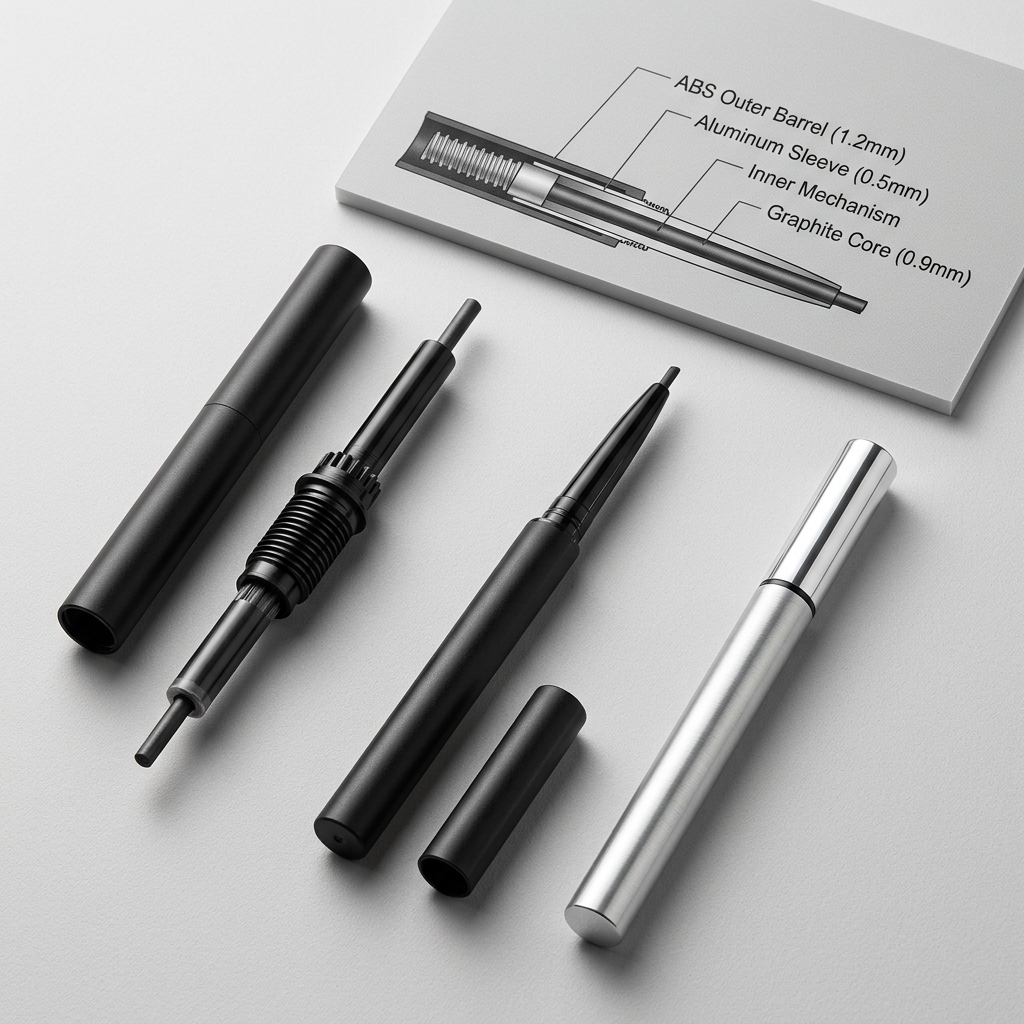
Structural Role of Inner Sleeves and Barrel Wall Thickness
The inner sleeve geometry determines how lateral pressure is distributed across the core during impact events. Three primary sleeve profiles are used in commercial eyebrow pencil packaging:
- Ribbed inner sleeve: Longitudinal ribs create discrete contact points that distribute radial pressure without full-surface contact, reducing stress concentration. Recommended for wax-based formulas prone to surface marking.
- Tapered sleeve bore: A bore that narrows by 0.02–0.05mm from base to tip provides progressive support, increasing resistance to cantilever bending at the most vulnerable core section.
- Smooth close-tolerance bore: Used with polymer-blend formulas where surface contact is acceptable; requires tighter manufacturing tolerances (±0.03mm) to prevent both binding and excessive clearance.
Barrel wall thickness benchmarks by format type:
- Twist-up format: Minimum 1.8mm wall thickness in ABS; 1.4mm in aluminum
- Sharpener-style: Minimum 2.2mm (must absorb sharpening torque)
- Retractable click-advance: Minimum 1.6mm, with reinforced collar at the mechanism interface
Material Durability Standards for Impact and Temperature Resistance
ABS (Acrylonitrile Butadiene Styrene) remains the dominant barrel material for mass-market custom eyebrow pencil packaging. Its notched Izod impact strength of 10–15 kJ/m² provides adequate drop protection at standard shipping temperatures, and it maintains dimensional stability across the −10°C to 60°C range relevant to most retail logistics chains.
PP (Polypropylen) offers superior chemical resistance and lower density but exhibits reduced impact strength at temperatures below 5°C—a critical limitation for cold-chain logistics or winter retail environments. PP barrels require wall thickness increases of approximately 15% relative to ABS to achieve equivalent drop performance.
Aluminum alloy barrels deliver the highest impact resistance and thermal stability, with no measurable dimensional change across −20°C to 80°C. The trade-off is cost: aluminum tooling and unit costs run 2.5–4× higher than ABS equivalents, positioning this material for prestige and travel retail segments.
For international shipping compliance, packaging should be validated against ISTA 2A (packaged-product drop and vibration testing), which simulates the combined stresses of parcel carrier handling. Suppliers unable to provide ISTA 2A test reports for their standard configurations represent a procurement risk for brands distributing through e-commerce channels.
Application Scenarios and Commercial Value for B2B Buyers
Matching Packaging Structure to Distribution Channel Requirements
Breakage risk profiles differ significantly by distribution channel, and packaging specifications must reflect these differences:
E-commerce fulfillment subjects individual units to repeated drop impacts (ISTA 2A simulates 1.0m drops across six faces) and extended vibration exposure during last-mile delivery. This channel demands maximum barrel wall thickness, high-retention cap designs (minimum 15N axial pull-off force), and sealed tip protection features.
Retail shelf display prioritizes consumer handling durability—units may be picked up, rotated, and replaced hundreds of times before purchase. Twist mechanism cycle durability and cap re-engagement consistency are the primary structural concerns.
Travel retail introduces pressure variation (aircraft cabin pressure cycling) and temperature extremes that accelerate differential expansion between core and barrel. Aluminum barrels or ABS formulations with low thermal expansion coefficients are preferred.
ROI of Investing in Breakage-Resistant Custom Packaging
The commercial case for specification-grade anti-breakage packaging is quantifiable:
- Return rate reduction: Brands switching from standard to precision-toleranced packaging report 30–60% reductions in damage-related returns, directly improving net margin per unit.
- Replacement cost avoidance: At average e-commerce return processing costs of $8–$15 per unit, a 1% breakage reduction on a 100,000-unit run saves $8,000–$15,000 in operational cost alone.
- Brand equity protection: A broken pencil at first use generates disproportionate negative reviews. Structural packaging investment functions as brand insurance.
- MOQ flexibility: Many precision packaging suppliers offer custom anti-breakage configurations at MOQs of 10,000–30,000 units, making the upgrade accessible to mid-scale private-label brands without full tooling investment.
FAQ
Q1: What is the minimum barrel wall thickness recommended to prevent eyebrow pencil core breakage during international shipping?
For ABS barrels in twist-up format, a minimum wall thickness of 1.8mm is the industry benchmark for ISTA 2A compliance. For ultra-fine formats (core diameter ≤1.2mm), increase to 2.0mm and add a reinforced collar at the tip exit point to reduce cantilever stress concentration.
Q2: How do I evaluate whether a twist mechanism supplier’s tolerance specifications are sufficient for ultra-thin 0.8mm eyebrow pencil formulas?
Request documented thread pitch accuracy (target ±0.05mm), core-to-barrel radial clearance specification (target 0.05–0.08mm for sub-1.2mm formats), and cycle durability test data at a lateral tip load of 0.05 N. Suppliers unable to provide these three data points should be disqualified for fine-tip applications.
Q3: Can protective sleeve upgrades be applied to existing packaging molds, or does breakage prevention require a full custom tooling investment?
In many cases, inner sleeve geometry and barrel wall thickness can be modified through insert tooling adjustments to existing molds, at a fraction of full tooling cost. However, mechanism-level upgrades—particularly thread pitch changes—typically require new mechanism components. A qualified packaging engineer should audit existing tooling before committing to either path.
Schlussfolgerung
Preventing breakage in custom eyebrow pencil packaging is a systems-level engineering challenge that spans formula fragility analysis, mechanism precision, material specification, and channel-specific structural design. No single component solves the problem in isolation: a precision twist mechanism paired with an undersized barrel wall will still fail under e-commerce drop conditions, just as a thick-walled barrel cannot compensate for a loosely toleranced thread pitch.
Procurement teams that align packaging specifications with formula fragility, distribution channel demands, and documented test standards will achieve measurable reductions in damage rates, return costs, and brand risk. The investment in specification-grade custom eyebrow pencil packaging consistently delivers positive ROI at commercial scale—and it begins with asking the right technical questions at the supplier qualification stage.